Paper, plastic or glass
Start with the final packaging.
Confirm material, available label area, curvature, contents and exposure. Nearby liquid, metal closures and the phone position can affect the result. Test after attachment.
RFIDAK / Blank, printed or encoded
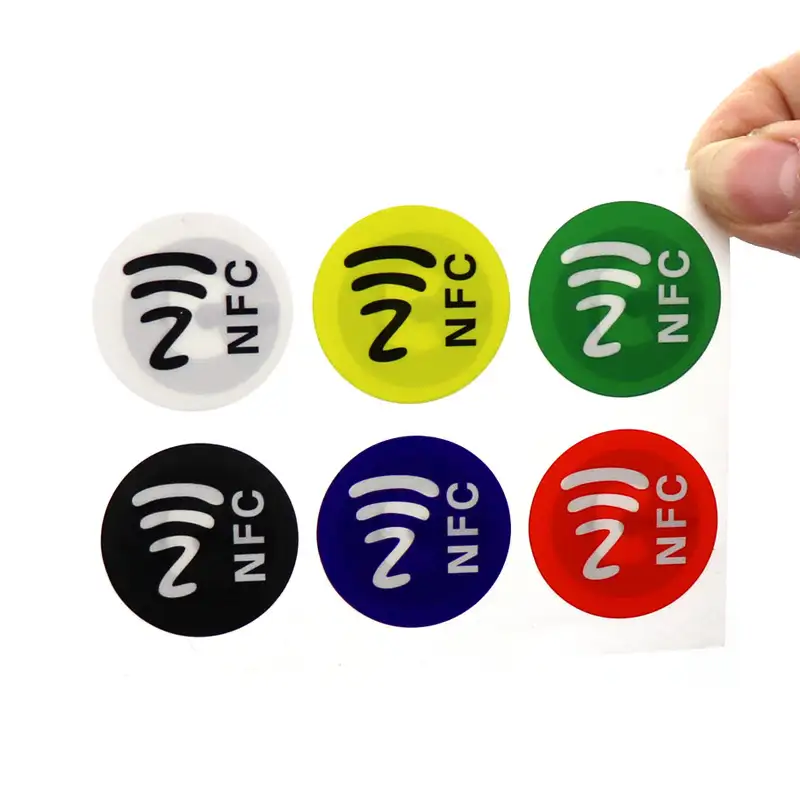
Adhesive NFC labels for phone-tap web links, product information and compatible app workflows. Choose NTAG213, NTAG215 or NTAG216, with your artwork and optional NDEF encoding.
Order options
Choose the tap purpose, mounting surface and supply format. Add your size, quantity and delivery country on the next step.
01 / Chip selection
All three listed chips use NFC Forum Type 2. Compare the actual encoded message with the available user memory.
Swipe to compare all columns.
| Chip | User memory | When to consider it | Check before encoding |
|---|---|---|---|
| NTAG213 | 144 bytes | Start here for a compact web-link payload. | Check the actual encoded NDEF message, including overhead. |
| NTAG215 | 504 bytes | More space when the approved payload exceeds NTAG213 capacity. | Confirm the receiving phone or app supports the record format. |
| NTAG216 | 888 bytes | More space for a larger approved NDEF message. | Larger memory does not add encryption or guarantee app-free handling. |
Send the final content. A short web address can be more practical than storing the full contact or product record. Record type, encoding and overhead matter; do not choose a chip from a universal character limit.
Check the phone action. Supported web-link records can use built-in phone handling. Contact records or app-specific actions may need compatible software. More memory does not change those requirements.
02 / The label in its real setting
An unmounted sample does not establish how the label will read or remain attached to the finished product.
Start with the final packaging.
Confirm material, available label area, curvature, contents and exposure. Nearby liquid, metal closures and the phone position can affect the result. Test after attachment.
Request an on-metal NFC construction.
A suitable antenna and isolation layer, often ferrite, may be needed. Approve the added thickness and mounted reading performance. A UHF on-metal label will not serve a phone’s built-in NFC reader.
Use one configuration record for the chip, construction and data. Ask for article-specific material or performance documents when your project requires them.
Send your label requirement →03 / Print, data & ownership
Visible artwork and chip content are separate deliverables. Approve both before encoding a batch.
You add content or print locally.
Confirm label stock, printer feed and an encoder that supports the selected NFC chip.
Your artwork, ready for local encoding.
Approve size, artwork, print position and how your team will encode and verify the labels.
Artwork and NDEF content prepared together.
Approve the payload, per-label data map, read-back checks and the locking plan.
A common configuration stores a web address in NDEF. The phone presents the supported action; the destination is maintained through your website.
Test the mounted tag.
Supported phone and NDEF record.
Keep the destination working.
Plan changes before locking. Permanent lock bits cannot be reversed. A locked tag can still point to a web page or redirect that you maintain, but changing its stored address requires writable memory and the appropriate access.
Separate identity from content. Map printed QR codes, serials and NDEF payloads explicitly. The factory-programmed UID is a different field. Static links and ordinary password protection do not provide per-tap product authentication.
For a public phone-tap link, keep the required NDEF content publicly readable. If reading is password-restricted, agree a compatible app workflow and test it; do not assume standard background reading will work.
Before a production order
A useful sample test covers the label, the phone and the destination together.
Ask about NFC samples →Buyer questions
The listed user-memory capacities are 144, 504 and 888 bytes respectively. They share 13.56 MHz NFC Forum Type 2 operation. Select against the actual encoded NDEF message, including formatting overhead; a character-count rule is not a reliable substitute. More memory does not add cryptographic authentication.
A supported NDEF web-link record can use built-in phone handling, but this is conditional. Apple documents background tag reading on iPhone XS and later, subject to device state and supported records; the user taps a notification to open the supported action. Android behavior depends on NFC hardware, settings, software and the record type. Test the intended phones and final encoded label. Contact records and app-specific actions may need compatible software.
Do not assume it will. Metal can change antenna behavior. Request an NFC construction designed for the actual metal or foil surface, often using a ferrite layer, and approve samples after mounting. Confirm size, added thickness, curvature, nearby liquid, phone position and the required tap behavior. A UHF on-metal label is not a substitute for a phone-readable NFC label.
If the NDEF memory remains writable, supported content can be rewritten with the necessary access. Permanent lock bits cannot be undone. When a locked tag stores a web address you control, you may change the page or redirect at that address without rewriting the tag, subject to your web setup. Define who maintains the address and approve the locking plan before encoding.
Specify the per-label printed QR or serial number and the NDEF payload in an approved data file. Agree which fields must match, how duplicates and rejected labels are handled, and what read-back report is required. Factory-programmed UID is a separate identifier and should not be presented as a writable sequential number.
No. A copied static web address is not authenticated merely because it came from an NFC sticker. The family provides features such as locking, a 32-bit password and an originality signature, but these are not equivalent to per-tap cryptographic authentication. For an authentication project, specify the security objective, chip, verification service and key-management responsibilities separately.
Printing capability does not establish NFC encoding support. Check the exact printer, installed RFID module, supported chip and protocol, software, inlay position and roll specification. A UHF RFID printer does not automatically encode this HF NFC family. Run the actual print-and-read workflow on sample stock.
The standard tags-and-labels MOQ baseline is 1,000 pieces. Confirm the selected chip, construction, artwork, encoding and quantities per design in the quote. Stock and custom samples follow the sample policy; agree sample charges and freight before shipment. Production timing and transit are quoted separately for the approved order and destination.
May we use Google Analytics cookies to measure visits and inquiry actions? Your choice does not affect the contact form. Cookie details