1. Why frequency is the first decision
Every other RFID choice \u2014 chip family, inlay design, reader brand, encoding, software stack \u2014 is downstream of the frequency decision. The chip families available at LF, HF and UHF are not interchangeable; the reader firmware that speaks ISO 14443 cannot read ISO/IEC 18000-63; the regional regulators that license 902-928 MHz UHF are entirely separate from the regulators licensing 13.56 MHz HF.
Most failed or over-budget RFID projects trace back to a frequency chosen for the wrong reason \u2014 usually chip-price comparisons on a data sheet rather than a workflow analysis. The procurement-correct order is application \u2192 required read distance \u2192 environment \u2192 frequency \u2192 chip \u2014 not the reverse.
This pillar guide covers each band as a procurement decision, not a physics lesson: where it wins, where it fails, which chips matter, what it costs at volume, and when to migrate to a different band. For a broader systems-level overview (readers, form factors, install considerations) see the RFID technology pillar.
2. LF (125-134 kHz) \u2014 short-range, niche-stable
Low-frequency RFID operates at 125 kHz for most legacy access applications and 134.2 kHz for animal ID under ISO 11784/11785. Read range is capped near 10 cm in practice, data rate is slow (roughly 8 kbit/s), and multi-tag anti-collision is basic compared to UHF.
The reason LF survives in 2026: it is the only band that reads reliably through biological tissue (livestock microchips), metal-rich environments (vehicle immobilizers, industrial equipment) and wet or muddy substrates (mining tool inventory). HF and UHF degrade sharply under those conditions.
LF has the largest installed base of legacy access hardware globally \u2014 HID Prox, Indala, AWID and EM-compatible readers are still deployed in hundreds of thousands of buildings. That installed base is the single biggest factor in whether a project should choose LF or migrate to HF DESFire.
LF at a glance
- Frequency
- 125 kHz (access) / 134.2 kHz (animal)
- Standard
- ISO 11784 / 11785 (animal); de-facto industry (access)
- Read range
- Up to 10 cm
- Typical tag cost
- $0.18 \u2013 $1.50
- Strengths
- Penetrates water, tissue, metal; large legacy installed base
- Weaknesses
- Short range, slow data, limited anti-collision
LF chip families
| Chip | Memory | Typical use |
|---|---|---|
| EM4100 / EM4102 | 64 bit read-only | Legacy access badges, door entry |
| EM4305 / EM4205 | 512 bit R/W | Re-encodable access credentials, asset ID |
| T5577 / Atmel T55x7 | 330 bit R/W | Multi-protocol programmable (emulates EM, HID, Indala) |
| HITAG 1 / S / 2 | 256-2048 bit | Vehicle immobilizer, industrial access |
| FDX-B (ISO 11784) | 128 bit | Livestock ear tag, pet microchip — 134.2 kHz subset |
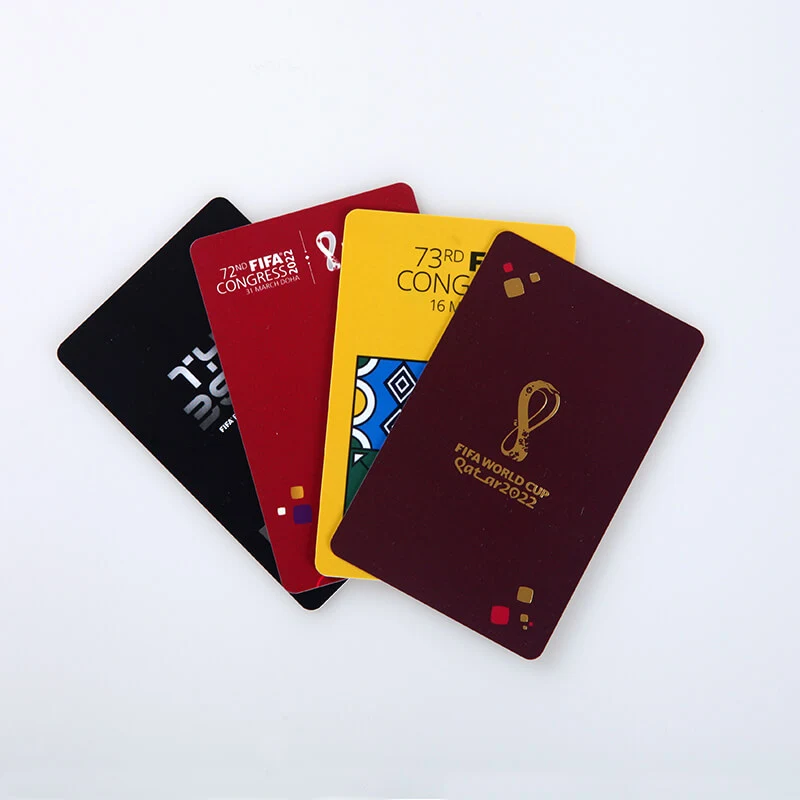
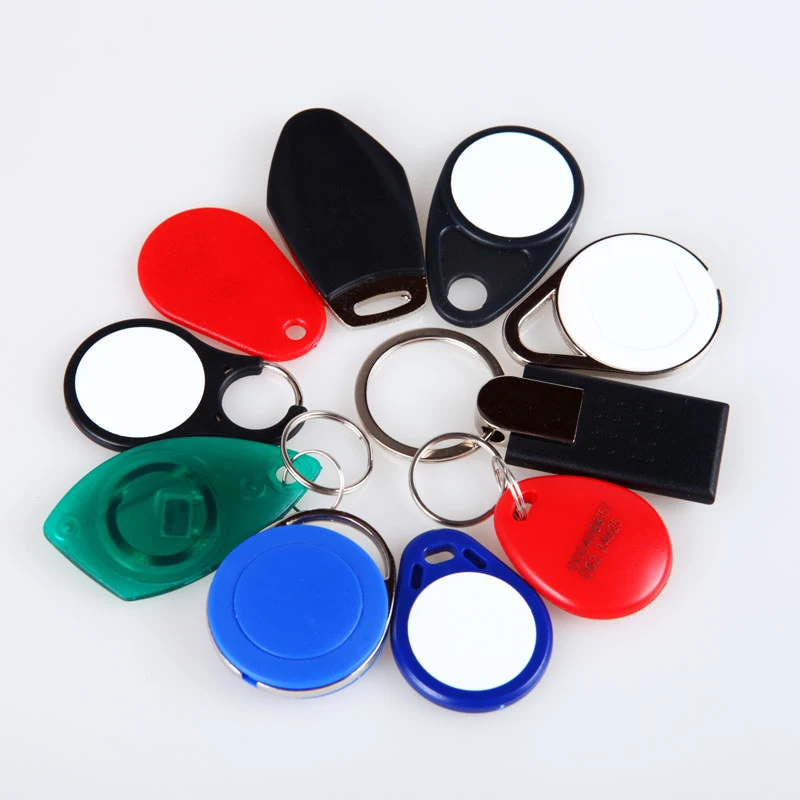
RFIDAK LF products: RFID keyfob (EM / T5577) \u2022 LF keyfob range \u2022 LF 125 kHz cards
3. HF / NFC (13.56 MHz) \u2014 the interoperable middle
HF at 13.56 MHz is the most standardized RFID band because it supports contactless payments, transit, passports, and smartphone tap workflows via NFC. Four standards govern HF usage: ISO/IEC 14443 A and B (proximity, used for most smart cards and NFC), ISO/IEC 15693 (vicinity, up to 1 m, used for library media and industrial), and ISO/IEC 18092 (the NFC Forum standard that extends 14443).
The HF chip universe is dominated by NXP (formerly Philips Semiconductors) with the MIFARE family for secure access and NTAG family for consumer NFC interactions. A newer tier \u2014 NTAG424 DNA with AES-128 SUN (Secure Unique NFC) authentication \u2014 is the foundation of EU Digital Product Passport and brand anti-counterfeit programs.
HF wins when: smartphone interaction is required, short intentional read distance is a feature (access control, payments), and liquid penetration matters more than metal penetration. HF loses to UHF when: bulk read of many tags per second is needed, or read distance beyond 1 m is required.
HF / NFC at a glance
- Frequency
- 13.56 MHz
- Standards
- ISO/IEC 14443 A/B, 15693, 18092 (NFC Forum)
- Read range
- 4 cm (NFC) \u2013 1 m (ISO 15693 vicinity)
- Typical tag cost
- $0.05 \u2013 $2.50
- Strengths
- Smartphone ubiquity (2.4 B+ NFC phones); strong crypto options; liquid-tolerant
- Weaknesses
- Short range; not suitable for bulk inventory; metal detunes sharply
HF / NFC chip families
| Chip | Memory | Typical use |
|---|---|---|
| MIFARE Classic 1K / 4K | 1-4 KB | Legacy transit, low-security access — Crypto-1 broken since 2008 |
| MIFARE Plus EV2 | 2-4 KB | AES-128 upgrade from Classic with SL1/SL3 migration |
| MIFARE DESFire EV3 | Up to 8 KB | High-security access, transit, payments; FIPS 140-2 validated |
| MIFARE Ultralight EV1 / C / Nano | 48-192 bytes | Single-use ticketing, disposable vouchers |
| NXP NTAG213 / 215 / 216 | 144 / 504 / 888 bytes | Consumer NFC, marketing tap, vCard, smart packaging |
| NXP NTAG424 DNA | 416 bytes | Cryptographic SUN authentication — anti-counterfeit, DPP |
| NXP ICODE SLIX / SLIX2 | 128 bytes | ISO 15693 library, industrial asset vicinity reads |
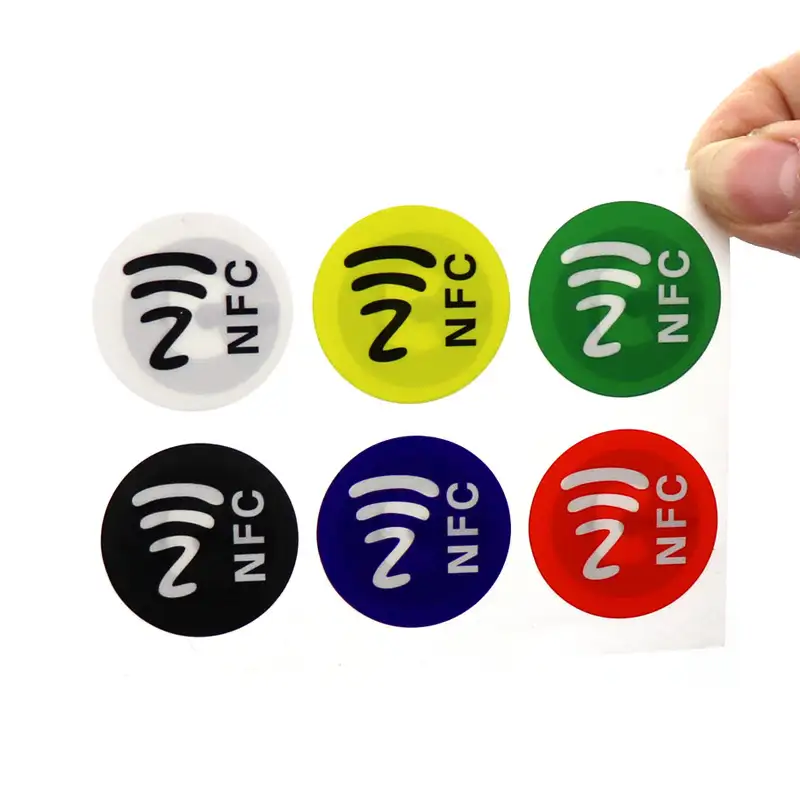
RFIDAK HF / NFC products: MIFARE / DESFire cards \u2022 HF silicone wristbands \u2022 MIFARE Classic vs DESFire \u2022 NFC technology deep-dive
4. UHF (860-960 MHz) \u2014 supply chain workhorse
UHF RFID under ISO/IEC 18000-63 (also called EPC Gen2v2 or RAIN RFID) is the backbone of retail item-level inventory, logistics, and industrial asset tracking. Passive Gen2v2 tags read up to 12 m under line-of-sight, 700+ tags per second on modern readers, and cost $0.04 \u2013 $0.08 per inlay at MOQ 100,000 (IDTechEx, 2024).
The UHF band is regionally allocated: US FCC 902-928 MHz, EU ETSI 865.6-867.6 MHz, China 920-925 MHz, Japan 916-921 MHz. Wrong-region inlays lose 30-50% of their read range because the antenna resonance is mismatched. For global products, specify a multi-band chip (NXP UCODE 9 or Impinj Monza M730 / M770) and test read performance in every target region.
Walmart has mandated UHF item-level RFID across apparel, eyewear, jewelry, home, footwear and sporting-goods categories since 2022; Macy\u2019s, Marks & Spencer, Target and Decathlon have similar programs. RAIN Alliance reports 42 billion UHF tags shipped in 2024 \u2014 roughly 10\u00d7 the combined LF + HF volume.
UHF fails when tags are mounted directly on metal (unless an on-metal design with a tuned spacer is used), when submerged in water, or when tag population is too sparse to justify the reader infrastructure cost.
UHF at a glance
- Frequency
- 860 \u2013 960 MHz (region-specific)
- Standard
- ISO/IEC 18000-63 (EPC Gen2 v2.1)
- Read range
- Up to 12 m (passive) / 100+ m (active)
- Typical tag cost
- $0.04 \u2013 $4.50 (on-metal)
- Strengths
- Long range, bulk read, lowest unit cost, global supply-chain system
- Weaknesses
- Detuned by water, metal without special design, regional regulation differences
UHF chip families
| Chip | Memory | Typical use |
|---|---|---|
| Impinj Monza R6 / R6-P | 96-128 bit EPC, 32-bit TID | High-volume retail item-level; strong backscatter |
| Impinj M730 / M750 / M770 / M780 / M800 | 96-128 bit EPC + 32-96 bit user | 2024 generation; optimized read rate and sensitivity |
| NXP UCODE 9 / 9xm | 96 bit EPC + 32 bit TID | Apparel and logistics volume SKU; self-tuning |
| NXP UCODE DNA | 96 bit EPC + 3DES crypto | Pharma and high-value goods anti-counterfeit |
| Alien Higgs 9 / H10 | 96 bit EPC + 128 bit user | Specialty industrial and on-metal optimized designs |
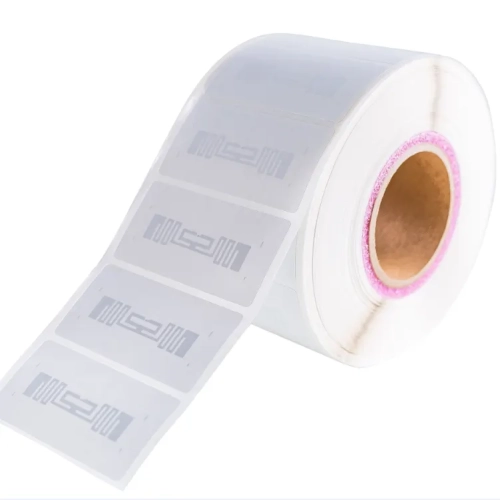
RFIDAK UHF products: Textile UHF laundry tag \u2022 UHF on-metal tag \u2022 Full UHF tag range \u2022 UHF retail inventory guide
5. 4-question decision framework
Use this flow before requesting any sample. Most procurement teams can isolate the correct band in under five minutes; the harder work is then selecting the chip within that band.
Do you need a read distance greater than 1 m?
Will end-users interact via smartphone tap?
Is this animal ID or a legacy immobilizer?
Do you need to read more than 50 tags per second at portals or gates?
Edge cases: for sub-dermal animal ID use LF 134.2 kHz regardless of other answers; for passport / ID workflows use HF ISO 14443 regardless of range requirement.
6. Regional UHF compliance map
UHF is the only band with meaningful regional variance at B2B scale. LF and HF allocations are largely harmonized globally; UHF is not. Confirm the target market sub-band before tag tooling and tag print buy.
| Region | UHF sub-band | Power limit | Authority / standard |
|---|---|---|---|
| United States | 902 – 928 MHz | 4 W EIRP | FCC Part 15.247 |
| European Union | 865.6 – 867.6 MHz | 2 W ERP | ETSI EN 302 208 |
| Japan | 916.7 – 920.9 MHz | 1 W ERP | ARIB STD-T107 |
| China | 920.5 – 924.5 MHz | 2 W ERP | GB/T 29768 (MIIT) |
| Brazil | 902 – 907.5 / 915 – 928 MHz | 4 W EIRP | ANATEL Resolution 506 |
| India | 865 – 867 MHz | 4 W EIRP | WPC Notification 2008-S.O.1763(E) |
| Australia | 920 – 926 MHz | 4 W EIRP | ACMA Class Licence 2015 |
| South Korea | 917 – 920.8 MHz | 4 W EIRP | KCC Radio Regulation Article 49 |
Sources: FCC Part 15.247, ETSI EN 302 208, ARIB STD-T107, GB/T 29768 (MIIT), ANATEL Resolution 506, WPC India Notification 2008-S.O.1763(E), ACMA Australian Class Licence 2015, KCC Radio Regulation Article 49. Power limits expressed at antenna; system EIRP / ERP varies with antenna gain.
7. Cost benchmarks by frequency
Indicative single-unit pricing at MOQ 10,000 pieces, in USD. Below MOQ 1,000 expect 30-60% premiums; above MOQ 100,000 expect 15-25% discounts. Cryptographic chips (MIFARE DESFire EV3, NTAG424 DNA, UCODE DNA) add $0.40 \u2013 $1.20 per unit to the baseline format price.
| Format | LF | HF / NFC | UHF |
|---|---|---|---|
| Sticker / wet inlay | $0.18 – 0.30 | $0.05 – 0.15 | $0.04 – 0.08 |
| PVC card | $0.45 – 0.80 | $0.15 – 0.40 | $0.20 – 0.55 |
| Silicone wristband | $0.65 – 1.20 | $0.45 – 0.95 | $0.55 – 1.10 |
| Textile laundry tag | — | $0.65 – 1.30 | $0.55 – 1.10 |
| On-metal hard tag | $1.50 – 3.00 | $1.20 – 2.50 | $1.50 – 4.50 |
| Keyfob | $0.35 – 0.85 | $0.45 – 1.10 | — |
Sources: IDTechEx 2024 RAIN RFID Forecasts; RFIDAK 2026 published price book at MOQ 10,000.
8. Upgrade and migration scenarios
Most real-world frequency decisions are actually migration decisions: replacing a legacy deployment with a more secure or higher-throughput successor. Four scenarios cover 90% of live migrations at RFIDAK customers in 2024-2026.
Migration
from LF 125 kHz legacy access
to HF MIFARE DESFire EV3
Why: Replace broken Crypto-1 / low-security LF with AES-128 secure cards as part of access system refresh.
Watch for: Must replace reader fleet (LF and HF readers are not interchangeable); plan dual-technology bridge cards during transition.
Migration
from HF MIFARE Classic
to HF MIFARE DESFire EV3 or MIFARE Plus EV2
Why: Crypto-1 cipher broken in 2008 (Garcia et al, USENIX Security); replace for any security-sensitive workflow.
Watch for: Plus EV2 in SL1 mode reuses Classic readers; DESFire requires full reader upgrade but gives AES + multi-application.
Migration
from Manual barcode / human inventory
to UHF Gen2v2 item-level
Why: Retail mandate (Walmart, Macy, M&S), inventory accuracy targets above 95%, or fulfillment speed gains.
Watch for: Requires reader portals, WMS integration, item-level tag budget; pilot 1 SKU family before rollout.
Migration
from UHF FCC-tuned inlays
to UHF global / multi-band inlays
Why: Expanding into EU / Asia markets where FCC-only inlays detune and lose 30-50% read range.
Watch for: Specify multi-band UCODE 9 or Monza M730 / M770; re-test dock doors in each region before deployment.
9. Industry playbook — which frequency wins where
Frequency selection is a settled question in many verticals: decades of deployment have produced a de-facto default that changes slowly. Below is the industry-standard frequency match for 8 B2B verticals, with the operational reason the dominant band won out. Use this to align with industry practice rather than re-litigate frequency choice from scratch.
Hospitality (hotels, resorts, cruise)
Winner: HF 13.56 MHz
Installed electronic lock base is overwhelmingly HF MIFARE (Saflok, VingCard, Onity, SALTO). Attempting to deploy UHF would require replacing every lock in the property — a $100K-500K CAPEX hit per 300-room property vs $2-5K for new HF cards. HF also delivers the ~3-5 cm read range that hotel security teams specifically want: no accidental unlock from a guest walking past a door. Only scenario for UHF in hospitality: cashless wristband payment at water parks / resorts, which is typically a parallel deployment alongside HF door locks.
Retail & apparel (item-level)
Winner: UHF 860-960 MHz
Walmart's 2022 mandate and the EU Digital Product Passport explicitly specify EPC Gen2v2 UHF. Retail workflow requires bulk-read of 50-500+ items simultaneously at 3-5 m range (shelf sweep, dock door, EAS gate). HF would require tap-by-tap scanning — operationally impossible at 1,000+ SKU store scale. HF plays a complementary role: NFC Forum chips for smartphone engagement at shelf, brand authentication, and DPP consumer verification — layered on the same garment as UHF for operational visibility.
Industrial laundry & linen
Winner: UHF 860-960 MHz
UHF won this category 2015-2020 replacing HF legacy deployments. Key reason: sort-portal throughput. A modern UHF tunnel reader inventories 200-600 garments per minute, while HF at ISO 14443A proximity maxes around 15-25 units per minute. For Berendsen / Elis / Cintas scale (100K+ garments/day per facility), UHF is the only frequency that meets throughput requirements. Tag wash-cycle durability (200+ industrial wash cycles, wash up to 90°C) is now standard across Impinj Monza R6-P and NXP UCODE 9 textile tag designs.
Library & media
Winner: HF 13.56 MHz (vicinity, ISO/IEC 15693)
ICODE SLIX on ISO/IEC 15693 reads at 50-100 cm vicinity — the sweet spot for library self-checkout workflows (stack of 5-10 books in one read). UHF would add unnecessary read range (6+ m) that creates privacy concerns in public library settings where patrons don't want their book selections readable from across the room. LF would be too short-range for self-service. HF 15693 is the de-facto standard in Bibliotheca, 3M, mk Solutions integrations across North American and European public library systems.
Logistics & supply chain
Winner: UHF 860-960 MHz (with on-metal tags)
Pallet-level and container-level tracking requires 5-10 m read range from fixed gate antennas — UHF's natural strength. Critical nuance: 80%+ of logistics tag applications involve metal substrates (containers, pallets, cages, returnable transport packaging), so anti-metal tag construction with ferrite spacer is mandatory. Standard UHF stickers on bare metal lose 90-99% range. HF is never used in logistics except for isolated pharmaceutical cold-chain use cases where sensor data is integrated.
Animal ID & livestock
Winner: LF 134.2 kHz (ISO 11784/11785 FDX-B)
The only vertical where LF remains dominant. ISO 11784/11785 is the universal livestock ear-tag standard recognized by USDA, EU, Australia, and 60+ national agricultural authorities. LF's ability to read through biological tissue (pet microchipping) and immunity to wet/muddy barn environments make it the stable default since 1996. HF and UHF have both attempted entries but failed against regulatory inertia — regulatory change at USDA / EFSA takes decades.
Enterprise access control
Winner: HF 13.56 MHz (MIFARE DESFire / Plus)
Fortune 500 enterprise access has consolidated on HF MIFARE family because of (1) installed reader base at scale, (2) AES-128 security via DESFire EV3 matching insurance cybersecurity requirements, (3) multi-application support (physical access + IT logon + cafeteria + secure print) on one card. LF Prox is still present in legacy installations but migrating out. UHF never gained traction in enterprise access because 5+ m range is actively undesirable — employees walking past sensitive doors would trigger unwanted events.
Consumer & marketing (NFC)
Winner: HF 13.56 MHz NFC (NTAG424 DNA)
Every iPhone (7+) and Android phone ships with an HF 13.56 MHz NFC radio — and only HF. UHF consumer readers do not exist in the smartphone system. For brand engagement, anti-counterfeit, luxury Digital Product Passport, loyalty tap-to-redeem, smart packaging — HF NFC is the only frequency that works with 2.4 billion consumer phones globally (NFC Forum, 2025). NTAG424 DNA's AES-128 SUN messaging plus iOS Background Tag Reading make HF NFC the consumer-facing default for all brand-authentication programs launching in 2024-2026.
10. Extended frequency FAQ — 12 questions buyers ask
Frequency-selection questions that come up most often during RFIDAK's sales engineering calls with buyers in 2024-2026. Each answer is written to stand alone for sharing with non-RFID stakeholders in procurement, IT security, operations, and finance teams who may not know the acronyms but need to approve the purchase decision.
1. Can I run UHF, HF, and LF on the same building's infrastructure?+
Yes, but each frequency requires its own reader fleet — the hardware does not overlap. Buildings routinely deploy LF Prox for legacy door access + HF MIFARE for payment + UHF for inventory all in parallel. Multi-band readers exist (some desktop enrollment stations and handheld devices support 125 kHz + 13.56 MHz + 860-960 MHz in one unit) but cost 3-5x single-band reader prices. The only time buyers need to worry about RF interference between frequencies is when antennas are installed within 0.5 m of each other at dock doors — LF inductive fields can desensitize UHF receivers at very close range. Separate mounting by 1-2 m and no practical interference occurs.
2. Does HF really work through water, and is that an advantage over UHF?+
Yes — HF 13.56 MHz penetrates water and biological tissue far better than UHF, which is absorbed heavily. In practice, this matters for: (1) pet microchipping and veterinary implants — LF / HF only, never UHF; (2) livestock identification through skin, muscle and rumen fluid — LF primarily, HF secondarily; (3) medical devices implanted in tissue; (4) swimming pool / water park wristbands where the tag sits against wet skin; (5) industrial laundry where tags are tumbling in wash water (though this is engineered around with textile encapsulation rather than relying on HF itself). For non-biological wet environments, HF advantage is minor — waterproof UHF wristbands work fine for cruise ship all-inclusive programs where the tag doesn't need to read while submerged at depth.
3. Why are some UHF readers 4 W EIRP in the US but only 2 W ERP in Europe?+
Regulatory policy difference. FCC Part 15.247 allows unlicensed 4 W EIRP in the 902-928 MHz ISM band. ETSI EN 302 208 allows 2 W ERP (which converts to about 3.3 W EIRP) in the 865.6-867.6 MHz band. Practical impact on read range: US installations reach ~8-12 m at dock doors, EU installations ~6-9 m — a 20-30% range reduction due to lower transmit power plus narrower frequency band (only 2 MHz vs 26 MHz in US). EU installations compensate with tighter antenna focusing and higher-gain directional antennas. Tag-side: same chip works in both regions, only the reader TX power differs. When specifying a global rollout, design to the EU constraint — US deployments will then have generous headroom.
4. Is 2.45 GHz microwave RFID still used anywhere?+
Rare outside niche applications. Microwave RFID at 2.45 GHz historically served: electronic tolling (now mostly migrated to UHF or DSRC), active container tracking (Savi Technologies, largely BLE-replaced), and a handful of race timing systems. The 2.45 GHz band is heavily shared with WiFi, Bluetooth, and microwave ovens — interference makes it unattractive versus clean UHF. For new B2B deployments in 2024-2026, 2.45 GHz is effectively never the right answer. If a vendor is proposing 2.45 GHz for a new project, ask pointed questions about why — they may be trying to sell legacy stock rather than the best fit. Exception: military ISO 18000-4 deployments for high-mobility asset tracking in certain national defense networks remain at 2.45 GHz by regulation.
5. What's the simplest way to pick frequency if I have no prior experience?+
Answer four questions in order. (1) Do consumers need to tap with phones? If yes, HF 13.56 MHz NFC — nothing else works with smartphones. (2) Do you need to read many items at once from a few meters away? If yes, UHF 860-960 MHz. (3) Is this an upgrade of an existing LF Prox or HF MIFARE deployment? Match the installed base to avoid reader replacement cost. (4) Is this livestock / pet / implant application? LF 134.2 kHz. If none of these apply, the default for new industrial deployments is UHF 860-960 MHz because of cost-per-tag economics. When still uncertain, request samples of all three frequencies from RFIDAK and test against your actual reader before committing.
6. Can one tag work globally, or do I need region-specific SKUs?+
One tag can work globally if you specify "worldwide antenna" design. UHF Gen2 chips are inherently broadband and work across all regional sub-bands (FCC 902-928, ETSI 865-868, Japan 916-921, China 920-925) — only the antenna needs optimization. A worldwide-tuned antenna trades 10-15% peak range per region for consistent performance across every region. For supply chain tags moving between regions (export cartons, global RTPs), always specify worldwide. For region-locked inventory (US-only retail, EU-only DPP), region-specific antenna delivers maximum range at minimum cost. HF and LF have no regional variation — 13.56 MHz and 125-134 kHz are globally unified under ISO standards.
7. How does frequency affect cost at volume?+
At MOQ 100K, UHF sticker inlays are the cheapest at $0.04-0.08 per unit (benefit of massive manufacturing scale from retail mandates). HF NFC stickers run $0.05-0.15. LF stickers are oldest technology and counterintuitively most expensive at $0.18-0.30 because LF manufacturing volume is 1-2% of UHF volume, so scale economies don't apply. For PVC cards, the cost curve inverts — HF MIFARE Classic cards are $0.15-0.40, UHF cards $0.20-0.55 (fewer suppliers make UHF cards vs stickers). The cheapest option for a new deployment is usually UHF stickers unless a use case specifically demands another format. For LF, expect a 2-5x cost premium versus UHF for equivalent format and volume.
8. Will 5G millimeter-wave replace current RFID bands?+
No — 5G mmWave operates at 24-71 GHz which is physically unsuitable for passive RFID. The wavelengths are millimeter-scale (matching the name), so tag antennas would need to be micrometer-scale to resonate — currently impractical. 5G does interact with RFID ecosystems via reader backhaul connectivity (fixed readers uploading inventory counts over 5G networks) but not at the tag layer. Emerging research on 5G-powered passive sensors shows promise at 5-10 year horizons but won't disrupt UHF Gen2's 860-960 MHz system in the current procurement cycle. For any project with a 2024-2028 decision window, UHF 860-960 MHz is the safe bet — it has 42 billion tags deployed in 2024 alone (RAIN Alliance) and global chip supply at scale.
9. How do I future-proof my frequency choice for 10-year deployments?+
Three practical moves. (1) Pick established ISO standards, not proprietary protocols — ISO/IEC 14443 (HF), 15693 (HF vicinity), 18000-63 (UHF Gen2v2), 11784/11785 (LF). All have 20+ year commitment from international standards bodies. (2) Avoid vendor-locked proprietary chips — if your chip supplier goes out of business, a standards-compliant chip has 5+ alternative sources. (3) Document your RFP in generic terms allowing drop-in chip substitution at repeat-order time — e.g., "any EPC Gen2v2 compliant chip with 128-bit EPC" rather than "Impinj Monza R6 specifically". Over 10 years, your current chip will go end-of-life; standards-based spec keeps you supplied. Frequencies themselves have stable 20+ year horizons; the risk is at the chip level, not the frequency level.
10. When should I pick dual-frequency or multi-standard tags?+
Rare but real cases. (1) Retail with consumer engagement: UHF for warehouse + NFC for shopper tap, as discussed in luxury DPP. (2) Access control migration: LF + HF dual-frequency card during transition years when you need both old LF readers and new HF readers to recognize the same card. (3) Global asset tracking with mobile field scanning: UHF for fixed portals + NFC for technician smartphone spot-check. Dual-frequency tags cost 40-80% more than single-frequency and add complexity — avoid unless there is a specific operational driver. Most "maybe we need dual frequency" thinking resolves to "run two parallel single-frequency deployments" once the actual workflow is mapped. Sample-test both before committing to the dual-frequency format because antenna coupling between the two frequencies can reduce range.
11. How does temperature affect frequency choice?+
All three frequencies have similar operating range when chip and housing are properly engineered — typical range is −25°C to +70°C for standard inlays, extendable to −40°C to +110°C for industrial-grade construction. Differences emerge at extreme conditions: LF and HF tolerate higher humidity better (water is more transparent at lower frequencies), while UHF is more sensitive to water damage if the chip substrate cracks. For applications requiring autoclave sterilization (134°C), PPS-encapsulated chips handle all three frequencies but cost 3-5x baseline PVC. For cold-chain cryogenic applications (−40°C or below), active BLE or cellular trackers are typically more reliable than passive RFID regardless of frequency. Always specify operating temperature range in RFP to get the right substrate.
12. Can I use the same reader for encoding and reading?+
Yes for most applications. Desktop reader-writer units (uFR Nano, ACR122U for NFC / HF; Impinj Speedway or desktop UHF writers for EPC Gen2) both encode and read within one device. For high-throughput encoding lines (encoding 10K+ cards/day), dedicated auto-encoding stations with conveyor feeding are more efficient and include final read-verification. For field-operations reader fleets (warehouse gates, point-of-sale), reading is usually read-only — encoding happens at the manufacturing facility or during initial provisioning. Clarify encoding needs upfront: if encoding is daily (hotel key programming), buy encoding-capable readers. If encoding is one-time at manufacture, buy read-only readers which are 30-50% cheaper.
11. Continue your research \u2014 8 deep-dive articles
These eight articles form the cluster around this pillar. Read in any order; each is self-contained and links back here for context.
RFID frequency bands explained (tactical deep-dive)
Line-by-line companion blog — ISO 11784, 14443, 15693, 18000-63 with chip-level guidance.
HF vs UHF RFID buying guide
The single most common procurement question — tradeoffs in range, smartphone support, liquid tolerance.
HF vs UHF RFID comparison
Side-by-side decision framework with use-case examples.
LF vs HF RFID comparison
Legacy access and immobilizer vs smart-card modernization.
NFC technology guide
HF band deep dive — NTAG family, NDEF, smartphone tap workflows, ISO 14443A.
RFID retail inventory guide
UHF in apparel and general merchandise — Walmart mandate, accuracy benchmarks.
Anti-metal RFID tags guide
How UHF tags are re-tuned for on-metal performance; tag designs for ferrous and non-ferrous substrates.
Laundry RFID tags buyer guide
UHF in industrial laundry — heat-seal vs sewn-in, wash cycle durability, chemical compatibility.
Whitepaper
12. Download the RFID Buyer’s Guide 2026 (PDF)
A 28-page printable companion to this pillar: 4-question decision framework, regional UHF compliance map, cost benchmarks at 1K / 10K / 100K MOQ, chip family reference and the 7-mistake procurement checklist.
- • Decision framework printable one-pager
- • Regional UHF map (FCC / ETSI / ARIB / MIIT / ANATEL / WPC / ACMA / KCC)
- • Chip selection guides for LF, HF and UHF
- • Cost benchmark tables by format and volume
Same PDF as linked from the RFID technology pillar. Localized editions (DE / FR / ES / JP) available on request.
RFIDAK
RFID
Buyer’s Guide
2026 edition
28 pages · PDF
13. Frequently asked questions
Can a single reader handle LF, HF and UHF at the same time? +
Not usually. A small number of multi-band desktop readers exist for enrollment, but production fleets are single-band per workflow because antenna design and power regulation differ. Plan one band per use case.
Will a UHF tag designed for FCC (902-928 MHz) work in Europe (865-868 MHz)? +
Range typically drops 30-50% because the inlay antenna resonance is mismatched. For global deployment, specify multi-band chips such as NXP UCODE 9 or Impinj Monza M730 / M770, which are tuned across the global UHF band.
Why would I still use LF in 2026? +
LF remains the best technical choice when the tag must be injected under skin or encased in metal — livestock ID (ISO 11784/11785), vehicle immobilizers, and some extreme-environment asset tags. LF also has the widest installed base of legacy access systems.
Can NFC replace UHF for retail inventory? +
No. NFC requires a reader within 4-10 cm of each tag, so item-level bulk read at portals is impractical. UHF Gen2v2 reads 700+ tags per second at up to 12 m and is the standard for retail and logistics. NFC wins for consumer interaction on a single item.
What is the lead time and MOQ difference between the three bands? +
Lead times are comparable (2-4 weeks stock, 4-6 weeks custom). MOQs differ by format, not frequency; UHF inlays typically start at 5,000 pcs, HF at 1,000 pcs, LF at 500 pcs because the installed volume is much larger at UHF.