01 / The system
How does an RFID system work?
An RFID product combines a chip and an antenna with a physical construction. A compatible reader communicates with it; connected software interprets the returned data. Reading a tag identifier is one step. Permission checks, inventory updates and payments require the appropriate application and configuration.
- 1
Tag or credential
Chip, antenna, stored data and the finished product.
- 2
Reader and antenna
The radio interface, commands and intended read zone.
- 3
Software workflow
Maps the data to an authorized action or business record.
Passive, battery-assisted or active?
| Model | How it operates | What to confirm |
|---|---|---|
| Passive | Uses energy from the reader field to operate and respond; no battery is needed for this exchange. | Reader protocol, tag construction and the required read or write operation. |
| Battery-assisted passive (BAP) | A battery supports circuitry or sensing; the RF reply still uses the reader signal rather than an independent transmitter. | The exact tag architecture, supported reader commands and battery maintenance. |
| Active | An onboard power source supports a radio transmitter. Transmission behavior depends on the system. | Compatible receivers, software, battery service and any positioning infrastructure. |
On a narrow screen, scroll the table sideways to compare every column.
When is RFID different from a barcode?
| Decision | Barcode | RFID |
|---|---|---|
| Reading method | Requires an optically readable symbol. | Uses radio; packaging and placement still affect capture. |
| Item identity | Can encode a serialized identifier. | Can encode a serialized identifier; allocation still needs control. |
| Capture process | Plan symbol visibility and scanner presentation. | Plan the read zone and handling of multiple or unwanted reads. |
| Changes and fallback | Changing the printed symbol requires replacement; linked records can be updated. | Writable memory depends on the chip and permissions. A matching printed code can support exceptions. |
On a narrow screen, scroll the table sideways to compare every column.
02 / Frequency and compatibility
Start with the interaction and the reader.
Frequency narrows the options; it does not establish compatibility by itself. Check the reader's documented protocol, commands and application requirements before selecting a card or tag.
| Technology | Protocol or format to verify | Selection boundary |
|---|---|---|
| LF — commonly 125 kHz | Exact reader-supported chip protocol and identifier format; LF systems are not all interchangeable. | Useful when an installed system specifies LF. Do not infer metal compatibility from the band. |
| HF — 13.56 MHz | ISO/IEC 14443 Type A or B, ISO/IEC 15693, or the specific interface required by the reader. | The same frequency does not ensure that files, commands or authentication are supported. |
| NFC — 13.56 MHz | Supported NFC tag type, NDEF content where applicable, phone operating system and application. | A phone tap needs a compatible implementation. NFC is not a separate frequency band or a promise that every HF tag works. |
| UHF / RAIN RFID — regional operating channels | EPC Gen2 / ISO/IEC 18000-63 support, including the required version and commands. | A candidate for item inventories and engineered read zones. Confirm local reader operation and performance on the actual object. |
On a narrow screen, scroll the table sideways to compare every column.
Read the detailed LF, HF/NFC and UHF selection guideChoose the chip after the system requirements.
Two products can share a frequency and still differ in commands, memory, security features and stored data. A familiar chip family or card shape is not proof that a lock, phone or inventory reader will support the finished product.
- Existing installation: obtain the approved credential or tag specification, exact equipment model and required transaction.
- New installation: agree the protocol, data format and software workflow with the integrator before ordering encoded stock.
- Secure application: confirm authentication, key management and authorized issuance for the selected chip and application.
03 / What to verify
Which standards belong in the specification?
Treat compatibility as a documented chain from the reader to the business application. A protocol logo, familiar chip name or successful identifier scan does not test the whole chain.
- Air interface and reader support
- Record the reader model, firmware, supported protocol and required commands. Ask the system provider to confirm the proposed chip before specifying a replacement.
- Data and memory layout
- Agree identifier allocation, memory fields, application files and encoding ownership. In a GS1 deployment, check the applicable identifier scheme and Tag Data Standard as well as the radio interface.
- Security implementation
- Specify authentication, access permissions, key provisioning and verification responsibility. For example, NTAG 424 DNA secure messaging requires configuration and verification; the chip name alone does not authenticate a product.
- Application acceptance
- Test the required action: opening an authorized door, accepting a stock movement or retrieving the correct record. Include rejection, duplicate and unavailable-system cases in the acceptance plan.
Confirm the region for every UHF installation.
Specify all countries where the equipment will operate. A tag's advertised tuning range does not establish that a reader and antenna configuration is approved in each country.
- List every deployment country
- Share installation locations and cross-border routes with the reader supplier. The destination of the shipment may differ from the countries where the equipment will operate.
- Confirm the approved reader configuration
- Request the applicable equipment approvals for the exact reader model, region setting and antenna configuration. Use the manufacturer and local integrator to confirm installation requirements.
- Match the tag to the deployed channels
- Confirm that the selected tag design is suitable for the reader channels at each site. A broad-band tag specification does not authorize a reader to use the same settings everywhere.
- Keep configuration evidence
- Record the approved settings and test setup in the project file. Recheck them when the reader, antenna, firmware, installation or destination changes; a general web table cannot approve a deployment.
04 / The finished product
Match the format to the way it will be used.
A card, label or enclosure changes handling and mounting. Each image below shows a product example; confirm its chip, dimensions and construction on the linked product page.

Cards
Custom PVC RFID Card
For carried credentials. Confirm card dimensions, printing, credential data and issuance with the installed system.
Explore this format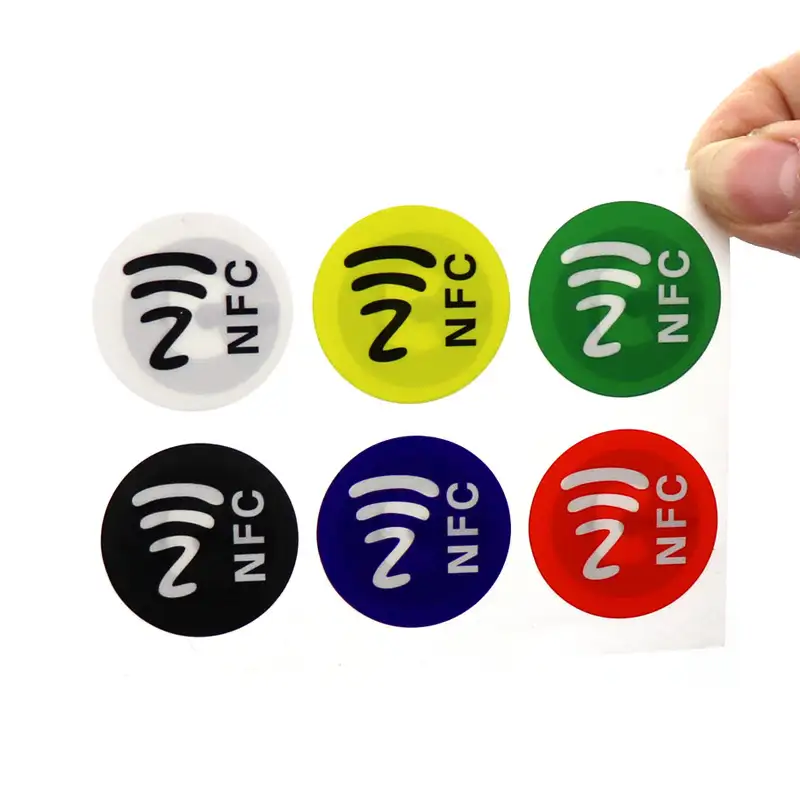
NFC stickers
Custom NFC Sticker
For a phone tap or compatible NFC reader. Confirm the encoded record, target phones and attachment surface.
Explore this format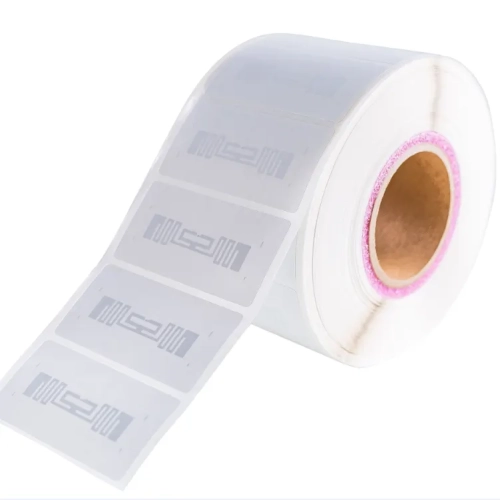
UHF labels
Custom UHF RFID Sticker
For item identification. Match the finished label and antenna to the packaging, regional reader setup and intended read zone.
Explore this format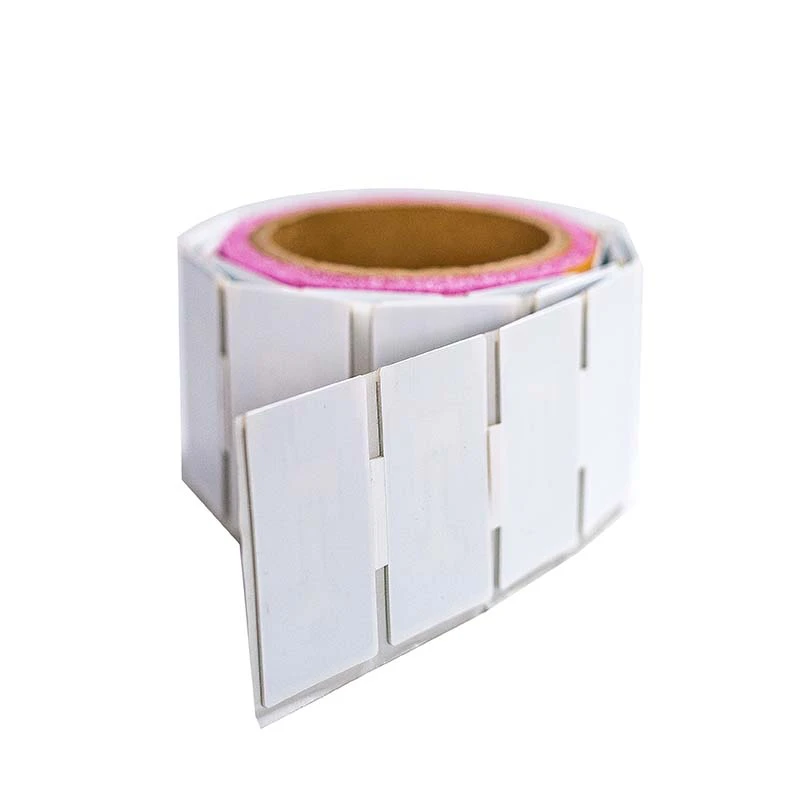
Industrial tags
Printable UHF On-Metal RFID Labels
For attached assets. Compare mounting, construction and tested operating conditions for the exact model.
Explore this format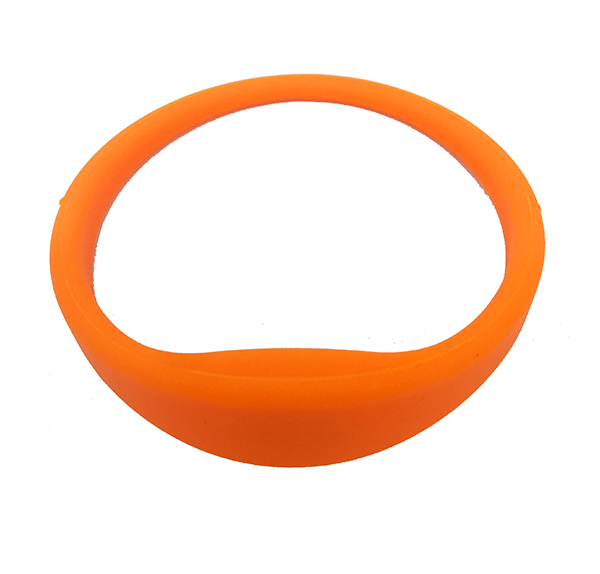
Wristbands
RFID Silicone Wristband
For worn credentials. Specify size, closure, exposure and the reader or event platform that will use the tag.
Explore this format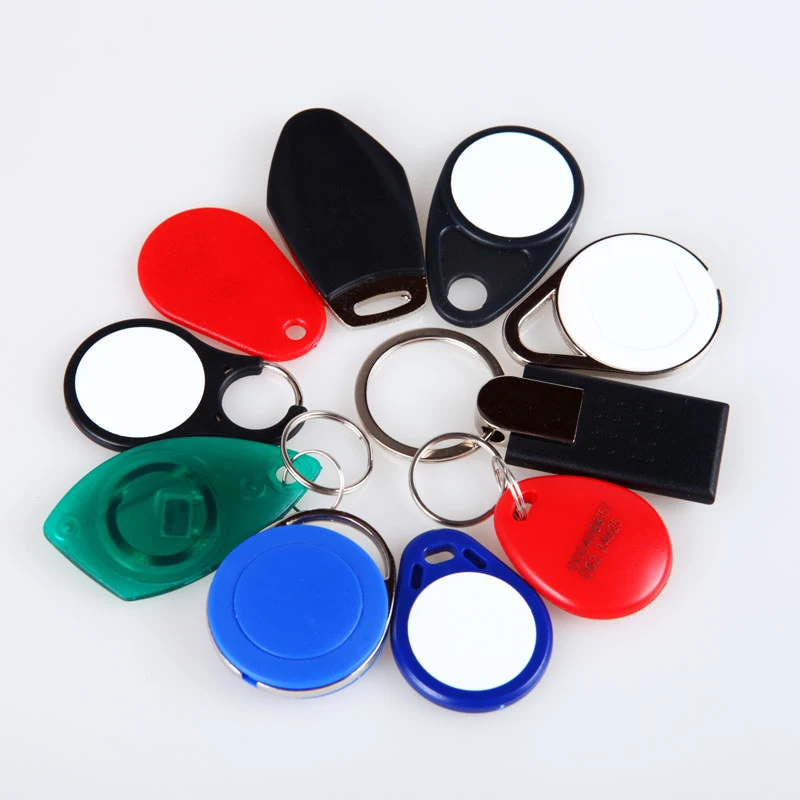
Keyfobs
RFID Keyfobs — Materials & Model Comparison
For keychain credentials. Confirm housing dimensions, chip configuration, numbering and authorized enrollment.
Explore this format05 / The operating conditions
How far will it read in your installation?
There is no single working distance for an RFID band or chip. Establish a required read zone, then test the finished tag on the actual item with the intended reader settings. Include unwanted reads outside the zone as well as missed reads inside it.
- Material and contents
- Test the label on the actual surface and on filled containers where relevant. Metal, liquids and nearby packaging can change performance; a suitable tag construction must be evaluated in place.
- Orientation, movement and read-zone boundaries
- Include realistic stacking, presentation angles and movement. Specify both the objects that should be read and the adjacent objects that must stay outside the transaction.
- Attachment and available space
- Provide mounting dimensions, curvature and permitted attachment methods. Assess adhesive preparation, stitching, fasteners or encapsulation against handling and removal requirements.
- The complete service process
- Describe temperature exposure, chemicals, moisture, pressure and mechanical stress. For laundry or industrial use, test the assembled tag through the agreed process, then verify reading and attachment again.
- Reader installation and surrounding equipment
- Trial the proposed antenna positions, cables, reader settings and nearby equipment under working conditions. Include simultaneous readers and normal site activity when establishing acceptance criteria.
06 / Application requirements
Select products for your application
Use these application guides to connect product candidates with the system, handling conditions and sample checks that matter for the job.
RFID access cards & keyfobs
Choose RFID access cards and keyfobs by reader, credential format and issuance workflow. Plan compatibility samples for offices, apartments and campuses.
Hotel RFID key cards & wristbands
Source hotel RFID key cards and resort wristbands with lock, encoder and issuance checks. Plan samples for room access, shared facilities and replacement.
Laundry and linen tracking
Plan laundry RFID tags around textile models, attachment, wash and finishing conditions, UHF read points and EPC mapping. Validate a complete pilot.
Industrial asset tracking
Compare PR3110 printable on-metal labels, rigid PCB tags, pallet tags and cable ties. Plan installed RFID samples around your asset and read point.
Library RFID labels & media tagging
Plan library RFID labels around HF or UHF equipment, item-data encoding and circulation workflows. Check books, media, gates and inventory with a pilot.
Event RFID and NFC credentials
Customize RFID event wristbands, badges and NFC stickers with your logo, numbering and agreed encoding. Request a bulk quote and sample options.
07 / From samples to production
Agree what a successful evaluation must prove.
Choose a representative sample plan around configuration variants, operating conditions and the consequences of a missed or incorrect transaction. Agree the acceptance criteria before the test.
Define the event and the baseline
Describe what must happen, where and to which objects. Record the current workflow and agree how missed items, incorrect events and operator effort will be measured.
Confirm the system and its owner
Identify the reader or lock provider, software owner and installer. Agree who controls identifiers, keys, encoding and integration before selecting the chip.
Shortlist the physical tag
Match the approved chip requirement to a card, label, wristband or durable housing. Send dimensions, surface details and photographs so candidates reflect the real installation.
Agree a sample test plan
Select representative configurations and state what a pass means. Separate a stock-format comparison from custom printing, encoding and testing of the intended production construction.
Run the complete pilot
Test identification, any required writing or authentication, and the software action. Include expected operating conditions, unwanted reads, failed tags and recovery procedures; retain the results.
Approve and control production
Approve the configuration, artwork, encoding file, packing and acceptance checks. Retain a reference sample and require review of chip, antenna, material or process changes before repeat supply.
Seven assumptions to check before placing an order.
The same frequency means the tags are interchangeable.
Match the protocol, chip functions, data layout and application. Confirm the required operation on the installed reader instead of relying on a frequency label.
A secure chip makes the complete system secure.
Security depends on provisioning, verification, permissions and system behavior. Define who implements these controls and test the configured application.
The longest advertised read range is the best choice.
Select a reliable read zone for the task. Excess coverage may collect neighboring objects, and a maximum-distance demonstration does not establish operational performance.
A material name or protection rating proves service life.
Request evidence for the complete tag under the specified exposure and attachment. A water-ingress result alone does not establish detergent, abrasion or wash-cycle performance.
Every reader observation is a completed business event.
The application must interpret identifiers, duplicates, direction and timing as relevant to the task. Verify that the correct event was accepted, not just that the reader saw a tag.
The lowest tag price determines project value.
Compare the same configuration and include encoding, installation, software, testing, replacement and operator work in the project estimate. Validate benefits against the pilot baseline.
A successful stock sample approves every production variant.
Approve the final chip, antenna, materials, attachment and encoding. A different size, backing, personalization process or software configuration may require another test.
08 / Quotation and supply
What determines RFID cost and minimum order quantity?
A useful price applies to a defined product configuration and quantity. Compare quotations with the same chip, construction, personalization, testing and delivery scope; a generic price range cannot resolve those differences.
- Chip and application configuration
- Exact chip variant, memory, required commands, personalization and any security provisioning scope.
- Tag construction and attachment
- Antenna, dimensions, material, backing or housing, attachment method and service-environment requirements.
- Artwork and data work
- Print method, variable information, numbering, encoding file, verification and reconciliation of rejected pieces.
- Quantity and repeat-order plan
- Quantity per configuration, number of designs, tooling or setup needs, and scheduled releases.
- Evidence and acceptance work
- Sample preparation, agreed inspection or test scope, product-specific documents and approval stages.
- Packing, timing and delivery scope
- Packing format, destination, target date and shipping terms. List readers, installation and software separately so a tag quotation is not mistaken for a complete system offer.
Confirm sample terms before shipment.
Choose the sample path around the decision you need to make. Confirm availability, charges and the test configuration before preparation.
- Available stock samples follow the free stock allowance in the current policy, with buyer-paid freight. Confirm the selected products; custom printing or encoding is a separate scope.
- Custom samples are paid work. Agree the configuration, fee and any eligible production-order credit before preparation.
- Larger B2B evaluation kits require project qualification and an agreed sample mix. They are separate from the standard stock allowance.
- Confirm preparation, customization and estimated transit separately. Approve the intended production construction and test results before authorizing bulk production.
09 / Ready for a useful response
What should your first inquiry include?
Use the same brief when comparing suppliers. An incomplete answer is a follow-up question; a checklist score does not establish who owns a factory or whether a product will work.
- Application and required operation: identify / read or write data / authenticated access / other:
- Existing reader or phone model, firmware, antennas and connection interface:
- Controller, software or app name and version; required data format and system-approved chip or protocol:
- Installation country or region; permitted reader frequency band and power settings, if known:
- Object material, metal or liquid nearby, attachment area and available dimensions:
- Required read zone, orientation, item spacing and movement; single-item or batch reading:
- Operating conditions and the checks a representative sample must pass:
- Preferred product format; chip, dimensions, printing and encoding requirements, if specified:
- Sample quantity and planned order quantity by configuration:
- Delivery country and postal code; sample evaluation date and required arrival date:
Use non-sensitive specifications. Keep live credentials, secret keys and personal records out of the inquiry.
Use this brief in your inquiryKeep a copy of the project brief.
Download the editable text checklist to share with your team or complete before requesting samples. It contains the same requirements as the inquiry above and is available without registration.
Download the project brief (.txt)10 / Continue with the specific decision
Go deeper where your project needs it.
LF, HF/NFC or UHF?
Compare interaction, protocol, equipment and regional settings before choosing a band.
Which chip configuration?
Compare memory, commands and application support after the reader requirements are known.
Compare two shortlisted options
Review specific differences between chip families, frequencies and product formats.
11 / Buyer questions
Questions to resolve before choosing RFID products.
What do I need for an RFID system besides tags?
You need a compatible reader and antenna arrangement, software that interprets the data, and a defined business workflow. Specify responsibility for installation, identifiers, encoding and integration. A tag supply quotation should state which of these services or devices it includes.
Do RFID tags need batteries?
Passive tags use the reader field and do not need a battery for the RFID exchange. Battery-assisted passive tags power additional circuitry while replying through the reader signal. Active tags power a transmitter. Confirm the exact architecture and maintenance requirements for the proposed device.
Can an ordinary NFC phone read a UHF RFID label?
A phone's built-in NFC interface operates at 13.56 MHz and does not read a UHF label through that interface. A compatible external UHF reader is a separate device. For an NFC tag, test the tag type, content, operating system and intended phone workflow.
How far can an RFID tag be read?
There is no single range for RFID. Ask for a result tied to the specific tag, reader, antenna, settings, object and test conditions. Define the required read zone and check identification, writing or authentication as separate operations when the project requires them.
Can I replace an existing RFID card with another card at the same frequency?
Only after the system provider confirms the chip, protocol, data format and application requirements. Test the actual access or transaction workflow; displaying a card identifier on a reader does not prove that the replacement is accepted by the system.
Should RFID replace all of our barcodes?
Evaluate the capture task first. Printed codes can remain useful for manual handling and exception recovery. When both are used, agree their identifier mapping and test that operators and software resolve each representation to the same intended record.
Can the same UHF RFID system be installed in several countries?
It may be possible, but confirm each destination with the reader manufacturer and integrator. Check approved reader models, operating settings and antennas, then confirm tag suitability for those channels. A wide-band tag does not remove equipment approval or configuration requirements.
Will a metal-compatible or washable tag work in every installation?
Those descriptions are not a substitute for a defined test. Specify the surface, mounting and full service process, then test the complete tag and read operation. Ask for evidence that matches the proposed construction and exposure, rather than transferring a result from another product.
What should I send for an RFID tag quotation and sample review?
Send the application, reader or lock model, chip requirement if known, object and attachment details, service conditions, quantity, customization and destination. Describe the action the pilot must prove. RFIDAK can then confirm the candidate configuration and applicable stock, custom or qualified evaluation-kit terms.
Technical references and their scope.
These primary sources explain the technology and configuration requirements. They do not certify every finished RFIDAK product or an untested installation.
- NIST SP 800-98 — RFID system fundamentals
Section 2 explains RFID components and power models. This 2007 reference is used for definitions, not current regional rules or cipher recommendations.
- GS1 System Architecture
Explains identification, data carriers and applications, including barcode and RFID use within a common identification system.
- GS1 EPC Gen2 UHF air interface — release 3.0.1
The February 2026 standard describes reader/tag communication and distinguishes protocol requirements from locally permitted operation.
- NFC Forum — NFC technology and NDEF
Covers 13.56 MHz NFC, device operation and the need to consider tag formats and mobile operating systems.
- NXP AN12196 — NTAG 424 DNA configuration
Provides a concrete example of chip personalization, secure messaging and verification-side implementation rather than security by chip name alone.
- NXP AN11564 — NFC antenna design and matching
Explains metal-induced detuning and NFC antenna design considerations. It is not a universal material or UHF performance guarantee.
- Impinj — selecting a RAIN RFID tag
Identifies region, environment, placement, attachment, size, range and memory as tag-selection factors.
- Impinj — reader resources and certified regions
Links reader technical resources and certified-region information. Confirm the exact device and installation with the manufacturer and integrator.
Make the next step specific
Share the system and the job it needs to do.
Start with the reader, application, item and operating conditions. We can use those details to discuss product candidates, open compatibility questions and sample requirements.
Plan a compatibility check