NFC sticker buying guide
NXP NTAG213 NFC stickers
RFIDAK supplies custom NXP NTAG213 NFC stickers with 144 bytes of user memory. Start here for a compact web-link payload. Confirm the complete NDEF message, target phones and application surface before ordering. The standard tag and label MOQ baseline is 1,000 pieces; availability, sample terms and delivery are confirmed in the quote.
Your chip preference carries into the editable inquiry.
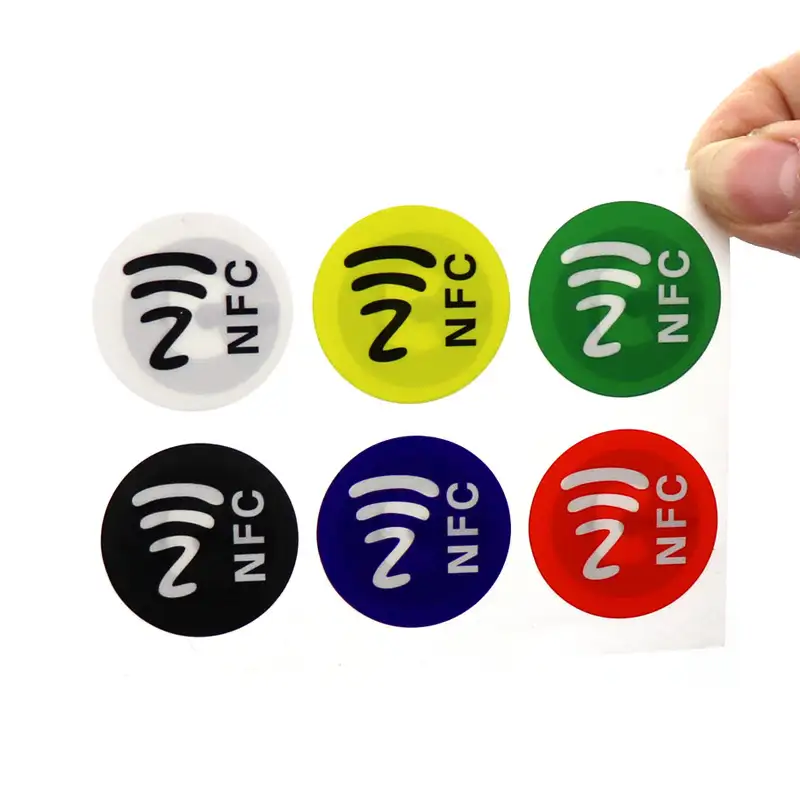
Quick spec — NXP NTAG213 Sticker
- Chip and user memory
- NXP NTAG213 · 144 bytes
- NFC protocol
- 13.56 MHz · NFC Forum Type 2 · ISO/IEC 14443 Type A
- Phone workflow
- Validate the NDEF record, phone model and intended action
- Label construction
- Confirm size, adhesive, surface and sheet or roll supply
- MOQ baseline
- 1,000 pieces; configuration confirmed in the quote
- Samples and delivery
- Agree availability, charges, freight and schedule
Chip technical brief
NTAG213 uses NXP ordering codes beginning NT2H1311G0; confirm the complete code and package for the supplied construction. Its 144-byte user area must accommodate the approved NDEF layout and encoding overhead, so a fixed URL character limit is not a sufficient sizing rule. The manufacturer-programmed 7-byte UID is separate from writable customer content. Permanent lock bits cannot be reversed; approve the final payload before locking. For a public phone-tap link, keep the required NDEF content publicly readable. If read access is password-restricted, agree a compatible application workflow and test it. A static URL or chip-originality signature alone does not authenticate the product carrying the tag. Validate the final label, mounting surface and intended phones together.
Technical sources: NXP NTAG213 / 215 / 216 specifications · Apple background tag reading · Android NDEF support. Chip specifications do not establish the finished sticker’s performance.
Selection checkpoint
144 bytes of user memory for a compact NFC web-link payload; validate the encoded message and phone action.
Typical use cases
- ▸Product-information web links
- ▸Contact-page links
- ▸Restaurant-menu web links
- ▸NDEF marketing posters after phone testing
Reader requirements to validate
Confirm the exact reader model, firmware, antenna, supported protocol and application or credential data with the system owner. Test the finished sample on the installed setup; a chip datasheet or shared frequency does not establish compatibility.
Specify the finished NFC sticker
RFID and NFC stickers combine a chip-and-antenna inlay with a face material, adhesive and release liner. Specify NFC or UHF first: they require the appropriate chip, frequency, protocol and reader. A UHF label does not serve a phone's built-in NFC reader. For metal or foil, select a construction designed for that technology and surface. NFC may require a ferrite isolation layer; UHF on-metal labels use their own antenna and mounting construction. Do not treat those layers as interchangeable. Approve the dimensions, inlay position, face material, adhesive, printing and individual, sheet or roll supply. Test the mounted label with the intended phones or readers and actual contents, curvature and exposure. Ask for material or performance documents for the selected article. The standard tags-and-labels baseline is 1,000 pieces; confirm configuration, quantity per design, encoding, sample charges, freight and production schedule in the quote.
Size and supply format
- • Round, square or rectangular: dimensions and inlay position to approve
- • Custom die-cut shape subject to construction review
Materials
- • Paper or polymer face material selected for printing and exposure
- • Adhesive and release liner matched to the mounting surface
Document scope to verify
Request current documents for the exact finished article, materials and destination. A form-factor name does not establish a certification or IP rating.
Plan your NXP NTAG213 sticker order
NTAG213 provides 144 bytes of user memory and is a starting point for a compact NDEF web-link message. Send the final address, including any item identifier or tracking parameters, so its encoded size can be checked with formatting overhead; a fixed URL character allowance is unreliable. For a destination that will change, consider an address under your control and agree who maintains the page or redirect after the tag is locked. Approve the label on the final packaging and intended phones, including the supported notification and opening behavior, before choosing the construction and encoding plan.
Who this chip fits
Packaging and marketing teams choosing a phone-tap route to product information, instructions or a contact page. This route suits buyers who can keep detailed content on a maintained website and want a clearly specified link, label and phone test before ordering.
Planning examples
Illustrative evaluation plans, not reported customer results.
Example 1
Planning scenario: a packaging team wants one support address on each product label. Compare a compact brand-controlled address with the proposed campaign URL, measure the actual encoded NDEF size and test the mounted sample. Assign ownership of the destination page before approving any permanent locking.
Example 2
Planning scenario: a venue needs NFC links on printed information signs. Check the full sign construction, including any metal backing, and test representative phones at the marked tap location. Agree whether a printed QR code should resolve to the same maintained address and verify both during sampling.
NTAG213 vs NTAG215 vs NTAG216
Compare user memory against the complete encoded NDEF message, including overhead. All three chips use NFC Forum Type 2; larger capacity does not add encryption or guarantee that a phone handles every record without an app.
On smaller screens, scroll the table horizontally to compare all fields.
| Chip | User memory | Access control | Typical Use | Quote basis |
|---|---|---|---|---|
| NTAG213 (this page) | 144 bytes | 32-bit password; no encrypted communication | Start here for a compact web-link payload. | Chip, construction, encoding and quantity |
| NTAG215 | 504 bytes | 32-bit password; no encrypted communication | More space when the approved payload exceeds NTAG213 capacity. | Chip, construction, encoding and quantity |
| NTAG216 | 888 bytes | 32-bit password; no encrypted communication | More space for a larger approved NDEF message. | Chip, construction, encoding and quantity |
Choose your label construction
Use the NFC sticker product guide to specify the surface, printing, encoding and supply format. Confirm NXP NTAG213 availability and the finished label in your quotation.
Frequently asked — NXP NTAG213 stickers
How do I know whether my URL fits an NTAG213 sticker?▾
NTAG213 has 144 bytes of user memory. Supply the exact final address and measure the encoded NDEF message with its formatting overhead. Include the longest item identifiers, parameters and any additional records used in production. Approve a read-back sample; a rule such as a fixed number of URL characters does not reliably establish fit.
Will an NTAG213 web link open without a separate app?▾
A supported NDEF web-link record can use built-in handling on compatible phones, subject to hardware, settings, software and device state. Apple documents background reading on iPhone XS and later with a notification that the user taps to open the supported action. Android behavior also depends on the device and record. Test the actual encoded and mounted label on the intended phones.
Can the same NTAG213 label be used on paper, glass and metal?▾
Confirm the complete mounting surface and nearby materials for each application. Metal or foil can change antenna behavior and requires a separately reviewed NFC construction, often including a ferrite layer. Curvature, liquid, thickness and phone position also belong in the sample test. The chip name alone does not establish surface compatibility or read distance.
What should I approve before the URL is permanently locked?▾
Verify the encoded address, printed QR or serial mapping, destination ownership and the complete phone action. Permanent lock bits cannot be undone. A locked address under your control may still lead to an updated page or redirect through your web setup. Keep the factory-programmed UID separate from writable content and retain the approved encoding record.
What should I send for an NTAG213 quote and sample plan?▾
Send the final URL, target phones, mounting surface, label drawing, artwork, printed-data mapping, supply format, quantities per design and destination. The standard tags-and-labels MOQ baseline is 1,000 pieces; confirm the selected construction and encoding in the quote. Agree sample charges, freight, production schedule and delivery terms separately before approval.
Ready to source NXP NTAG213 stickers?
Send the NXP NTAG213 preference, NDEF message, application surface, label format, quantity and destination. We will confirm availability, sample charges and a delivery schedule for the proposed configuration.
Request a NXP NTAG213 Quote