Skip to content
RFID Keyfob

RFID FR4 Glassfiber Keyfob

Need a smaller credential than a full-size RFID card?

MOQ
500 pcs

Stock SKU. Custom tooling from 2,000 pcs.

Lead time
7–15 days

Standard; rush possible on request.

Free sample
Ships in 1–3 days

Stock samples via DHL / FedEx.

Use this keyfob or transponder when the credential needs to stay on keys, in pockets, or with everyday access routines. Confirm reader compatibility, shell style, numbering, and branding before production planning starts.

What buyers usually confirm first

swipe →

Reader Match

Will it match the access system already in the field?

Most keyfob projects start by checking reader frequency and installed credential compatibility.

Shell Choice

ABS, epoxy, or a more premium shell style?

Shell material affects durability, branding, and how the credential feels in everyday use.

Supply Plan

Need numbering, encoding, or dependable repeat-order supply?

Replacement and rollout programs often care as much about consistency as the first sample batch.

Spec Check

What to confirm before keyfob sampling

Reader compatibility, shell style, numbering, and branding choices usually decide the right keyfob build.

Product Name RFID FR4 Glassfiber Keyfob
Housing Material FR4 grade-4 glass-reinforced epoxy laminate
Flame Rating UL94 V-0
Dimensions 45 x 30 x 1.2 mm
Weight 2.2 g
Standard Color Black (laser-markable surface)
Operating Temperature -30 deg C to +100 deg C
Antenna Construction Etched copper foil embedded in FR4 laminate
Operating Frequency 125KHz (LF), 13.56MHz (HF)
LF Chip Options EM4200, TK4100
HF Chip Options MIFARE Classic 1K, DESFire EV2, NTAG213/215/216, ICODE SLIX
Read Range 5-12 cm (LF), 3-8 cm (HF)
Marking Laser-etched UID (decimal, hex, barcode, QR)
Compliance UL94 V-0, RoHS, REACH
MOQ 1,000 pieces

Shortlist Logic

Why buyers shortlist this keyfob style

These points usually matter when convenience, system match, and everyday durability all matter at once.

FR4 grade-4 glass-reinforced epoxy laminate - UL94 V-0 flame retardant, industrial PCB substrate used in circuit boards and telecom equipment
Slim 45 x 30 x 1.2 mm format, only 2.2 g - thinnest and lightest RFID keyfob available, fits inside wallet card slots
Working temperature -30 deg C to +100 deg C - tolerates outdoor yard cold and data center server cabinet heat without warping
Laser-markable surface - high-contrast white laser etching on black FR4 produces tamper-resistant sequential UID numbering
Etched-into-laminate antenna - embedded directly in FR4 copper foil layer, mechanically superior to bonded inlays
Flame retardant UL94 V-0 approved for defense, telecom central office, and data center cabinet interior use

Use Cases

Where buyers usually deploy this keyfob

These are the access and membership workflows where a compact credential often beats a full-size card.

Data center personnel access

thin format fits inside wallet card slots and badge holders, tolerates 65-75 C server cabinet temperatures

Aerospace and defense contractor ID

UL94 V-0 flame retardant credential compliant with DoD and DLA physical security standards

Telecom central office technician credentials

flame retardant requirement for NEBS Level 3 certified facilities

Cold-chain logistics driver and warehouse worker ID -30 deg C tolerance for frozen food distribution and pharmaceutical cold storage

Outdoor utility worker and field service

weather-tolerant credential for linemen, meter readers, and field technicians

High-security research lab access

laser-engraved sequential UIDs match chip UID for tamper-resistant audit trails

FR4 Glassfiber vs PPS Keyfob — How To Choose

Flame-retardant slim or chemical autoclave? Pick by hazard class

Both are specialty industrial keyfob materials for hazard-specific deployments. FR4 glassfiber targets flame-safety code compliance (data centers, aviation, defense). PPS thermoplastic targets chemical / autoclave exposure (pharma, refinery, hospital). Non-interchangeable — verify which hazard dominates before specifying.

RFIDAK FR4 glassfiber RFID keyfob — 1.2mm slim fiberglass PCB with UL94 V-0 flame retardant rating, for data centers, avionics, and defense applications Option A

FR4 Glassfiber Keyfob (this product — flame-retardant)

FR4, UL94 V-0, 1.2 mm slim wallet-fit

Primary hazard
Flame-retardant (UL94 V-0)
Thickness
1.2 mm (slim, wallet-compatible)
Chemistry
Moderate (better than ABS)
Unit price (MOQ 1K)
$0.75 – 1.45

Best for

  • Data center (fire suppression code)
  • Aviation / avionics / defense
  • Cold-chain logistics with wallet carry
RFIDAK PPS RFID keyfob — polyphenylene sulfide thermoplastic for chemical, autoclave 134°C, and high-temperature industrial applications Option B

PPS Keyfob (sibling — chemical + autoclave)

PPS thermoplastic, 134 °C autoclave

Primary hazard
Chemical + high-temp autoclave
Thickness
3-5 mm (rigid industrial)
Chemistry
Acid / base / solvent tolerant
Unit price (MOQ 1K)
$1.45 – 2.75

Best for

  • Chemical plants, refineries, pharma
  • Hospital autoclave-reprocessed credentials
  • Power plant / steam environments

Quick decision tip — If the primary workplace hazard is fire / flame code compliance (data centers, aviation, defense), FR4 (Option A) with UL94 V-0 rating meets the code at half the PPS price. If the hazard is chemical exposure or autoclave sterilization, PPS (Option B) is the only option that survives the chemistry. Both materials are specialty — for merely rugged / outdoor / wet environments, <a href="/product/rfid-abs-keyfob">ABS</a> or <a href="/product/rfid-silicone-keyfob">silicone</a> cover the baseline at 1/2 to 1/4 the cost.

RFID FR4 Glassfiber Keyfob Types

1 Should I choose the FR4 keyfob for my data center / defense / cold-chain program?

Yes — if you need a slim 1.2 mm wallet-fit credential that survives data center server cabinets (65-75°C continuous), defense / DoD / DLA flame-retardant requirements (UL94 V-0), telecom NEBS Level 3 central office facilities, cold-chain logistics (-30°C frozen food / pharma cold storage), or outdoor utility field service. FR4 is the same industrial PCB substrate used in circuit boards and telecom equipment — it delivers properties no other keyfob material matches in a single package.

Pick a different material if you need lowest cost (use ABS), IP68 pool / waterpark immersion (use silicone), premium hospitality feel (use leather), tech-promo visible chip (use epoxy), or 134°C autoclave + acid / base chemical resistance (use PPS). Pick FR4 when slim wallet-fit + flame retardant + temperature range -30 to +100°C + laser UID marking on black surface + audit-grade tamper-resistance matter together.

2 Spec decision matrix — keyfob material alternatives (sibling products)

Comparison across all 6 keyfob material options. Prices indicative at MOQ 5,000 pieces.

MaterialIP / temp rangeSpecial propertyBest fitUnit price
The ABS keyfobIP65, -20 to +60°CLowest cost + 9 stock colorsApartment, office, fitness, parking, school$0.45 – 0.85
The silicone keyfobIP68 (1.5 m), -40 to +200°CWaterproof + autoclave 121°C + medical-gradeWaterpark, pool, hospital, marine, construction$0.85 – 1.45
The leather keyfobSplash, -10 to +60°CPremium tactile + gold / silver hot-stampHotel-grade, corporate exec gift, luxury brand$1.85 – 4.50
The epoxy keyfobIP66, -25 to +80°CTransparent visible chip + UV-stableTech promo, hackerspace, university, conference$0.95 – 1.65
The PPS keyfobIP68 + chemical, -40 to +200°CAutoclave 134°C + acid / solvent / baseChemical plant, industrial laundry, autoclave$1.45 – 2.75
The FR4 keyfob (this product)IP67, -30 to +100°CSlim 1.2 mm wallet-fit + UL94 V-0 flame retardant + laser UIDData center, defense / DoD, telecom NEBS, cold chain, utility field$0.75 – 1.45

Verdict: FR4 wins exclusively when slim wallet-fit + flame retardant matter together. The 1.2 mm thickness fits standard ISO 7810 CR-80 card slots while the UL94 V-0 rating qualifies the credential for defense / telecom / data center deployments where plastic alternatives are excluded by safety code.

3 Typical deployment pattern - data center credential compliance

Data center operators choose FR4 keyfobs where fire-marshal and NFPA-aligned reviews flag plastic credentials inside white space: FR4's UL94 V-0 flame rating clears that requirement, and the 1.2 mm wallet-fit profile suits technicians who carry credentials in cargo pockets.

Multi-line laser UID marking (employee ID, region, clearance, site, version, batch fields) supports the audit-traceability documentation that SOC 2 and ISO 27001 access reviews ask for.

4 Compatibility reference — chips, certifications, multi-line UID fields

Verified compatibility across LF / HF chips, defense / telecom certifications, multi-line laser UID format, and target deployment environments.

CategorySupportedNotes
LF chips (125KHz)EM4200 (R/W 512-bit), TK4100 (read-only 64-bit)For legacy proximity reader fleet compatibility in data center cabinets
HF chips (13.56MHz)NXP MIFARE Classic 1K, MIFARE Plus EV2, DESFire EV1 / EV2 / EV3 (2K / 4K / 8K), NTAG213 / 215 / 216, ICODE SLIXDESFire EV3 with AES-128 is the data center / defense modern default
CertificationsUL94 V-0 flame retardant (the FR4 substrate property), RoHS 3, REACH SVHC, FCC Part 15, CE EMC + LVDUL94 V-0 is the unique value vs other keyfob materials
Defense / DoD specificationsDLA Physical Security Standard 2024, NFPA 75 (data center fire safety), DoD CAC-equivalent secure access workflowsCustomer specifies clearance-level encoding for FIPS 201 / PIV-equivalent integrations on request
Telecom NEBS specificationsNEBS Level 3 central office facility credentialingUL94 V-0 + temperature range qualifies for cabinet-interior installation
Data center facility integrationsHID iCLASS Seos, Lenel OnGuard, Software House CCure, Genetec Synergis, Brivo Onair, Honeywell Pro-Watch, VerkadaWiegand 26/34 (legacy) or OSDP Secure Channel (modern); DESFire AES authenticated read
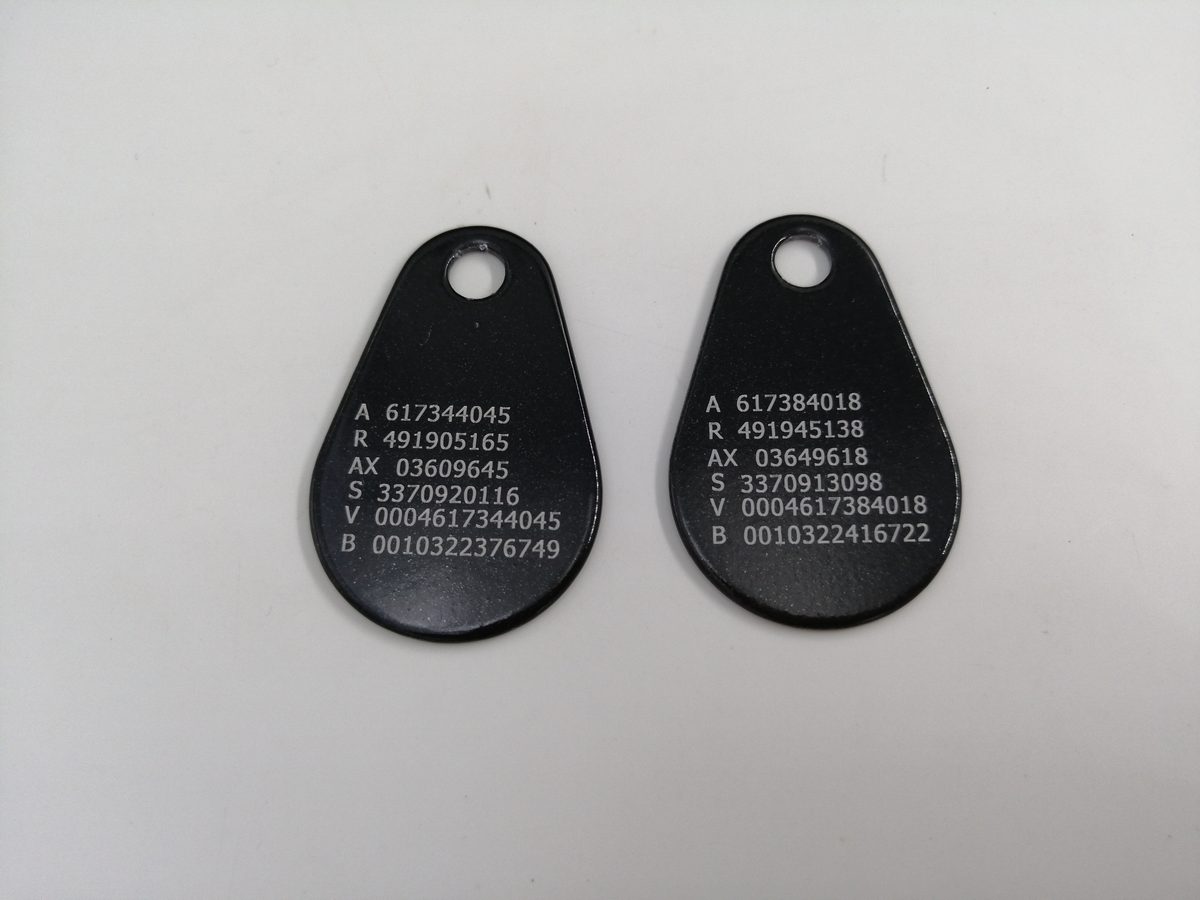
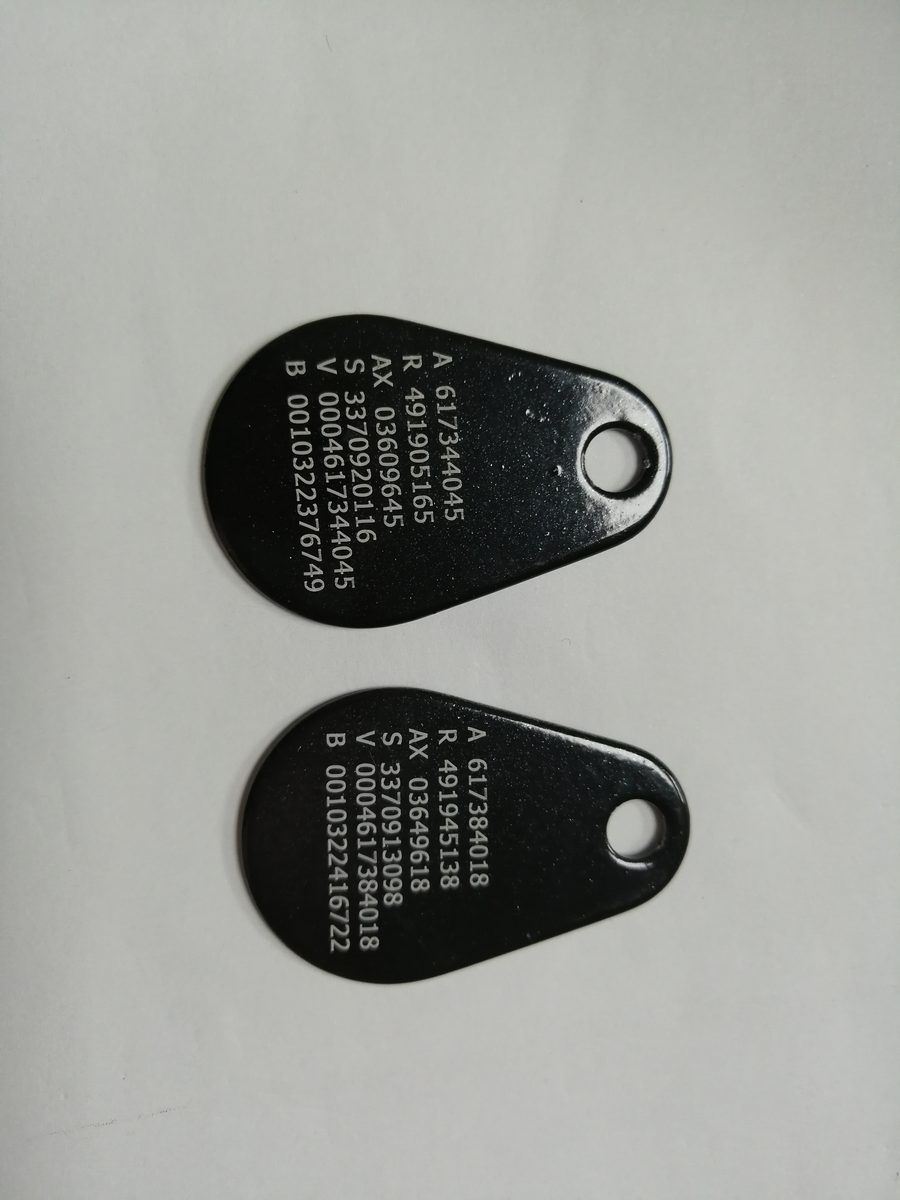
Multi-line laser UID format (A/R/AX/S/V/B)A=asset/employee ID, R=region, AX=access level, S=site code, V=version, B=batchUp to 6 lines, 1-2 mm character height, fully customer-configurable in CSV upload
Laser UID format options10-digit decimal, 12-digit hexadecimal, Code 39 barcode, Code 128 barcode, QR code (up to 25 x 25 mm)UID matches encoded chip UID for audit-grade traceability; CSV mapping file delivered
Cold chain compatibility-30°C continuous operation validated for frozen food / pharma cold storage / outdoor winter serviceMost other keyfob materials specced -20°C minimum; FR4 unique at -30°C
Wallet card slot compatibility1.2 mm thickness fits standard ISO 7810 CR-80 card slots, badge holders, money clipsOther fob materials at 5-8 mm thickness require dedicated keyring carry

5 Cost at volume — FAQ

How much does the The FR4 keyfob cost at 5K pcs? Stock 29.6 x 44.8 x 1.6 mm + DESFire EV3 2K + black FR4 + single-line laser UID: $0.95-1.25 per unit at MOQ 5,000. Volume brackets: MOQ 1,000 (evaluation) = $1.45-1.95; MOQ 5,000 = $0.95-1.25 (base); MOQ 25,000 = $0.78-0.98; MOQ 100,000+ = $0.62-0.85.

Chip upgrade? DESFire EV3 2K (data center secure default): included. EM4200 LF (cost-optimized legacy): -$0.20-0.35. TK4100 (read-only LF): -$0.30-0.45. MIFARE Classic 1K (legacy HF): -$0.15-0.25. DESFire EV3 4K / 8K: +$0.35-0.85. NTAG213 / 215 / 216 (NFC business card use case): -$0.10 to +$0.05.

Multi-line laser UID up-charge? Single-line UID (decimal or hex): included. Multi-line A/R/AX/S/V/B fields (up to 6 lines): +$0.08-0.18. Laser barcode (Code 39 / 128): +$0.05-0.10. Laser QR code (up to 25 x 25 mm): +$0.10-0.18. CSV upload of per-fob unique multi-line content: included at 1,000+ MOQ.

Custom dimensions? Stock 29.6 x 44.8 x 1.6 mm: no premium. Custom dimensions: NRE $1,800-3,500 + 3-week tooling for 5,000+ MOQ. 0.8 mm ultra-thin variant (wallet-insert / phone-case embedding): +20% cost premium over stock thickness.

How should I compare against ABS for data centers? FR4 costs more per fob, but in data halls the decision is usually not cost at all: the UL94 V-0 flame rating clears fire-marshal and NFPA-aligned reviews that standard plastic credentials fail, and FR4 tolerates hot-aisle temperatures that age ABS quickly. Where compliance applies, FR4 is the qualifying option rather than the premium one.

What about FR4 vs PPS for industrial sites? PPS handles 134°C autoclave + acid / base / solvent chemical exposure. FR4 handles -30 to +100°C + flame retardant but NOT autoclave or strong chemical exposure. For chemical / autoclave sites use PPS; for data center / defense / cold chain / telecom use FR4.

6 Market context - the UL94 V-0 wallet-fit niche

The FR4 keyfob niche sits at the intersection of compliance and ergonomics: data center, defense, telecom, and cold-chain operators need flame-rated (UL94 V-0), temperature-tolerant credentials that still fit a wallet card slot. Ongoing data-center buildout keeps adding facilities where standard plastic credentials get flagged at fire review, which steadily feeds this segment.

Laser UID Marking Standards - RFID FR4 Glassfiber Keyfob detail

7 Laser UID Marking Standards

FR4 laminate is engineered for laser ablation: the black surface oxide layer is precisely removed by the laser to reveal a bright white or cream-colored mark in the underlying glass-epoxy substrate. Standard markable content includes: 10-digit decimal UID matching the chip's serial number, 12-digit hexadecimal UID for HF chips, Code 39 and Code 128 barcodes, and QR codes up to 25 x 25 mm. The supplies the laser UID CSV file paired with each chip's encoded UID, enabling automated enrollment into host access control, time-attendance, and asset management systems. For defense and high-security deployments, the laser UID is cryptographically linked to the chip UID to create a tamper-evident credential where surface modification breaks the verification chain.

8 Slim Form Factor for Wallet Carry

At 1.2 mm thickness, the FR4 keyfob is thinner than a standard ISO 7810 CR-80 card (0.76 mm) is tall. This fits naturally inside wallet card slots, badge holder pouches, and cardholder money clips the carrier does not need to add a bulky fob to their key ring. For corporate users who already carry a wallet but prefer a keyfob format over a card, FR4 delivers the small size of a fob in a wallet-compatible thickness. The 45 x 30 mm footprint matches approximately one-third of an ISO CR-80 card surface area, providing enough space for antenna geometry to achieve 3-8 cm read range with standard HF readers and 5-12 cm with typical LF proximity readers.

Multi-Line Laser UID A/R/AX/S/V/B Fields - RFID FR4 Glassfiber Keyfob detail

9 Multi-Line Laser UID A/R/AX/S/V/B Fields

The black FR4 surface accepts up to 6 lines of laser-engraved text in precise 1-2 mm character heights. The most common multi-field format used by industrial access control integrators includes: A (asset ID), R (region code), AX (access level), S (site code), V (version), and B (batch ID) producing a dense per-credential traceability record that survives autoclave, solvent wash, and drop impact without fading. Each line is independently configurable in customer CSV upload: a single 1,000-piece order can carry 1,000 unique multi-line serials with no additional setup charge beyond the CSV data import. Typical QR-code and barcode alternatives consume more surface area and are less legible at arm's-length reading compared to laser text.

Side Profile 1.2 mm Thickness - RFID FR4 Glassfiber Keyfob detail

10 Side Profile 1.2 mm Thickness

At just 1.2 mm thick, the FR4 keyfob is substantially thinner than ABS (6 mm), silicone (5 mm), and PPS (6 mm) alternatives. The side profile reveals the laminated construction: two outer FR4 epoxy sheets bonded to an inner copper-etched antenna layer under heat and pressure. This sandwich construction provides the mechanical integrity of a rigid PCB while the thin outer face supports laser marking without puncturing to the antenna layer. The 1.2 mm thickness fits in wallet card slots that reject 5-6 mm plastic fobs, making FR4 the preferred format for corporate users who do not want a bulky keychain attachment.

Dimensional Specification 29.6-44.8-1.6 mm - RFID FR4 Glassfiber Keyfob detail

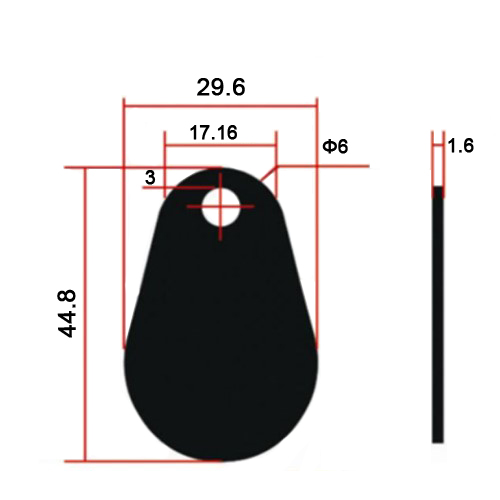
11 Dimensional Specification 29.6-44.8-1.6 mm

The stock FR4 keyfob measures 29.6 mm wide 44.8 mm tall 1.6 mm thick (tolerance 0.2 mm), with a 6 mm keyring hole offset 17.16 mm from the top and 3 mm from center. The teardrop profile follows a natural 'finger-grip' contour for tap-and-hold usage at reader pedestals. Custom dimensions are supported for 5,000-piece minimum orders with 3-week tooling lead time. The 1.6 mm profile is the current industry-standard FR4 thickness matching PCB substrate inventory for cost efficiency; a 0.8 mm ultra-thin variant is available for specialized wallet-insert and phone-case embedding applications at 20% cost premium.

Supplier Fit

Why buyers source RFID FR4 Glassfiber Keyfob from RFIDAK

Once the format is right, most teams still need confidence in manufacturing control, sample support, and repeat-order reliability.

ISO 9001

Quality-focused manufacturing and sample support for custom RFID projects.

Since 2008

RFID manufacturing experience across cards, tags, labels, wristbands and readers.

Free Samples

Test product compatibility before bulk purchasing and customization decisions.

Commercial Fit

How buyers usually move this product from shortlist to sample

Most inquiry-ready visitors want to know whether this product matches their workflow, region and approval stage. These cues help them move faster without leaving the product page.

Residential and facility operators

Usually replacing or expanding apartment, office and parking credentials that must match installed readers.

Access-control distributors

Often need broad shell options, dependable repeat supply and clear compatibility checkpoints.

Gym and loyalty program teams

Typically care about portability, branding and compact credentials that are easy for end users to keep.

Quote Checklist

What to send us for a faster recommendation

  • Existing reader frequency, protocol or a photo of the working credential.
  • Preferred shell style, color, logo treatment and whether numbering is required.
  • Encoding, UID print or packaging expectations for the finished keyfob.
  • Sample quantity, bulk quantity and target market or shipping destination.

Market Notes

Regional conversations often tied to this category

North America

Apartment access, gyms and parking systems often start with compatibility matching and sample verification.

Europe

Corporate and residential upgrades often compare stronger chip options alongside shell durability and print quality.

Middle East and Africa

Hotels, residential compounds and visitor systems often want branded credentials with dependable daily-use performance.

Before You Order

Procurement guides every RFID Keyfob buyer reads first

Five short reads on the procurement-side topics every B2B RFID buyer wants answered before signing a quote — MOQ thresholds, lead time reality, pricing transparency, sample policy, and how to audit a Chinese factory before your first order.

Buyer Questions

Questions buyers usually ask before sample approval

These FAQs cover the points that usually come up between a first shortlist and a real sample or quote request.

What is the minimum order quantity (MOQ) for RFID FR4 Glassfiber Keyfob? +

For RFID FR4 Glassfiber Keyfob, the standard MOQ starts at 500 pieces on stock SKUs. Custom shapes, molds or non-standard materials typically move MOQ to 2,000–5,000 pieces to cover tooling setup. Exact MOQ and unit pricing are quoted per project once chip, customization and packaging are confirmed.

Does RFIDAK provide free samples of RFID FR4 Glassfiber Keyfob? +

Yes. Stock rfid keyfob samples of RFID FR4 Glassfiber Keyfob are typically free; we only ask buyers to cover DHL/FedEx express shipping. Samples ship in 1–3 business days after your order is confirmed and arrive in 2–5 days to most countries. Custom samples (new chip, new size, printed artwork) usually take 3–7 additional days.

What is the production lead time for RFID FR4 Glassfiber Keyfob? +

Standard RFID FR4 Glassfiber Keyfob orders ship in 7–15 business days after PO confirmation and artwork approval. Large runs (>100k units) or orders with complex encoding / custom molds may take 15–25 business days. Rush production is available on request for time-sensitive launches; confirm MOQ and artwork early to protect the timeline.

Can RFID FR4 Glassfiber Keyfob be customized for my brand or project? +

Yes. RFID FR4 Glassfiber Keyfob supports end-to-end customization: full-color CMYK / silk-screen / UV printing, laser engraving, serial numbering, custom chip encoding (UID write, NDEF, sector locking), custom shape / size (subject to tooling MOQ), and packaging. Share your artwork, chip requirement and quantity and we will return a spec sheet + price within 24 hours.

Is RFID FR4 Glassfiber Keyfob compatible with my existing reader or system? +

Compatibility depends on the frequency band (LF 125 kHz / HF 13.56 MHz / UHF 860–960 MHz) and chip family used by your reader or installed system. Send a photo of your current card / reader model and we will recommend the matching chip + test a sample before bulk order.

What certifications and quality control does RFIDAK apply to RFID FR4 Glassfiber Keyfob? +

RFIDAK operates under ISO 9001:2015 (Quality Management) and ISO 14001 (Environmental Management), audited by SGS. RFID FR4 Glassfiber Keyfob is subject to incoming material inspection, in-process QC at every lamination / bonding / encoding step, and 100% electrical performance testing before shipment. Products meet CE, FCC, RoHS and REACH as applicable by market. Full test reports are available on request for buyer audits.

Can RFID FR4 Glassfiber Keyfob be pre-encoded or printed with my artwork before shipment? +

Yes. RFID FR4 Glassfiber Keyfob can ship with UID range assignment, NDEF URL encoding (for NFC), sector-locked user data, serial numbering, and CMYK / silk-screen / UV printing of your artwork. Provide an AI/PDF artwork file at 300 dpi with 3 mm bleed and a chip-encoding spec; we return a digital proof for approval before production.

How does RFIDAK ship RFID FR4 Glassfiber Keyfob internationally? +

RFIDAK ships RFID FR4 Glassfiber Keyfob via DHL / FedEx / UPS (door-to-door, 3–5 days to most countries), air cargo (5–7 days for heavier orders), or sea freight (20–35 days for bulk over 500 kg). Standard Incoterms are EXW, FOB Shenzhen and DDP; choose based on customs clearance preferences. Commercial invoice, packing list and CoC / MSDS are included automatically.

How does RFIDAK handle repeat orders of RFID FR4 Glassfiber Keyfob? +

For repeat buyers, RFIDAK locks tooling, artwork and chip encoding on file so subsequent POs ship faster — typically 5–10 business days for stock chip types at previously-run quantities. Price is adjusted transparently per chip market rate and FX movement; we flag any chip shortage (e.g., DESFire EV3) before quotation so the project plan stays realistic.

What are the technical specifications of RFID FR4 Glassfiber Keyfob? +

Key RFID FR4 Glassfiber Keyfob specs: frequency 125 kHz (LF), 13.56 MHz (HF); dimensions 45 x 30 x 1.2 mm; substrate FR4 grade-4 glass-reinforced epoxy laminate. A full technical datasheet including read range, chip memory map, IP / temperature rating and compliance certificates is available on request; attach your reader model and target environment so we can confirm suitability before quoting.

Get Free RFID Samples

Try before you buy. Request free samples of any RFID product from our 50+ SKU catalog. Samples shipped via DHL/FedEx within 1-3 business days worldwide.

Not ready to chat? Just drop your email and we'll send the RFIDAK product catalog (PDF).

We'll only use your email to send the catalog and reply to your inquiry.

WhatsApp Get a Quote