1.8 mm bodies. Slotted carry. Reader-specific credentials.
RFID clamshell cards are rigid, slotted proximity credentials for access and attendance. The C2T41W reference measures 85.5 × 54 × 1.8 mm, with an ABS shell, PVC backing and a 37 × 63 mm rectangular antenna. Compare it with the C2E42W EM4200 configuration for a long-distance ID reader, or a separate PVC-face thick-card format with LF and HF chip options.
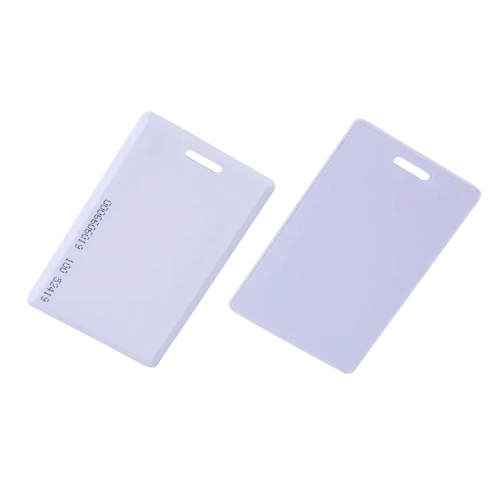
Slotted clamshell card facesOriginal product photograph shows the attachment slot and visible numbering. Appearance does not identify the installed chip or its encoding.
C2T41W physical reference
A rigid shell around a wire antenna.
The standard reference combines an ABS body and PVC backing. Its listed antenna measures 37 × 63 mm, with a wire diameter of 0.05 mm. These dimensions describe C2T41W, not every card with the same outer shape.
The reference mass is approximately 8 g. No dimensional tolerance or numerical slot size is published; use the selected production drawing for a close-fitting holder.
Keep the body, chip and reader condition together.
C2T41W and C2E42W are published supplier model references. The printable-face card is a separate listed format without a model number. Keep each row’s dimensions, chip and packing together when requesting samples.
Supplier lists PPS, ABS and PVC; specify the selected shell material
Chip reference
EM4200 · 125 kHz
Antenna
Larger-antenna construction described; no antenna dimensions published for this model
Reading example
0.8–1.2 m supplier example with a long-distance ID reader
Packing
100 / box; 1,000 / carton
Supplier-listed working temperature: −20 to +60 °C. The reading example is for a reader/card combination, not a distance guaranteed by 1.8 mm thickness.
Listed LF or HF options: TK4100, EM4200, EM4305, MIFARE 1K and NTAG21x, among others
Antenna
Supplier shows rectangular and round antenna constructions
Reading example
No numerical reading distance published for this format
Packing
100 / box; 2,000 / carton
The source lists offset, silkscreen, digital and laser printing methods. The finished card still needs to fit the selected printing process and media path.
The shell outline does not reveal the antenna inside.
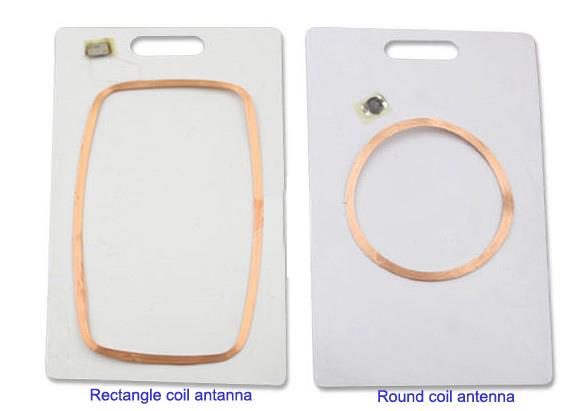
The supplier photographs show both rectangular and circular coils in similar card bodies. Coil shape is one part of the RF design; it does not establish the chip, data format or a guaranteed distance on its own.
Rectangular and round coil examples
Original supplier comparison from the printable-face thick-card listing. The antenna shape changes inside a similar outer shell; this image does not identify a chip or show a dimensional scale.
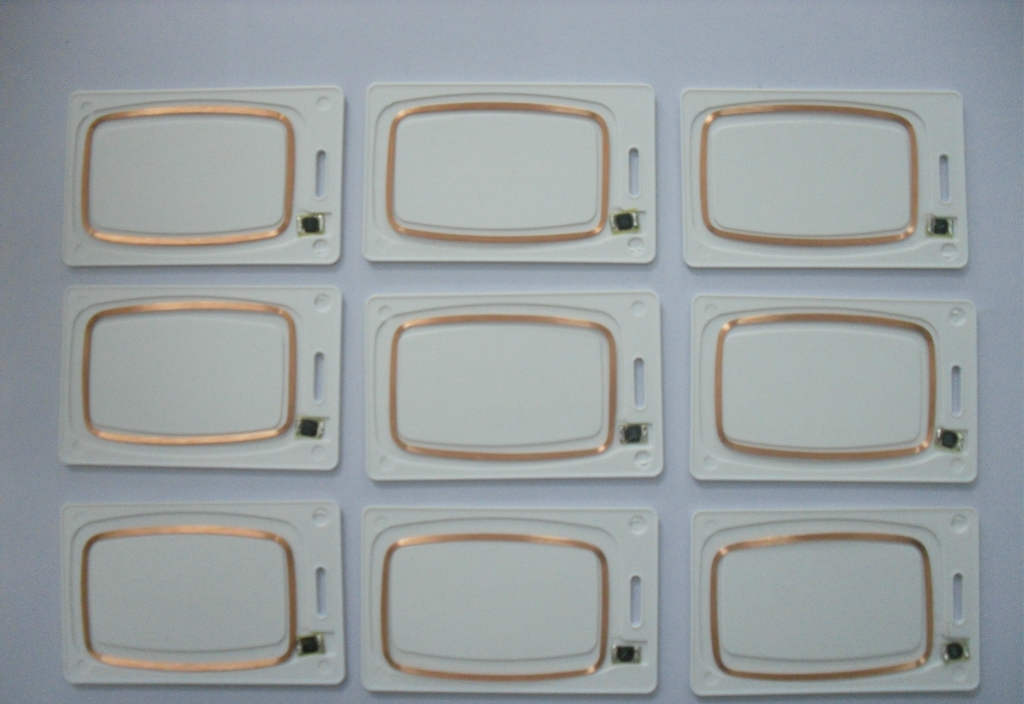
Coil and module inside the shell
Original supplier construction photograph. The coil follows the inner body and the module sits near the short edge; added holes or trimming can damage these components.
Use the existing slot for the attachment.
The supplied oblong slot is near the short edge. The interior photo places the module close to that edge and the antenna around the card body. Avoid cutting, drilling or adding a second hole without an antenna-layout drawing.
EM4200 is read-only. EM4305 is a different device.
Both appear in published thick-card options, but they do not have the same memory or command set. HF options belong to a different radio interface. The manufacturer data below help identify the credential your reader needs.
Clamshell card IC interfaces, memory and reader requirements
Chip & interface
Memory & behavior
Where it applies
EM4200LF · 100–150 kHz IC range; card reference at 125 kHz
RFID frequency and the access-system record are separate. A 125 kHz card still needs the reader’s expected encoding and identifier format. ISO/IEC 14443 A describes the HF options here; it is not the air interface of the EM4200 LF card.
Printed identification and physical fit
Make the visible number useful to the issuing team.
01
Shell, backing and print face
C2T41W lists logo and number marking. The separate 86 mm format uses a PVC face and lists offset, silkscreen, digital and laser methods. Specify the actual surface and process; “printable” does not mean every finished shell can pass through a desktop printer.
02
Card number and enrollment record
Keep the visible serial, raw reader value and enrolled credential record distinct. An EM4200’s ID remains fixed when access is granted or revoked; the administrator changes permissions in the system.
03
Holder and printer clearance
Measure against the 1.8 mm finished body, including any applied label. Check the clip through the existing slot and the holder opening. For local printing, use the printer manufacturer’s approved media thickness and feed requirements.
Technical documents
Take the specifications into your card evaluation.
The reference includes the named models, separate printed-face format, original construction photos and chip-manufacturer links.
Select the card and application. On the next page, add quantity, reader model, required identifier format, artwork and destination.
For replacement orders, include the current credential specification and enrollment method. Pricing, MOQ, sample charges and delivery schedule are stated for the quoted configuration.
No. EM4200 uses factory-programmed laser ROM. Enrolling or deleting a card in an access-control database changes the system record, not the chip identifier. EM4305 is a different, writable LF device with 512-bit total EEPROM; its reader commands and configuration must be supported by the intended system.
Why does one clamshell reference list centimeters and another list meters?
The C2T41W listing gives 5–13 cm depending on the reader. C2E42W gives 0.8–1.2 m specifically on a long-distance ID reader. These describe different card-and-reader conditions. Card thickness alone does not produce that distance; antenna geometry, reader field, orientation and installation all affect the result.
Can I print a 1.8 mm clamshell card in a normal card printer?
Only if that printer supports the finished card’s thickness, surface and feed path. A rectangular card outline does not establish printer compatibility. The separate PVC-face format is listed for several printing methods, but this is not approval for every desktop printer. Provide the printer model for locally printed cards or order the required marking on the finished card.
Will any 125 kHz card replace an existing access card?
No. Frequency is only one requirement. The reader must recognize the chip’s modulation, data rate and identifier format, and the controller must enroll the expected credential value. A number printed on the shell may be a serial or a formatted representation, so compare it with the value actually received by the system.