UHF label buying guide
NXP UCODE 8 UHF RFID labels
Request NXP UCODE 8 UHF labels from RFIDAK for an external EPC Gen2 reader workflow. NXP marks UCODE 8 / 8m No Longer Manufactured; confirm traceable chip availability and any replacement before approval. Specify the installation country, tagged item, EPC format and reading task. The standard label MOQ baseline is 1,000 pieces; configuration, sample terms and delivery are confirmed in the quote.
Your chip preference carries into the editable inquiry.
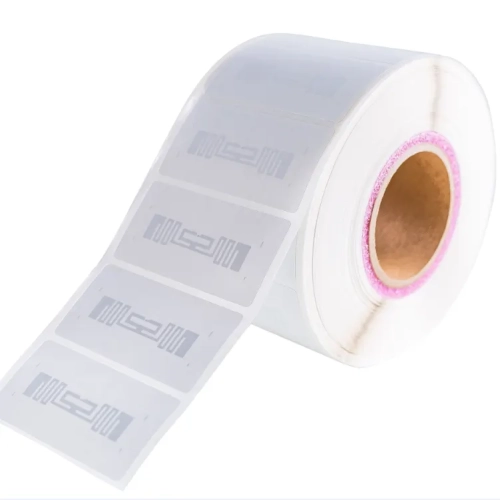
Quick spec — NXP UCODE 8 Sticker
- Chip memory
- NXP UCODE 8 · 128-bit EPC; 0-bit user memory
- Radio protocol
- UHF EPC Gen2 / ISO/IEC 18000-63; match the regional band
- Reading hardware
- External UHF reader; a phone’s built-in NFC does not read this label
- Finished construction
- Approve inlay, size, adhesive, tagged item and supply format
- MOQ baseline
- 1,000 pieces; confirm chip and configuration
- Samples and delivery
- Agree availability, charges, freight and schedule
Chip technical brief
UCODE 8 provides 128 bits of EPC memory and no user memory. Keep the item identifier in the agreed EPC format and the product record in your connected system. Its Self-Adjust feature concerns RF performance; chip sensitivity does not establish the reading distance of an adhesive label on a finished item. NXP marks the UCODE 8 / 8m product page No Longer Manufactured. Confirm the exact chip, traceable availability and repeat-order plan, and approve any proposed replacement on the actual reader, encoder and tagged item.
Technical references: NXP UCODE 8 — manufacturer specifications · NXP UCODE 8 — technical documentation. Confirm the exact chip variant and current supply status; specifications for a chip do not certify a finished label or retail program.
Selection checkpoint
Confirm traceable UCODE 8 supply and approve any substitute on your complete label workflow.
Typical use cases
- ▸Retail item identification after program approval
- ▸Asset labels with a mounted-sample test
- ▸Logistics identifiers linked to the customer system
Reader requirements to validate
Confirm the exact reader model, firmware, antenna, supported protocol and application or credential data with the system owner. Test the finished sample on the installed setup; a chip datasheet or shared frequency does not establish compatibility.
Specify the UHF label on the actual item
RFID and NFC stickers combine a chip-and-antenna inlay with a face material, adhesive and release liner. Specify NFC or UHF first: they require the appropriate chip, frequency, protocol and reader. A UHF label does not serve a phone's built-in NFC reader. For metal or foil, select a construction designed for that technology and surface. NFC may require a ferrite isolation layer; UHF on-metal labels use their own antenna and mounting construction. Do not treat those layers as interchangeable. Approve the dimensions, inlay position, face material, adhesive, printing and individual, sheet or roll supply. Test the mounted label with the intended phones or readers and actual contents, curvature and exposure. Ask for material or performance documents for the selected article. The standard tags-and-labels baseline is 1,000 pieces; confirm configuration, quantity per design, encoding, sample charges, freight and production schedule in the quote.
Size and supply format
- • Round, square or rectangular: dimensions and inlay position to approve
- • Custom die-cut shape subject to construction review
Materials
- • Paper or polymer face material selected for printing and exposure
- • Adhesive and release liner matched to the mounting surface
Document scope to verify
Request current documents for the exact finished article, materials and destination. A form-factor name does not establish a certification or IP rating.
Define the reading task before comparing distance
A chip name does not establish a finished label’s read range. Agree the item, label position, reader and antenna, regional settings, orientation and required reading zone. Include metal, liquid and neighboring tagged items in the sample test.
- Record the setup. Keep the inlay, surface, reader, antenna, power settings and distance consistent across candidate samples.
- Use known item counts. Test representative motion, spacing and orientation; distinguish missed items from unwanted reads outside the zone.
- Check encoding separately. Verify the approved EPC and printed identifier map, duplicates and rejected labels. A readable tag may still contain the wrong identifier.
- Agree acceptance. Document the required result and the approved configuration before bulk production or a component change.
Plan your NXP UCODE 8 label order
NXP lists UCODE 8 with 128 bits of EPC memory and no user memory, and marks its UCODE 8 / 8m product page No Longer Manufactured. Begin a repeat-order request by confirming the exact approved chip, inlay and traceable quantities available. A proposed alternative must fit the EPC scheme and be approved as a complete label on the installed system. Compare material, adhesive, dimensions, mounting surface, regional band, readers, antennas and software before accepting a change. UCODE 8 Self-Adjust is an RF feature; it does not guarantee a fixed distance, universal reader performance or approval under a retailer program.
Who this chip fits
Buyers maintaining an existing UCODE 8 label specification, integrators checking traceable repeat supply, and sourcing teams validating an alternative before changing an approved UHF label.
Planning examples
Illustrative evaluation plans, not reported customer results.
Example 1
Planning example (not a customer case): A buyer requests replenishment of an approved UCODE 8 label. The quotation identifies the chip, inlay, traceable available quantity and delivery plan. If the original construction cannot be supplied, the team reviews a documented alternative before changing the order specification.
Example 2
Planning example (not a customer case): An integrator compares a proposed replacement with its retained UCODE 8 sample. It checks EPC capacity and encoding, label dimensions and adhesion, then tests reading on actual objects under the same country settings, antennas, packing conditions and software.
Monza R6 vs M730 vs UCODE 8 labels
These are chip-level differences, not a ranking of label reading distance. Confirm the exact inlay, EPC format, access rules and available construction. A common protocol does not establish that an encoder, retailer program or installed system has approved the label.
On smaller screens, scroll the table horizontally to compare all fields.
| Chip | Memory | Access control | Selection checkpoint | Supply and quote |
|---|---|---|---|---|
| NXP UCODE 8 (this page) | 128-bit EPC; 0-bit user memory | 32-bit access and kill passwords; confirm encoding and lock rules | A specified UCODE 8 configuration; approve supply or any proposed substitute | NXP: No Longer Manufactured; confirm supply |
| Impinj Monza R6 | Up to 96-bit EPC; no user memory; factory-programmed TID is separate | Standard Monza R6 has no access or kill password and is not killable; confirm EPC encoding and lock requirements | Existing 96-bit EPC requirements; verify that access and kill passwords are not required | Confirm chip, inlay, conversion and quantity |
| Impinj M730 | 128-bit EPC; no user memory; factory-programmed TID is separate | Shared 32-bit access/kill password storage; approve configuration and lock rules. Password access is not cryptographic product authentication | A 128-bit EPC requirement; validate encoding and shared password behavior | Confirm chip, inlay, conversion and quantity |
Choose your label construction
Use the UHF label product guide to specify the surface, printing, encoding and supply format. Confirm NXP UCODE 8 availability and the finished label in your quotation.
Frequently asked — NXP UCODE 8 stickers
Can I still request a label with UCODE 8?▾
You can request a supply review, but NXP currently marks the UCODE 8 / 8m product page No Longer Manufactured. Do not assume ongoing chip production or available stock. Confirm the complete chip name, traceable inlay availability, quantities, delivery and repeat-supply plan in the quotation. Any alternative requires approval before substitution.
Does UCODE 8 have 96-bit or 128-bit EPC memory?▾
NXP lists UCODE 8 with 128 bits of EPC memory and no user memory. UCODE 8m is a separate variant with 96-bit EPC and 32-bit user memory. Do not mix their capacities. Define the EPC format, printed-data mapping and read-back checks, and treat the factory TID as a separate identifier.
How should we approve an alternative to an existing UCODE 8 label?▾
Check the replacement chip's EPC capacity, protocol and access or lock behavior first. Then review the finished inlay, size, face material, adhesive and roll specification. Compare samples on the real mounting objects with the installed readers, country settings, antennas, encoder and software. Approve acceptance criteria and any retailer-required documentation before changing the production record.
Does Self-Adjust guarantee a reading distance or compatibility with every reader?▾
No. Self-Adjust is an RF feature of the chip. The finished antenna, object material, metal or liquid, orientation, packing density, reader setup, regional settings and software determine the installed result. Use a documented mounted-label sample test. The UHF chip also cannot be read using a phone's built-in NFC radio alone.
What should I send for a UCODE 8 label quotation?▾
Send the existing approved chip and inlay reference, retained sample or drawing, EPC specification, artwork, material, adhesive, quantity per design, countries of operation and destination. The standard tags-and-labels baseline is 1,000 pieces; confirm actual supply, sample terms, encoding, production and freight in the quote. Include any buyer-required label or inlay approval documents.
Ready to source NXP UCODE 8 stickers?
Send the NXP UCODE 8 preference, installation country, reader and encoder models, tagged item, EPC format, label requirements, quantity and destination. Request separate sample, setup, unit and freight costs with an agreed schedule.
Request NXP UCODE 8 Pricing