A branded strap. A separate tag. Your choice of closure.
RFID fabric wristbands combine a polyester strap, separate PVC RFID tag and sliding closure. The published WB505 strap reference is 350 × 15 mm; a 35 × 25 mm tag is listed for the event format. Choose woven artwork or heat-sublimation printing, then a one-way slider or reusable bead. LF and HF chip options support different readers and event workflows.
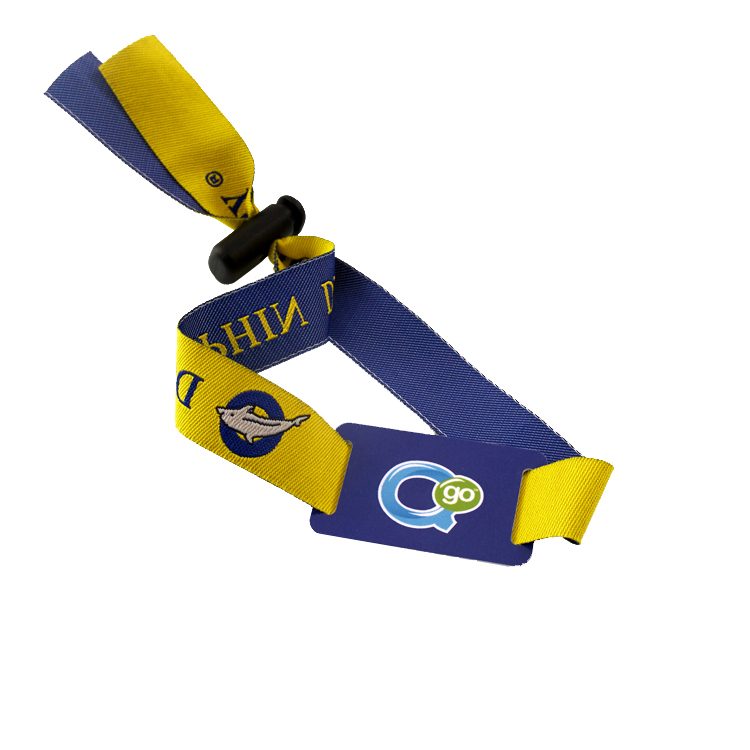
Woven strap with separate tag and sliderThe strap, slotted RFID tag and sliding fastener are visibly separate parts. The photograph does not label a chip or tag dimensions.
Published product specifications
Start with the strap and tag dimensions.
The supplier lists WB505 with a 350 × 15 mm strap. Its event-format reference uses a 35 × 25 mm PVC tag. The tag passes over the strap through two slots; the separate slider adjusts the band.
Flat length is not wrist circumference. The tails and fastening allowance use part of the strap length. Match the closed fit to the wearer’s wrist measurement.
Reference family
WB505 cloth wristband
Strap size
350 × 15 mm laid-flat reference; custom dimensions are listed as an option
Materials
Polyester strap with a separate PVC RFID tag
PVC tag reference
35 × 25 mm in the event-wristband listing; tag outline is selected separately from the strap
Artwork
Woven design: up to 8 yarn colors. Printed design: heat-sublimation graphics
Closure options
One-way plastic slider or reusable round bead
RFID options
125 kHz LF or 13.56 MHz HF; the installed chip and reader protocol are selected together
Packing reference
100 pieces per bag; 2,000 pieces per carton in the WB505 listing
The published WB505 fabric format uses a 350 × 15 mm strap. Choose the artwork method and closure below; these are configuration references, with the finished chip, tag outline and print layout identified on the order.
A removable configuration for repeat wear. It does not have the one-way closure of the event-issue versions.
The one-way slider and reusable bead are separate closure choices. A sample removal check establishes how the chosen band behaves when pulled, cut or refitted; ticket cancellation remains a software function.
Artwork and identification
Use the fabric for branding and the tag for readable detail.
Choose the artwork method before preparing the production file. The strap and PVC face have different usable areas, and the fabric can move or fold during wear.
Printed fabric and a QR tag face
The tag face provides a flat area for a QR code. Printed artwork and the RFID credential can reference the same ticket record.
Woven artwork
The supplier lists up to 8 yarn colors. Letters and shapes are formed by the yarn pattern, producing visible textile texture. Favor clear lettering and bold motifs over tiny text.
Heat-sublimation artwork
Printing adds multicolor artwork to the fabric surface. This route accommodates gradients and detailed graphics; approve the colors and orientation on the actual strap.
PVC tag personalization
The supplier lists logo printing, laser-marked UID numbers, barcodes and an optional epoxy layer. Keep a scannable code inside the tag’s safe area and clear of the strap slots.
Give each ticket an explicit data record.
A useful enrollment file separates the printed ticket number, the chip UID returned by the reader, and the event-system record. Add any encoded NFC content as its own field. The printed QR and RFID identifier can point to the same record without being the same value.
Ultralight EV1, Ultralight C and NTAG are different choices.
These families appear in the supplier’s chip options. Their memory and authentication differ even when the wristband looks identical. The values below describe the IC, not a chip identified from a product photograph.
Fabric wristband RFID chips, user memory and authentication comparison
Chip & interface
Memory & protection
Application fit
NTAG213 / NTAG215 / NTAG21613.56 MHz · ISO/IEC 14443 A · NFC Type 2
Reader distance needs a finished-band test. The supplier’s event example lists 2–5 cm, with another WB505 listing giving a reader-dependent 2–10 cm range. Neither establishes a fixed distance for every chip or a long-range gate system. Check the selected antenna and chip while the band is worn.
Technical documents
Share a specific wristband brief.
The reference brings together published dimensions, artwork and closure options, chip memory and source links.
Take your selected configuration into the inquiry.
Choose a finish and closure, then add quantities, artwork, chip or reader details, event date and destination on the next page.
Sample charges, MOQ, pricing and schedule are stated for the selected assembly. Include the event platform’s required chip and data format when encoding is needed.
Is a 350 mm fabric wristband suitable for a 350 mm wrist?
The 350 mm measurement is the published flat strap length. Part of the strap forms the two tails passing through the slider, so it is not the usable wrist circumference. The selected lock, tag and tail allowance determine the closed fit. Use actual wrist measurements when choosing sizes.
Are MIFARE Ultralight EV1 and Ultralight C the same chip?
No. Ultralight EV1 has 48 or 128 bytes of user memory, depending on the variant, and 32-bit password protection. Ultralight C has 144 bytes of user data memory and 3DES authentication. They share the 13.56 MHz ISO/IEC 14443 A interface, but the memory layout, commands and authentication workflow differ.
Can the QR code and NFC chip open the same ticket record?
Yes, when the event system maps both identifiers to that record. Keep the printed ticket or QR value, chip UID and any encoded NFC content as separate fields in the enrollment file. For NTAG213/215/216, the UID is manufacturer-programmed; sequential ticket numbers are a separate field. QR plus NFC does not by itself create two-factor authentication.
Does a one-way slider turn the band into a cashless payment system?
No. The slider controls physical removal. Cashless use needs a compatible chip, readers, account software and the operator’s transaction rules. Specify the exact chip and personalization required by the selected platform; a wristband photo or matching frequency cannot establish platform compatibility.