Silicone vs Fabric RFID Wristbands: Which Should You Order?
The two flagship wristband materials solve different problems. Silicone is a waterproof season ticket you reuse for years; fabric is a keepsake that stays on all festival. Cost-per-wear math, branding, closures and a decision checklist.
Quick Answer
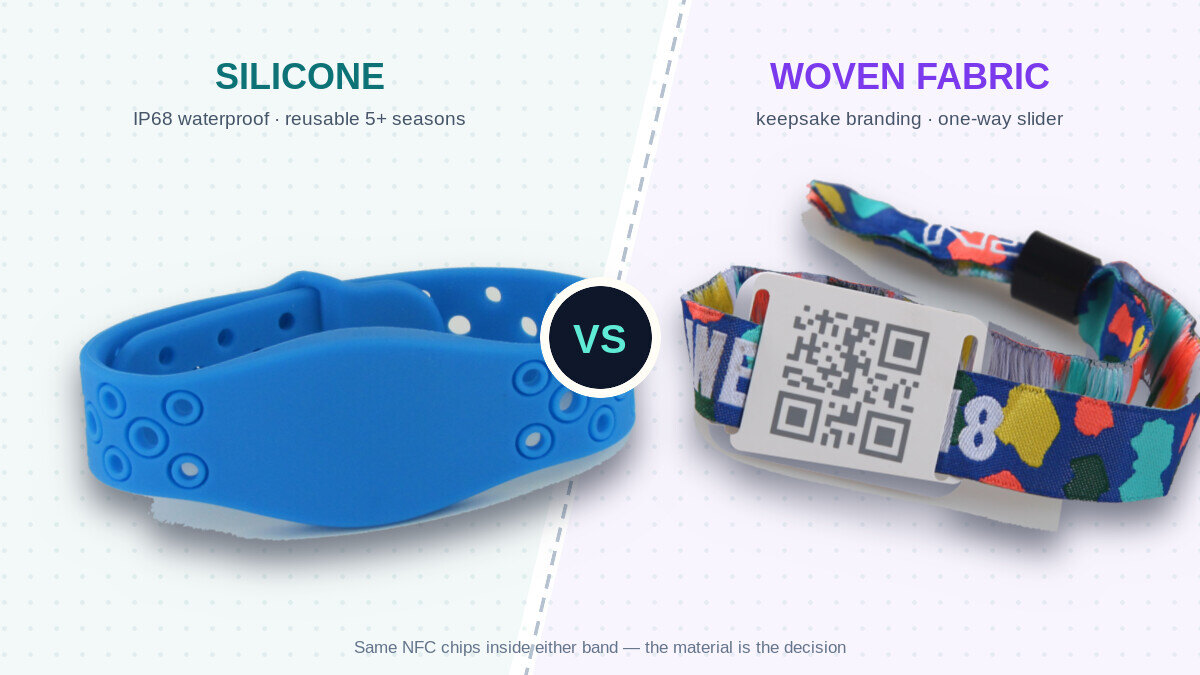
Choose silicone when the band must survive water or be reused — IP68 waterproof, wipes clean, lasts 5+ years, $0.85–$1.30 per piece at 500 pcs FOB Shenzhen. Choose woven fabric when a multi-day festival wants keepsake branding — full-colour woven art with a one-way slider that stays on all weekend. The chips inside (NTAG213/215, MIFARE Classic, DESFire) are identical either way.
This is the most common either/or in event wristband sourcing, and the good news is that it is not a technology decision at all. Both bands carry the same HF 13.56 MHz chips, read on the same gates, and pair with the same cashless backends. What you are actually choosing is a lifespan and a texture — a rubber season ticket versus a woven souvenir.
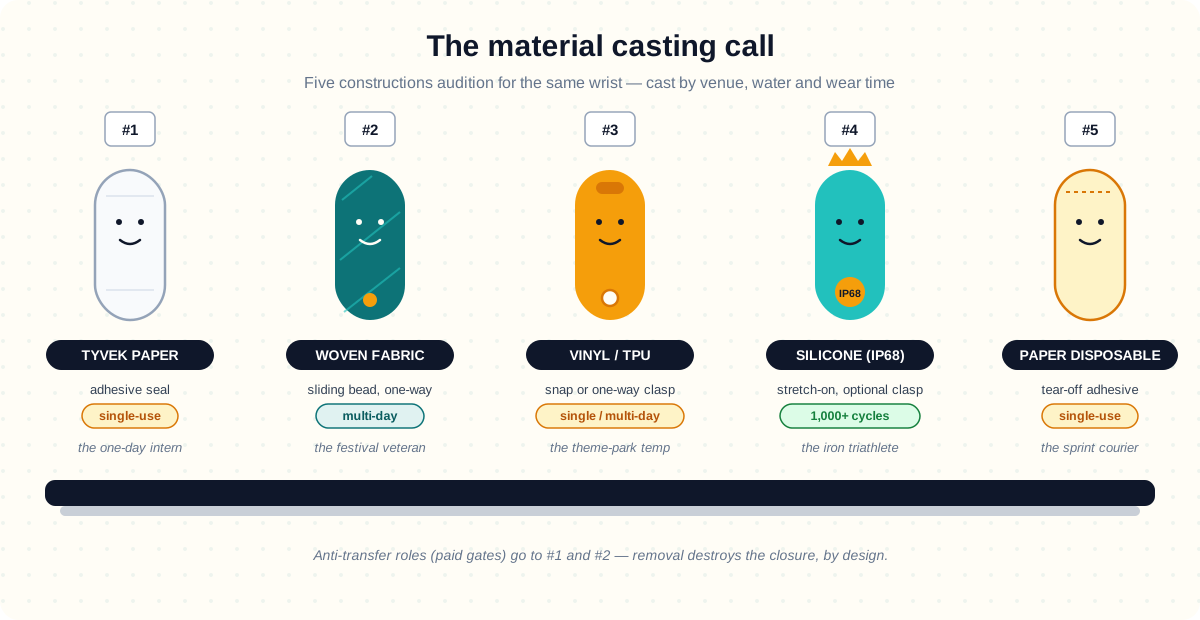
Head-to-head comparison
| Factor | Silicone | Woven fabric |
|---|---|---|
| Water | IP68 — pools, slides, ocean, sunscreen | Splash-proof; the chip module survives, the band stays damp |
| Lifespan | 5+ years, re-encodable across seasons | One event — the one-way slider is the point |
| Branding | Silkscreen, deboss / emboss, Pantone match | Full-colour woven or printed satin art — the premium look |
| Closure | Fixed ring (Ø45–72 mm) or adjustable snap | One-way slider — anti-transfer by design |
| Comfort | Smooth, hypoallergenic, food-grade silicone | Soft textile — most comfortable in summer heat |
| Hygiene | Wipes / sanitizes clean between wearers | Single-wearer by nature |
| Price at 500 pcs | $0.85–$1.30 (NTAG, FOB Shenzhen) | Quoted by volume and art complexity — 24 h quote |
| Chips | Identical: NTAG213 / 215 / 216, MIFARE Classic 1K / 4K, DESFire EV1–EV3, plus LF options | |
When silicone wins
- Water is involved. Waterparks, pools, beach resorts, swim schools — IP68 sealed per IEC 60529, tested against chlorine, saltwater and sunscreen.
- The band comes back. Gym memberships, season passes, staff credentials, recurring venue programs: collect, sanitize, re-encode, reissue. After a handful of reuses the cost per wear undercuts every disposable format.
- Skin contact rules apply. Food-grade silicone (FDA 21 CFR 177.2600, EU 1935/2004) for all-day wear across adult and child sizes.
When fabric wins
- The band is merchandise. Full-colour woven art turns the credential into the festival souvenir people keep wearing — free brand impressions for years.
- Multi-day, no-transfer entry. The one-way slider cinches tight and does not come off without scissors, which is exactly the anti-pass-back property a 3-day pass needs.
- Summer heat. Textile breathes better than rubber over a sweaty long weekend.
The cost-per-wear math
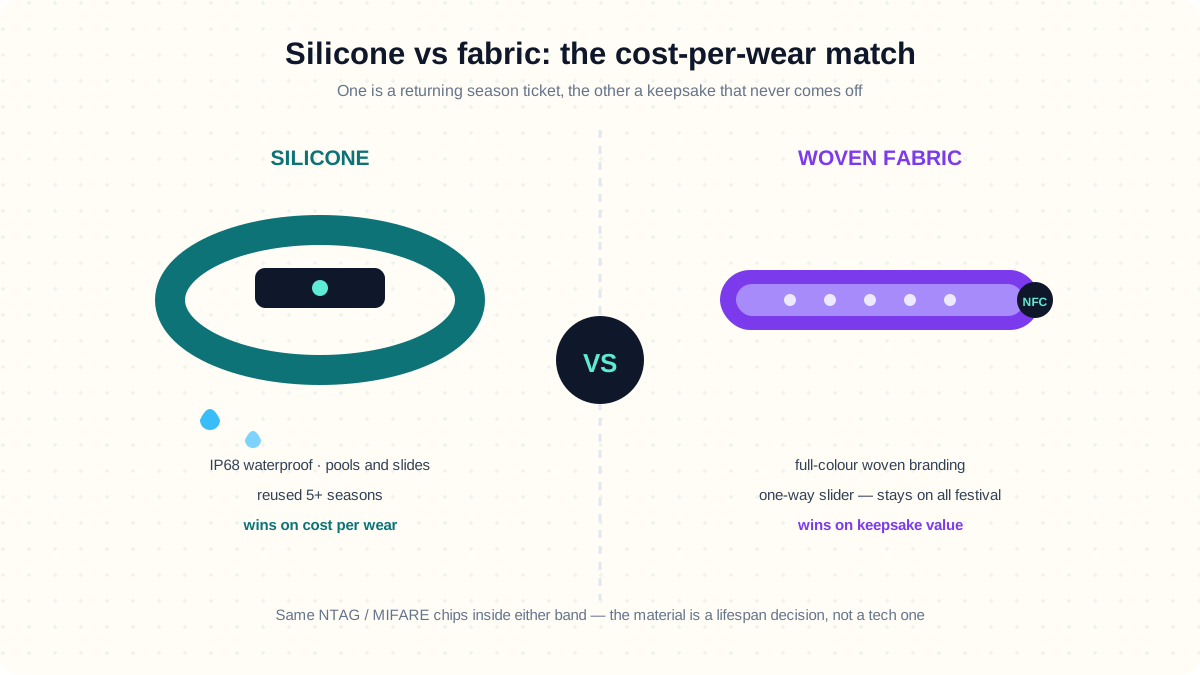
Sticker price and real price diverge the moment a band gets reused. A silicone band at roughly $1.00 that cycles through ten visits costs about $0.10 per wear, plus a sanitizing step.
A fabric band is single-assignment by design — its price is its cost per wear, and the marketing afterlife on the attendee's wrist is the bonus you are actually buying. Neither answer is wrong; they are just different budgets.
Full volume-tier tables live in the event wristband buyer's guide and the RFID pricing guide.
The hybrid strategy most large events land on
General admission gets woven fabric (keepsake, anti-transfer); staff, vendors and VIP get silicone (reusable, wipeable, easy to spot at a glance). Because both use the same chip families, one reader fleet and one backend serve both populations — you are splitting the material budget, not the architecture.
The split also simplifies teardown: fabric bands leave on wrists as souvenirs, while the silicone population is collected, sanitized and boxed for the next event — two disposal stories, zero extra infrastructure.
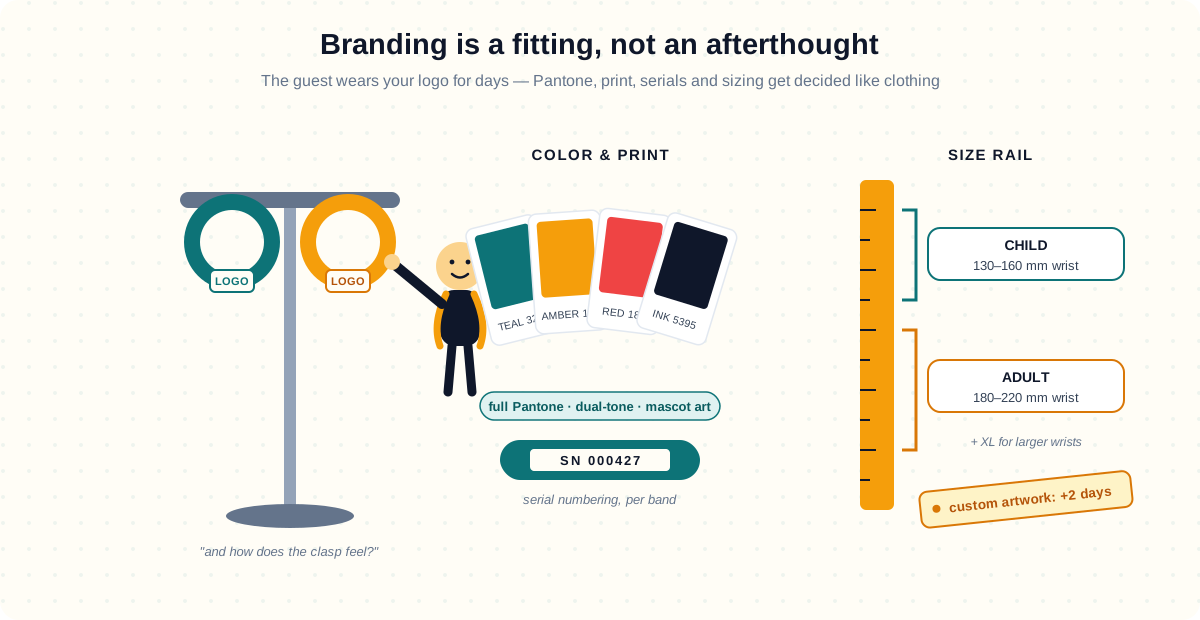
Sizing, closures and fit
Fit matters more than most first-time buyers expect, because a band that slides off a child’s wrist at the wave pool is a lost credential, not a comfort complaint.
Silicone comes in two architectures. Fixed closed rings run Ø45–72 mm inner diameter — simple, nothing to fiddle with, but you must stock 2–3 sizes to cover adults and children. Adjustable versions use a snap or buckle strap (typically 210 mm adult / 165 mm child length) that fits everyone from one SKU at the cost of a removable closure.
Woven fabric is one-size by construction: a 15 mm-wide textile strap threaded through a one-way plastic or metal slider. The wearer (or gate staff) cinches it snug once; it will not loosen without cutting the band. That is the anti-transfer property multi-day passes rely on — and the reason fabric bands are cut off, not collected, at teardown.
One practical fit note for both materials: the chip module reads best when the reader can get within a few centimetres of it, so oversized bands that rotate freely around the wrist slow down gate lines. Snug is faster.
Choosing the chip inside the band
The material decision and the chip decision are independent — every chip below ships in both silicone and fabric. Match the chip to the system, not the band:
- NTAG213 / 215 / 216 — the event default. NFC Forum Type 2 tags that both iPhone and Android can read without an app; ideal for entry scanning, tap-to-URL engagement and light loyalty programs. Memory (144 / 504 / 888 bytes) is the only difference that matters at ordering time.
- MIFARE Classic 1K / 4K — the legacy-fleet choice. If the venue’s existing readers and access software already speak Classic, staying on it avoids re-keying the whole installation. Its Crypto-1 cipher is dated, so keep it away from stored value.
- MIFARE DESFire EV2 / EV3 — the moment real money loads onto the band for cashless payment, step up to AES-128 mutual authentication. Costs a multiple of NTAG per chip; buys you a credential that resists cloning.
- LF 125 kHz (TK4100, EM4200) — only when an older LF reader fleet is already installed and replacing it is off the table.
Full protocol and security detail lives in the chip comparison guide; if you are weighing Classic against DESFire specifically, see MIFARE Classic vs DESFire. Always confirm the final chip with your access-control or cashless vendor before artwork approval — the reader fleet constrains the choice, not the band.
Durability and skin-contact compliance
Both materials spend days against skin in sun, sweat and sanitizer, so material documentation belongs in the purchase file, not an afterthought.
Silicone: food-grade silicone rubber formulated to FDA 21 CFR 177.2600 and EU Regulation 1935/2004 food-contact requirements, hypoallergenic and latex-free, and stable across roughly -40 °C to +90 °C wear conditions.
It shrugs off chlorine, saltwater, sunscreen and UV over a multi-year service life. The IP68 sealing claim traces to the IEC 60529 ingress-protection standard — ask for the test basis if your program audits claims.
Woven fabric: polyester yarn with a sealed chip module. The textile itself tolerates rain and daily wear for the length of a festival; it is not built for years of laundering.
For programs with formal skin-contact requirements — children’s events, healthcare — request the material compliance documentation at quotation time rather than after delivery: RoHS / REACH declarations for the module and, where the program requires it, skin-contact test reports for the textile.
Ordering: MOQ, lead time and artwork
Commercial terms are identical for both materials. Custom orders start at 500 pieces; production runs 7–15 business days after artwork approval, plus 2–5 days express freight. Free stock samples are prepared in 1 business day (buyer covers $25–60 courier freight, refunded against the first production order over $500) — details on the sample policy page.
Artwork: vector AI or PDF at 300 dpi. For silicone, supply Pantone references for the band colour and one-colour art for silkscreen or deboss. For fabric, full-colour art is woven or printed edge-to-edge — fine text below ~4 pt weaves poorly, so keep sponsor logos chunky.
Both formats support sequential numbering and printed UID for on-site troubleshooting. Pre-encoding at the factory, paired with a CSV UID export file, turns gate-side account pairing from a manual chore into a bulk import.
60-second decision checklist
- Will bands touch water beyond rain? → silicone
- Will the same band be reused across visits or seasons? → silicone
- Is the band part of the merch / brand experience? → fabric
- Multi-day event, one wearer, no transfers? → fabric
- Mixed populations (GA + staff + VIP)? → hybrid, same chip family throughout
Still split? Order both as samples — they are free, prepared in 1 business day, and a band on a real wrist settles arguments faster than any comparison table. Product detail: silicone wristband · fabric woven wristband · full range on the wristbands category page.
Sources
- IEC 60529 — Degrees of protection provided by enclosures (IP Code). iec.ch
- FDA 21 CFR 177.2600 — Rubber articles intended for repeated food-contact use. ecfr.gov
- EU Regulation (EC) No 1935/2004 — Materials and articles intended to come into contact with food. eur-lex.europa.eu
- NXP Semiconductors — NTAG213/215/216 NFC Forum Type 2 tag family. nxp.com
- NFC Forum — tag type technical specifications. nfc-forum.org
Need help turning this guidance into a product shortlist?
Use this next step when the article has narrowed the direction and you now need help choosing chips, formats, samples or the closest product family.
Comparison Pages
Compare the closest alternatives before you request samples
Open one of these if the article clarified the topic but the team still needs a cleaner format, chip or frequency decision.
Quick FAQ
Questions buyers often ask after reading this guide
Which is cheaper: silicone or fabric RFID wristbands?
On sticker price at festival volumes the two sit in a similar band, with silicone at $0.85-1.30 per piece at 500 pieces FOB Shenzhen. The real divergence is cost per wear: a roughly $1.00 silicone band reused across ten visits costs about $0.10 per wear, while a woven fabric band is single-assignment by design - its price is its cost per wear, offset by the keepsake branding value on the attendee wrist afterwards.
Are fabric RFID wristbands waterproof?
Fabric wristbands are splash-proof: the sealed chip module survives rain and handwashing, but the woven textile band itself absorbs water and stays damp. For pools, waterparks, beach resorts or any program with deliberate water exposure, silicone wristbands with IP68 sealing per IEC 60529 are the correct choice - they are tested against chlorine, saltwater and sunscreen exposure.
Do silicone and fabric wristbands use the same RFID chips?
Yes. Both materials carry the same chip families - NTAG213/215/216 for NFC tap, MIFARE Classic 1K/4K for legacy access systems, MIFARE DESFire EV1/EV2/EV3 for AES-secured cashless payment, plus LF options for older reader fleets. The material is a lifespan and branding decision, not a technology decision, which is why hybrid deployments (fabric for general admission, silicone for staff and VIP) run on a single reader fleet and backend.
What branding options do silicone and fabric wristbands support?
Silicone bands take silkscreen printing, debossed or embossed logos and custom Pantone color matching. Fabric bands take full-colour woven art or printed satin - the premium keepsake look festivals favor. Both formats support sequential numbering and UID laser engraving for on-site troubleshooting. Sizing covers adults (210 mm) and children (165 mm), with fixed silicone rings from 45-72 mm inner diameter plus adjustable strap versions.
Can silicone RFID wristbands be re-encoded and reused?
Yes - that is their core economic advantage. NTAG user memory is rewritable unless deliberately locked, and MIFARE sector data can be rewritten by any system holding the keys, so a returned silicone band can be sanitized, re-encoded and reissued to a new member or guest. The chip UID itself is factory-fixed, so systems that bind accounts to UID simply remap the UID to the next account. Gyms and season-pass venues typically cycle the same band for multiple years.
Can smartphones read fabric RFID wristbands?
If the band carries an NTAG chip, yes - NTAG213/215/216 are NFC Forum Type 2 tags, so NFC-enabled Android phones and iPhones (iOS 13+, background reading for NDEF-encoded tags) can read them without a special app. Bands built on MIFARE Classic or DESFire are detected by phones at the ISO 14443 level, but their protected data requires the matching keys and reader software. If smartphone tap engagement is part of the plan, specify NTAG at ordering time.
What is the MOQ and lead time for silicone or fabric RFID wristbands?
Custom orders for both materials start at 500 pieces. Production runs 7-15 business days after artwork approval, with 2-5 days DHL/FedEx express freight on top. Free stock samples are prepared in 1 business day - the buyer covers courier freight ($25-60), refunded against the first production order over $500 - so most buyers have a band on a real wrist within a week of asking.
How do events prevent wristbands being transferred between guests?
Fabric bands solve it mechanically: the one-way slider cinches tight and only comes off with scissors, so a multi-day pass cannot be handed over the fence. Silicone bands rely on fit (correctly sized fixed rings are hard to remove discreetly) plus system-side binding - the chip UID is tied to a named account or photo at first entry, so a transferred band fails the identity check at the gate even though it still reads.
Author
Wei Chen
RFID Applications Engineer at RFIDAK
Wei Chen is an RFID applications engineer at RFIDAK with 10+ years in RFID card and tag manufacturing in Shenzhen, focused on chip selection, laundry RFID durability testing and access-control compatibility.