RFID Wristbands for Events: 2026 Buyer's Guide
Festival and event RFID wristband procurement in one pass. Tyvek vs fabric vs silicone, chip selection, real bulk price tiers, 500-pc MOQ, and a work-back order calendar that gets bands on wrists before doors open.
Quick Answer
RFIDAK supplies event RFID wristbands from 500 pcs MOQ, FOB Shenzhen: single-use Tyvek / paper NFC bands at $0.30–$0.80 per piece, reusable IP68 silicone bands at $0.85–$1.30 per piece at 500 pcs (falling to $0.28–$0.42 at 1M), with free samples prepared in 1 business day and 7–15 business day production after artwork approval.
Every event wristband order is really three purchases wearing one strap: an entry credential that has to beat the box-office queue, a payment token that has to survive beer and sunscreen, and a piece of merchandise attendees will photograph, argue about, and wear to brunch for years. Buy for only one of the three and the other two will file complaints.
This guide walks the full procurement decision in order — material, chip, price, calendar — using the numbers we publish on our own product pages rather than the "contact us to find out" school of pricing. If you want the broader application view first (hotels, resorts, theme parks), start with our RFID wristband applications guide, then come back here to spend money wisely.
Step 1: Pick the band material (this is a lifespan decision)
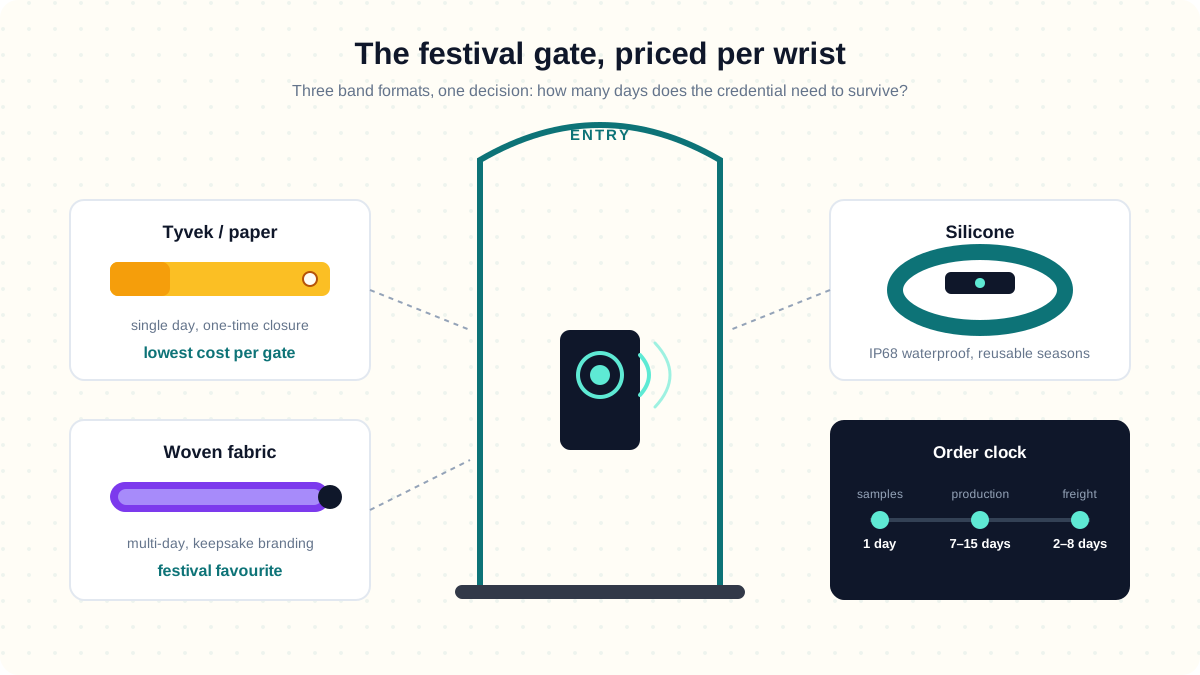
Material choice is not aesthetics — it is a question of how many days the credential must survive and whether it goes in water. Four materials cover essentially every event use case:
| Material | Typical unit cost | Lifespan | Best for |
|---|---|---|---|
| Tyvek / paper | $0.30–$0.80 | Single day | One-day events, tamper-evident adhesive closure |
| PVC / vinyl | Low, quoted by volume | 1–3 days | Waterparks day passes, snap-lock closure |
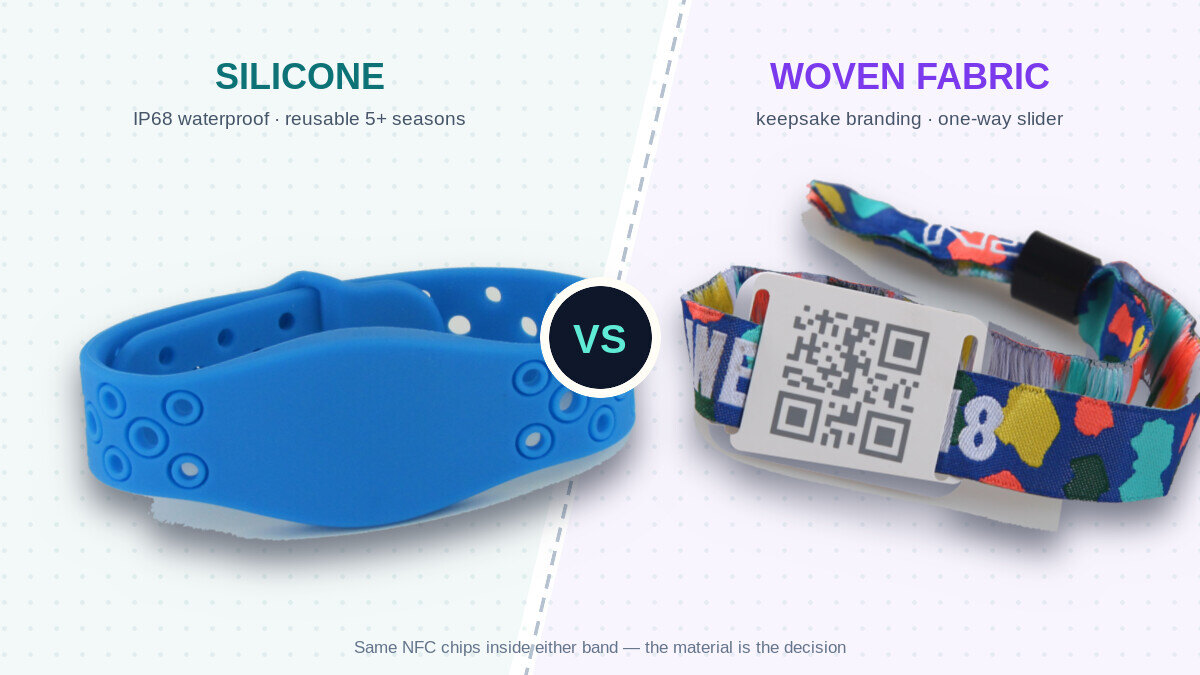
| Woven fabric | Mid, quoted by volume | Multi-day festival | Keepsake branding, one-way slider stays on all weekend |
| Silicone | $0.85–$1.30 at 500 pcs | 5+ years, reusable | Recurring events, VIP / staff, pools — IP68 |
The shortcut: single-day gate = Tyvek, multi-day festival = fabric, anything wet or recurring = silicone. If you are torn between the two biggest categories, we wrote a dedicated head-to-head: silicone vs fabric RFID wristbands.
Step 2: Pick the chip (match the readers, not the brochure)
The chip decides what the wristband can do; the reader fleet decides which chip you are allowed to want. Confirm with your access-control or cashless vendor before locking anything — the most expensive wristband is the one that arrives incompatible.
| Chip | Use it when | Notes |
|---|---|---|
| NTAG213 | Entry scan + smartphone tap engagement | The event default — cheap, universal, iPhone / Android readable |
| NTAG215 / 216 | Larger NDEF payloads, richer tap content | More user memory for links, vCards, campaign data |
| MIFARE Classic 1K | Venue already runs Classic-based access | Legacy compatibility play, not a security play |
| MIFARE DESFire EV3 | Cashless payment wallets | AES-128 mutual authentication — see Classic vs DESFire |
| UHF (e.g. Monza R6) | Crowd-flow analytics at 1–3 m range | Complements, not replaces, the HF tap chip |
Deeper chip homework lives in our RFID chip comparison — but for most events the honest answer is NTAG213 for the gate and DESFire EV3 the moment real money moves over the band.
Festival wristband bulk pricing: what volume actually does
Here is the silicone tier table straight from our silicone wristband product page (base config: NTAG 13.56 MHz chip, debossed or silkscreen logo, FOB Shenzhen):
| Quantity | Unit price (USD) | Note |
|---|---|---|
| 500 pcs | $0.85–$1.30 | Silicone MOQ |
| 10,000 pcs | $0.55–$0.85 | Typical mid-size festival volume |
| 100,000 pcs | $0.38–$0.55 | Multi-event season contracts |
| 1,000,000 pcs | $0.28–$0.42 | Per-unit cost down 60–75% vs MOQ |
Single-use Tyvek / paper NFC bands run $0.30–$0.80 depending on volume and print. What moves your quote inside those ranges, in descending order of impact:
- Chip family — DESFire EV3 costs multiples of NTAG213; UHF sits between.
- Decoration — debossed logo is cheapest, full-colour multi-zone silkscreen and Pantone matching add steps.
- Encoding and numbering — pre-encoded chip data, sequential UID printing, QR pairing.
- Packaging — bulk bags are free-ish; individually polybagged-and-labelled is not.
Cross-check against the full RFID pricing guide if wristbands are only one line of a bigger credential order. And if you are buying for a US event specifically, our US events wristband page covers regional compliance and freight in more detail.
MOQ and the order calendar: working backwards from doors
Custom wristband orders start at 500 pieces across silicone, fabric and disposable styles. Fully custom band molds — a new shape rather than a new print — typically need 2,000–5,000 pieces to amortize tooling (the arithmetic behind that is in the RFID MOQ guide).
The calendar, working backwards from event day:
| When | What happens | Time it takes |
|---|---|---|
| T−6 to 8 weeks | Request samples, confirm chip with reader vendor | Samples free, prepared in 1 business day, DHL / FedEx 2–5 days |
| T−5 weeks | Lock artwork, approve PDF proof | Quote within 24 h; production starts only after your sign-off |
| T−4 weeks | Production + encoding + QC | 7–15 business days; rush available on request |
| T−1 to 2 weeks | Freight + customs + on-site distribution prep | Express 2–5 days; leave buffer for customs moods |
Full logistics detail — incoterms, air vs express, customs paperwork — is in the RFID lead time guide. The one-line version: order 6–8 weeks out and the calendar is comfortable; order at 3 weeks and everyone earns their rush fees.
Cashless and entry: how the band plugs into the system
Most event deployments are closed-loop: the chip UID (or a token written to the chip) maps to a guest account in the cashless vendor's backend. Attendees load funds online or at top-up stations; vendors tap to charge; settlement happens in the backend, not on the chip. Per-cap spending lifts 15–30% versus cash-only operations once tap friction disappears.
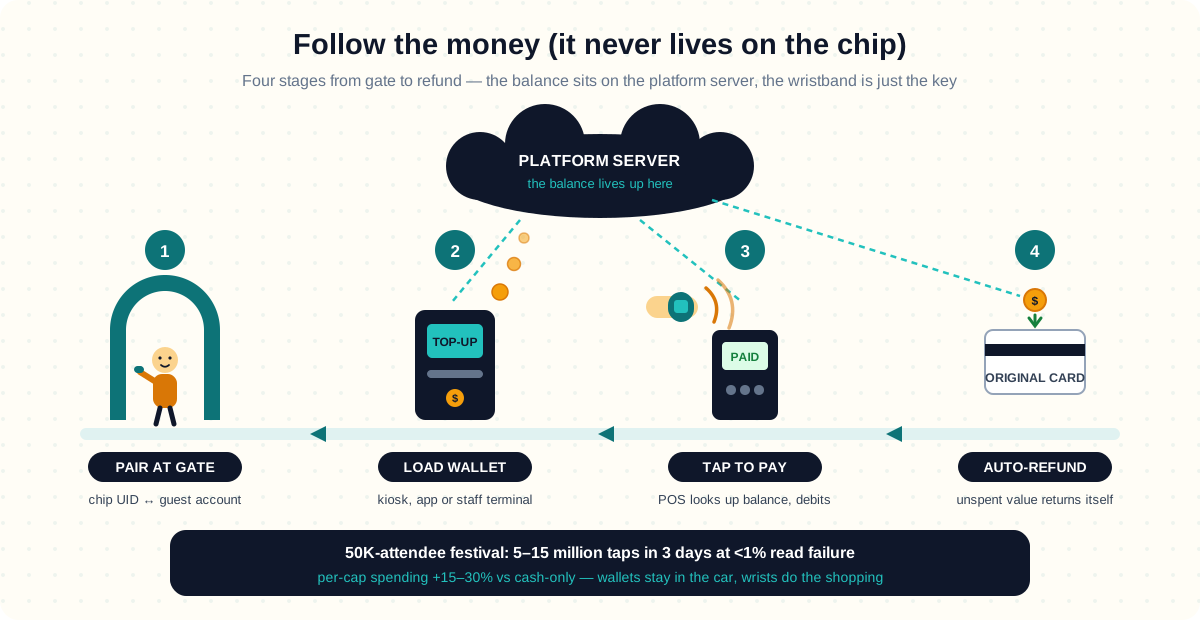
Decisions to make before ordering:
- UID-only vs pre-encoded: UID pairing is simplest; we can also pre-encode chip data or NDEF URLs before shipment so bands arrive event-ready.
- Security tier: real money on the band means DESFire EV3 and key management, not Classic.
- Numbering: sequential printed IDs plus UID export files (CSV) make on-site troubleshooting humane.
Our event NFC / RFID solution hub maps the full architecture — entry flow, top-up, vendor POS — if you are building the whole stack rather than just buying bands.
Branding that survives the weekend
Available decoration by material: woven logos and full-colour printed satin for fabric bands; silkscreen, debossed and embossed marks with custom Pantone matching for silicone; full-colour print for Tyvek and PVC. All formats support sequential numbering and UID laser engraving. Sizing covers adults (210 mm) and children (165 mm), with fixed silicone rings from Ø45–72 mm plus adjustable straps.
One planning note from the trenches: order 3–5% overage. Gate teams lose bands, VIP lists grow on Friday afternoon, and a carton of spares is much cheaper than an emergency air shipment.
Five ordering mistakes we see every season
- Locking the chip before talking to the reader vendor. Compatibility first, unit price second.
- Ordering exact headcount. No overage means no mercy on show day.
- Skipping the sample step. A free sample plus 2–5 days of DHL beats discovering strap sizing issues in week zero.
- Leaving encoding for on-site. Pre-encoding at the factory turns a night of volunteer work into a line item.
- Treating freight as instant. Customs does not care about your gate time.
On-site operations: distribution, activation and failure handling
The order does not end at the loading dock — plan the last hundred metres too. Packaging format decides how fast your gate teams work: bands can ship bulk-cartoned (cheapest), individually bagged, or pre-sorted and labeled by tier (GA / VIP / staff / vendor), and pre-sorting at the factory costs far less than volunteers re-sorting 20,000 bands the night before doors. If bands mail out with tickets, specify individual bagging with the printed ID visible.
At the gate, the failure playbook matters more than the failure rate. Every deployment should stage a carton of blank spares at each entrance, the printed sequential ID + UID export CSV, and one supervisor phone that can query the cashless backend directly.
With those three staged, staff can look up and re-issue any guest whose band will not read in under a minute. A band failure with a 30-second recovery script is a shrug; the same failure with no script is a queue.
Accessibility is the quiet requirement: small child wrists, prosthetics, sensory sensitivities and medical devices all show up at scale. Stock the child size (165 mm), and keep a handful of the same chip in card or lanyard format so nobody is turned away because a strap does not fit — same UID pairing, different carrier.
Next steps
The fastest path to a decision is physical: request free samples (prepared in 1 business day), tap them against your actual readers, then price your volume with the interactive estimator on the silicone wristband page. Browse all seven wristband styles on the RFID wristbands category page, or send your event date and headcount and we will reply with an exact quote within 24 hours.
Sources
- NFC Forum — tag type technical specifications (NTAG family = Type 2). nfc-forum.org
- NXP Semiconductors — NTAG213/215/216 and MIFARE DESFire product families. nxp.com
- ISO/IEC 14443 — proximity card air interface underlying HF event credentials. iso.org
- IEC 60529 — IP ingress-protection ratings referenced for waterproof silicone bands. iec.ch
- Impinj — UHF RAIN RFID tag chips used for crowd-flow analytics add-ons. impinj.com
Need help turning this guidance into a product shortlist?
Use this next step when the article has narrowed the direction and you now need help choosing chips, formats, samples or the closest product family.
Comparison Pages
Compare the closest alternatives before you request samples
Open one of these if the article clarified the topic but the team still needs a cleaner format, chip or frequency decision.
Quick FAQ
Questions buyers often ask after reading this guide
How much do RFID wristbands for events cost in 2026?
Single-use Tyvek or paper NFC wristbands run $0.30-0.80 per piece depending on volume and print. Reusable silicone wristbands with an NTAG chip and debossed or silkscreen logo run $0.85-1.30 per piece at the 500-piece MOQ, falling to $0.55-0.85 at 10,000 pieces, $0.38-0.55 at 100,000 and $0.28-0.42 at 1 million, FOB Shenzhen. The biggest price movers inside those ranges are chip family (DESFire EV3 costs multiples of NTAG213), decoration complexity, pre-encoding and packaging format.
What is the minimum order quantity for custom event wristbands?
Custom RFID wristband orders start at 500 pieces across silicone, fabric woven and disposable styles, including custom colors and logo printing. Fully custom band molds - a new shape rather than a new print - typically require 2,000-5,000 pieces to amortize tooling. Free standard samples are prepared in 1 business day and ship via DHL or FedEx in 2-5 days, so most buyers validate fit and reader compatibility before committing to a production run.
How far in advance should I order wristbands for a festival?
Six to eight weeks before doors is comfortable: samples arrive in under a week (prepared in 1 business day plus 2-5 days DHL), artwork proof approval takes a few days, production runs 7-15 business days after sign-off, and express freight adds 2-5 days plus a customs buffer. Rush production is available, but ordering at three weeks out converts calm logistics into rush fees. Add 3-5% overage to headcount for lost bands and late list additions.
Which chip should festival wristbands use?
NTAG213 is the event default for entry scanning and smartphone tap engagement - inexpensive and readable by both iPhone and Android. Move to MIFARE DESFire EV3 with AES-128 mutual authentication the moment real money loads onto the band for cashless payment. UHF chips such as Monza R6 add 1-3 meter crowd-flow analytics but complement rather than replace the HF tap chip. Always confirm chip choice with the access-control or cashless vendor before ordering, because the reader fleet constrains the choice.
Can RFID wristbands run cashless payment without a mobile app?
Yes. Most event deployments are closed-loop: the chip UID or an encoded token maps to a guest account in the cashless backend, attendees load funds online or at top-up stations, and vendors charge with a sub-second tap. No app is required on the attendee side. Per-cap spending typically lifts 15-30% versus cash-only operations once tap friction disappears. Factory pre-encoding and CSV UID export files make on-site account pairing significantly faster.
How should event wristbands be packaged for on-site distribution?
Three formats: bulk cartons (cheapest, fine when one team bands everyone at one gate), individually bagged (needed when bands mail out with tickets), and factory pre-sorted by tier with labeled cartons for GA, VIP, staff and vendor populations. Factory pre-sorting costs far less than volunteers re-sorting thousands of bands the night before doors. Specify the format at ordering time, along with sequential printed IDs and a UID export CSV for gate-side troubleshooting.
What should the gate team do when a wristband fails to read?
Run a 30-second recovery script instead of debugging in the queue: look the guest up by the printed sequential ID in the UID export file, re-issue a blank spare band, and pair the new UID to their account. That requires three things staged in advance - a carton of spares at each entrance, the printed-ID-to-UID CSV, and one supervisor device that can query the cashless backend directly. Ordering 3-5% overage is what makes the spares carton possible.
What options exist for guests a standard wristband does not fit?
Stock the child size (165 mm strap) alongside the adult 210 mm, and keep a small reserve of the same chip in card or lanyard format for prosthetics, medical devices, or sensory sensitivities - the backend pairs a UID to an account regardless of the carrier, so a card credential works identically to a band at every gate and point of sale.
Author
Wei Chen
RFID Applications Engineer at RFIDAK
Wei Chen is an RFID applications engineer at RFIDAK with 10+ years in RFID card and tag manufacturing in Shenzhen, focused on chip selection, laundry RFID durability testing and access-control compatibility.