RFID MOQ Guide 2026: Minimum Order Quantity by Product Family
Plan RFID minimum orders using the confirmed card, tag and wristband terms, then validate the chip and finished design with samples before a production order.

RFIDAK's standard published minimums are 500 pieces for cards, 1,000 pieces for tags and labels, and 500 pieces for wristbands. Custom tooling generally starts at 2,000–5,000 pieces depending on tooling. Confirm the exact chip, construction and quantity in a current written quotation.
What MOQ means for an RFID order
Minimum order quantity is tied to a particular finished specification, not just to the RFID frequency. Chip sourcing, antenna design, molding, print setup, encoding and inspection can change the feasible batch. A stock item and a newly tooled custom shape may have different minimums even when they use the same chip.
RFIDAK's published product minimums
| Product family | Published MOQ | Confirm before order |
|---|---|---|
| Cards | 500 pieces | Chip article, card body, print and encoding |
| Tags and labels | 1,000 pieces | Inlay, dimensions, adhesive and printer format |
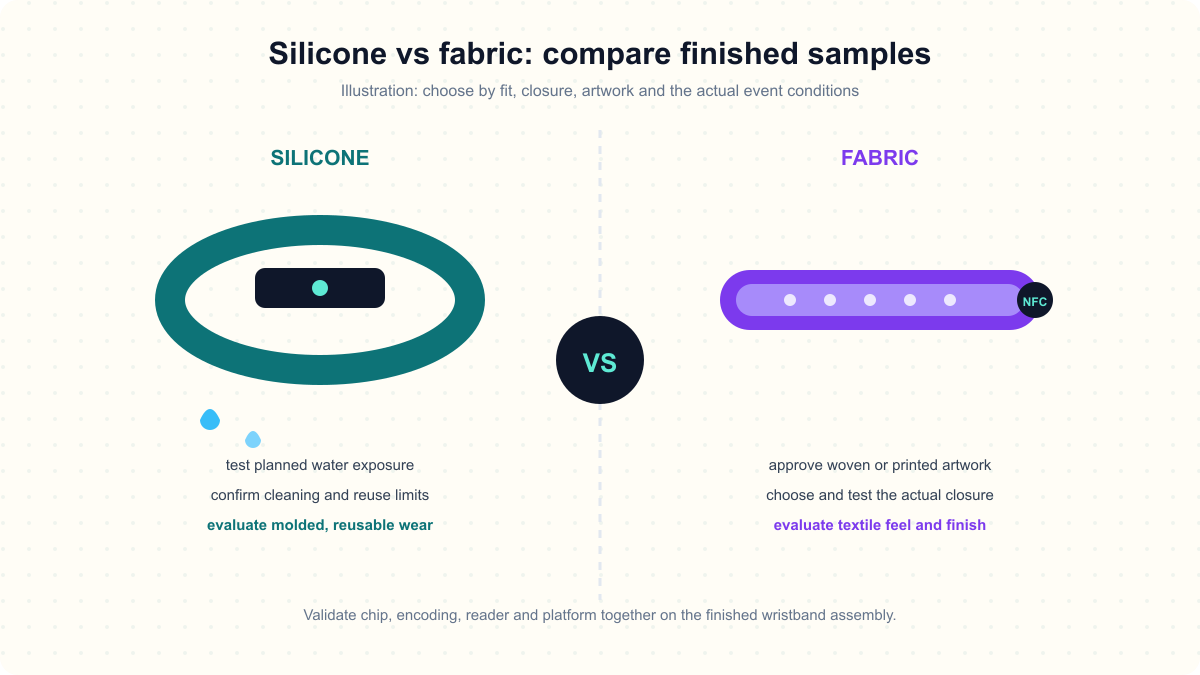
| Wristbands | 500 pieces | Material, closure, chip, artwork and sizing |
| Custom tooling | 2,000–5,000 pieces depending on tooling | Tooling ownership, approved drawing and sample |
These are RFIDAK terms from our sample and ordering policy. They are not an industry-wide price list or a promise that every chip is available at the same minimum.
Why a custom design can need a larger run
A new mold, antenna die or print setup adds fixed work before the first production unit. Ask the supplier to separate tooling, setup and per-unit prices. Request an approved pre-production sample and a clear rule for reuse of the tooling on repeat orders.
Validate below the production MOQ
Owner-confirmed RFIDAK policy includes up to 5 free stock samples, with buyer-paid express freight. B2B evaluation kits may be available in larger quantities by product family; confirm the kit, chip and test scope before treating it as a production quotation. Use the sample to check the installed reader, mounting surface, encoding and artwork.
For a pilot, ask whether a stock construction can be used while the final artwork or tooling is approved. Keep the pilot's acceptance criteria and the bulk purchase decision separate.
Compare the full order economics
At each quoted quantity, calculate finished-unit cost plus one-time setup, samples, inspection, encoding, freight and destination charges under the same delivery term. A lower unit price at a higher tier is useful only if the extra inventory, cash commitment and storage make sense for your program. No fixed discount percentage applies across chip families.
RFID MOQ FAQ
Can I order fewer than the published production MOQ?
Ask about stock samples or an evaluation kit first. A custom pilot or smaller production batch depends on the selected article and must be confirmed in writing.
Do I need a different MOQ for a new mold?
Custom tooling usually needs its own quantity and setup agreement. RFIDAK's published planning range is 2,000–5,000 pieces depending on tooling; confirm the finished drawing and commercial terms.
What should I send for an accurate quote?
Send the reader model, chip or protocol, product form, dimensions, mounting and exposure conditions, artwork, encoding scheme, quantity, destination and required arrival date. Request a current written quote after sample validation.
Need help turning this guidance into a product shortlist?
Use this next step when the article has narrowed the direction and you now need help choosing chips, formats, samples or the closest product family.
Quick FAQ
Questions buyers often ask after reading this guide
How can I reduce effective MOQ without changing supplier?
Ask whether standard materials, stock tooling, a shared chip specification or staged deliveries can reduce the first commitment. Multiple artworks, sizes or chip configurations can change setup and minimum quantities, so have the supplier confirm the exact quantity per design in writing.
What MOQ applies to samples versus production orders?
RFIDAK's published standard tags-and-labels MOQ baseline is 1,000 pieces. Confirm the exact chip, antenna, construction, print, encoding and quantity per design in a written quote. Free stock samples (up to 5 pieces) — buyer covers DHL/FedEx freight ($25–60), refunded 1:1 against the first production order over $500. Larger evaluation lots, custom samples, production timing and delivery are agreed separately for the selected configuration.
Can I order just 50 pieces of a custom RFID card?
RFIDAK's published standard card MOQ baseline is 500 pieces. Confirm the exact chip, card construction, printing, encoding and quantity per design in a written quote. Free stock samples (up to 5 pieces) — buyer covers DHL/FedEx freight ($25–60), refunded 1:1 against the first production order over $500. Larger evaluation lots, custom samples, production timing and delivery are agreed separately for the selected configuration.
Why does inlay MOQ start at 10,000 when card MOQ is 100?
Minimum quantities depend on the specific inlay, packaging, stock position and conversion process; there is no universal reel-size rule. Ask for an itemized quote for evaluation stock and for the finished card at the quantity needed.
Does MOQ change for repeat orders of the same SKU?
A repeat specification may reduce setup work, but a lower MOQ is not automatic. Request a written repeat-order quote with the current chip availability, quantity per release and any framework commitment.
Are there low-MOQ options for OEM hardware (RFID readers)?
Reader and OEM-board quantities depend on the exact model, firmware changes, certification scope and current stock. Ask for a model-specific sample and production quote, including the support and approval needed for any custom integration.
Are stock chips genuine NXP / Impinj?
For each proposed lot, ask for the exact manufacturer article number, procurement traceability and any available distributor or chip-maker documents. Test the received samples and agree acceptance evidence in the purchase order. A UID or TID readout alone does not prove an authorized supply chain.
What is the smallest realistic UHF apparel pilot?
Size the pilot from the garments, store or warehouse read points, variants and statistical acceptance criteria. Include representative sizes, fabrics, packaging and handling. Request current inlay and converted-label quotes rather than assuming a fixed pilot quantity or shared-buyer allocation.
Author
RFIDAK RFID Editorial Team
RFID supply editorial team
RFIDAK publishes practical RFID guides to help buyers compare chips, product formats, sampling plans and sourcing options before production.