How to Order RFID Cards from China: MOQ, Cost & Checklist
A practical seven-step sourcing guide with RFID card MOQ ranges, an RFQ checklist, sample approval, quality control, payment terms, shipping, and landed-cost planning. Written for first-time importers who want the timeline honest up front.
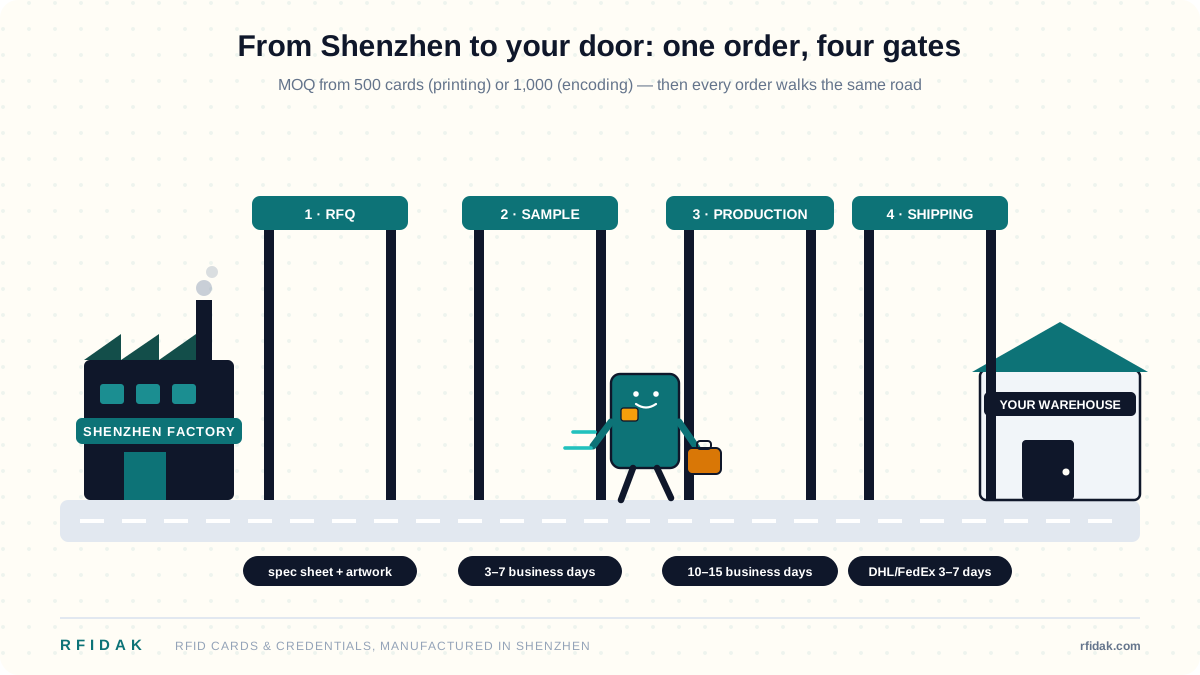
Quick Answer
To order RFID cards from China, follow seven steps: define the chip, material, artwork and encoding; qualify the manufacturer; approve physical samples; compare MOQ and total landed cost; agree the QC plan; choose shipping terms; and confirm payment milestones. Typical starting quantities are 100–200 blank cards, 100–500 digitally printed cards, or about 500 offset-printed cards. Secure encoding, special materials and custom tooling can require more. Allow roughly 7–10 weeks for a first order and confirm current price, production and freight in the written quote.
Need a quote you can compare line by line?
Send your chip, card material, artwork, encoding format, quantity and destination to request an itemized RFID card quote. If the chip is not confirmed, start with the sample and compatibility process before approving print production.
Why Source RFID Cards from China?
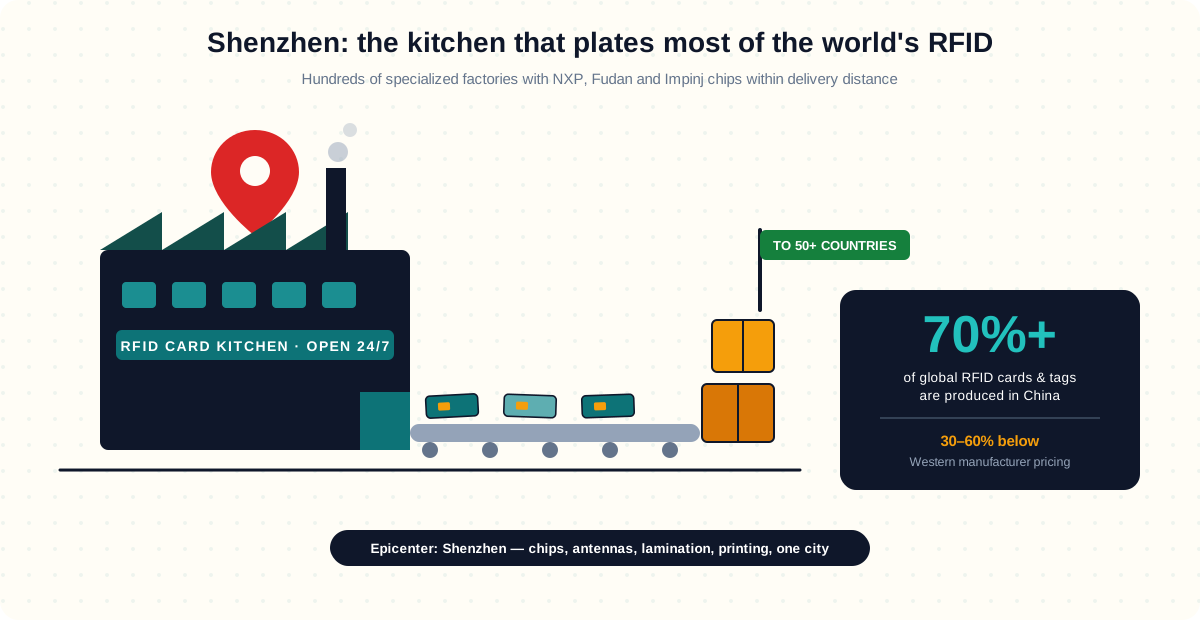
China has a mature RFID card manufacturing ecosystem, especially around Shenzhen, with established access to chip distribution, antenna conversion, card lamination, printing, encoding and export logistics. This concentration gives international buyers a broad choice of standard PVC cards, eco materials, security chips and finishing options from one supply base.
The commercial advantage depends on the specification and order size, not the country name alone. Compare suppliers on verified chip origin, sample performance, QC records, communication and total landed cost rather than relying on an unqualified percentage saving.
Step 1: Define Your RFID Card Specifications
Factories quote specs, not vibes. Before contacting manufacturers, prepare a clear specification sheet including:
Chip Selection
- LF (125kHz): EM4100, T5577, HID compatible
- HF (13.56MHz): Mifare Classic 1K/4K, Mifare DESFire EV2/EV3, NTAG213/215/216, Fudan FM08/FM11 — the MIFARE Classic vs DESFire comparison covers which security level your project needs
- UHF (860-960MHz): Alien H3, Impinj Monza, NXP UCODE
- Dual-Frequency: LF + HF or HF + UHF combination
Card Material & Size
- Standard PVC: Credit card size (85.5 x 54mm, 0.84mm thick), most common — browse custom PVC RFID cards
- PET/ABS: More durable alternatives for industrial use
- Eco-friendly: RFID wood cards, RFID paper cards, or recycled PVC — see the PVC vs paper card comparison
- Custom shapes: Die-cut to any shape, mini cards, or RFID keyfobs for access-control credentials
Printing & Finishing
- Full-color CMYK offset or digital printing
- Magnetic stripe (HiCo/LoCo), signature panel
- Embossed or flat numbering, UID printing
- Finishes: matte, glossy, frosted, metallic, soft-touch
- Security features: UV ink, hologram, microtext
Step 2: Choose a Reliable Manufacturer
Not all RFID card factories are equal — some are world-class plants, and some are a desk, a logo, and a cousin who knows a plant. Look for these indicators of a quality manufacturer:
- Certifications: ISO 9001 (quality management), ISO 14001 (environmental), ISO 45001 (occupational health & safety), plus product test reports (RoHS / REACH) with certificate numbers you can verify with the issuing body
- Experience: At least 5-10 years in RFID manufacturing
- Sample Policy: Willingness to provide free or low-cost samples before ordering
- Technical Support: English-speaking team that understands chip specifications
- Export Experience: Track record of shipping to your country
- Factory Audit: Verified supplier status on platforms like Alibaba, or direct factory audit
RFIDAK, located in Shenzhen, has been manufacturing RFID products since 2008, holds ISO 9001 and ISO 14001 certifications, and exports to 50+ countries. We offer free samples and dedicated English-speaking project managers for every order.
Step 3: Request Samples and Quotes
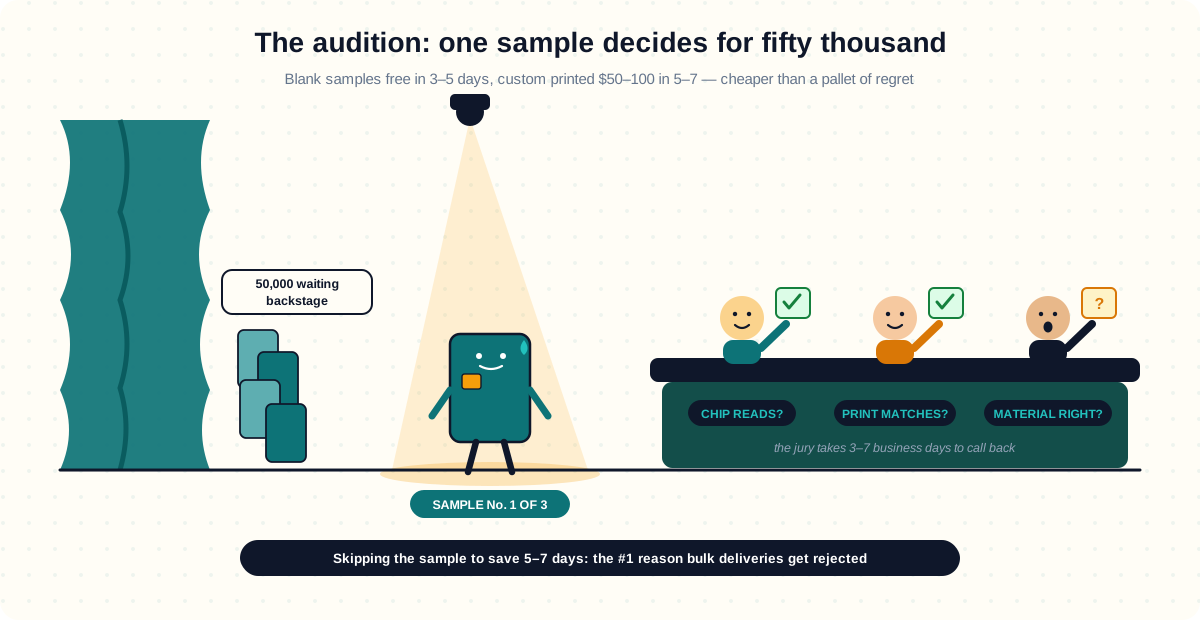
Always audition the card before hiring fifty thousand of it: test samples before placing a bulk order. A professional manufacturer should provide:
- Blank chip samples: Free (you pay shipping)
- Custom printed samples: 1-3 pieces with your artwork, usually $50-100 including design setup
- Sample timeline: 3-5 business days for blank samples, 5-7 days for custom printed
When quotes arrive, compare the total landed cost, not the headline number: card unit price, setup/tooling fees (if any), encoding/data writing fees, packaging, and shipping cost to your destination. The cheapest unit price with three surprise fees attached is not the cheapest quote.
Step 4: Understand MOQ and Pricing Tiers
MOQ changes with the print process, chip availability, personalization and material. Use the ranges below for RFQ planning, then ask the supplier to state the exact MOQ, sample quantity and price breakpoints in the quote.
| Order Type | Typical MOQ | Lead Time |
|---|---|---|
| Blank white cards | 200 pcs | 3-5 days |
| Custom printed (offset) | 500 pcs | 7-10 days |
| Custom printed (digital) | 100 pcs | 5-7 days |
| Special materials/shapes | 500-1,000 pcs | 10-15 days |
Request at least three quantity tiers so the quote exposes the real price curve. Common comparison points are 1K, 5K, 10K, 50K and 100K, but the useful breakpoints depend on chip allocation, print setup and encoding labor.
Step 5: Quality Control Process
Quality control is not a mood; it’s a checklist. Professional RFID manufacturers should implement these quality checks:
- Incoming Material Inspection: Verify chip specifications, antenna quality, PVC sheet consistency
- In-Process Testing: we read-test 100% of chips after lamination, plus print quality inspection
- Final QC: Card dimensions, print alignment, chip functionality, bending test
- Encoding Verification: where data encoding is required, we verify 100% of written data
Ask your manufacturer for their QC report format and request photos/videos of your production batch before shipment. A factory that documents its checks will happily show you; a factory that improvises will change the subject.
Step 6: Shipping and Logistics
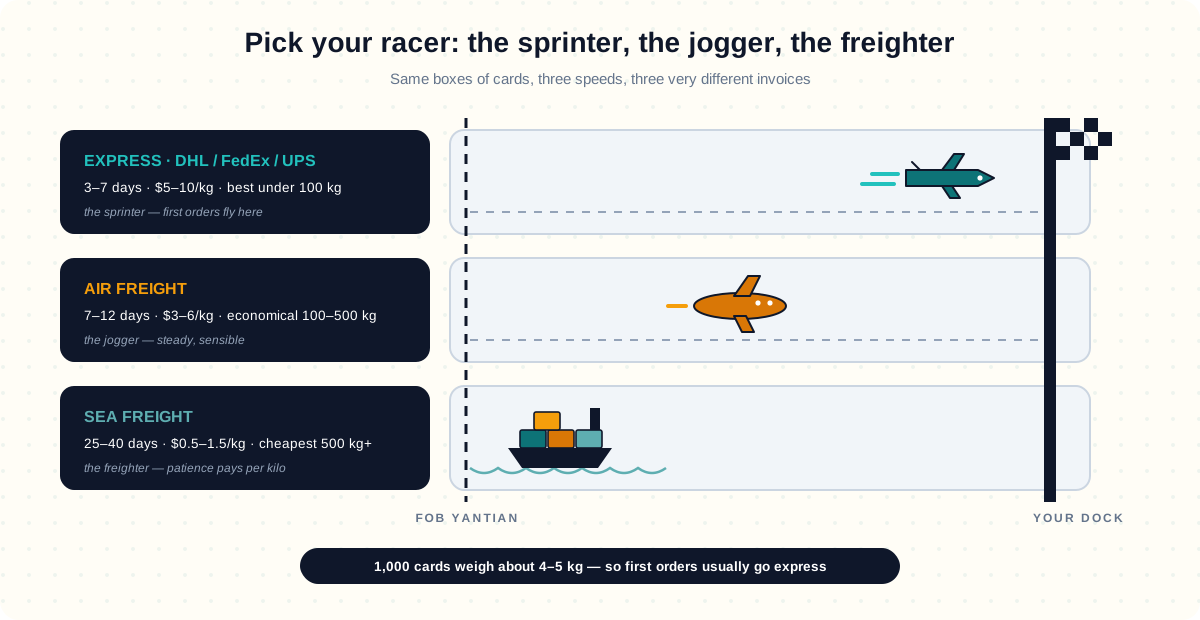
Freight rates move with route, fuel, season and chargeable weight. Compare methods by current door-to-door quote, customs responsibility and delivery window rather than using a fixed per-kilogram estimate:
- Express courier: usually the simplest option for samples, pilots and smaller production orders
- Air freight: worth comparing when the shipment is too large for economical courier service but still time-sensitive
- Sea freight: suited to large replenishment orders where the lower freight cost justifies a longer and less predictable transit window
Ask for package count, gross weight, dimensions, Incoterm and destination charges before comparing freight. For a first order, courier service often reduces coordination; established high-volume reorders may justify air or sea freight.
Step 7: Payment Terms
Payment terms are trust, written in percentages. Common payment methods when ordering from China:
- T/T (Wire Transfer): the most common route. Our standard terms are 30% deposit, 70% before shipment
- PayPal or card: Sometimes available for samples and smaller orders; confirm fees and the legal payee before payment
- Western Union: Used for sample payments
- L/C (Letter of Credit): May suit larger orders when both parties and their banks agree the document terms
Common Mistakes to Avoid
Five classic ways buyers donate money to the learning curve:
- The leap of faith: not testing samples before bulk production
- The bargain hunt: choosing solely based on price without verifying quality
- The vague order: not specifying the exact chip model (e.g., saying "Mifare" without specifying Classic 1K vs DESFire)
- The customs surprise: ignoring import duties and customs requirements for your country
- The verbal agreement: not requesting data encoding specifications in writing
Buyer checklist before contacting a manufacturer
- Chip type and frequency — see our frequency guide or Mifare chip comparison
- Card material (PVC, PET, wood, paper) and size (CR80 standard or custom)
- Printing requirements — artwork file, color mode (CMYK), finish (matte/gloss)
- Encoding needs — UID read-only, custom data, or encoding by buyer
- Quantity and timeline — MOQ typically 500–1,000 pcs for custom cards
- Compliance — ISO 14443, ISO 15693, or specific certifications needed
RFID Card Sourcing Planning Examples
These illustrative planning scenarios show how requirements can change the order path. They are not current quotations; actual chip cost, freight and lead time must be confirmed for the destination and order date.
US small startup (1K MIFARE Classic 1K cards)
First-time buyer ordering blank MIFARE Classic 1K cards for a small access control project. Total: ~5 kg, 30% T/T deposit, DHL Express shipping. Timeline: 14 business days from PO to delivery. Cost typical: $0.20–$0.30 per card + $80–$150 freight. Common path for <5K orders.
EU enterprise (50K DESFire EV2 access cards with photo ID)
Office building badge program. Custom artwork + photo-ID printing + DESFire EV2 4K with site-key encoding. Total weight ~250 kg. Air freight CIF Frankfurt + EORI registration for VAT. Timeline: 30–40 business days including artwork sign-off and sample iteration.
Latin America hotel chain (200K NFC room keys)
Hotel chain ordering NFC NTAG216 + custom hotel-brand printing for room keys (see the hotel access RFID solution for lock-compatibility planning). Total ~1,000 kg. Sea freight FCL from Yantian to Buenos Aires; 30% deposit + 70% before B/L. Timeline: 50–60 days including sea transit. Per-card cost typical: $0.25–$0.40 at this volume.
SE Asia distributor (1M UHF inlay tags)
Mid-tier distributor ordering 1M UHF Monza R6 inlays for resale across SE Asia. Pre-encoded SGTIN-96 with assigned GS1 prefix. Sea freight FCL with quarterly replenishment. L/C at sight payment terms. Per-tag cost ~$0.06 + $0.02 encoding. Distributor markup 30–50% for end-customer pricing.
Ready to Order?
RFIDAK exists to make this journey pleasantly boring: transparent pricing, free samples, dedicated project management, and reliable quality. Manufacturing RFID since 2008 with shipments to 50+ countries, we have walked every gate on this road more times than we can count.
Key Takeaways
- 7-step procurement: specification → supplier qualification → samples and quote → MOQ agreement → QC plan → shipping → payment milestones.
- Planning MOQ: 100–200 blank cards, 100–500 digital-print cards and about 500 offset-print cards; custom materials, tooling and secure encoding may require more.
- First-order timing: allow roughly 7–10 weeks when compatibility testing and printed proof approval are required; repeat orders can be shorter.
- Required RFQ data: chip family, material, dimensions, artwork file, encoding pattern, packaging.
- Landed-cost comparison: include card, setup, encoding, packaging, freight, duty, tax and destination charges.
Common pitfall
Do not skip physical sample approval to shorten the schedule. Verify the chip on the real reader, inspect print and material, and approve the encoding test file before bulk production starts.
China RFID Sourcing FAQ
How do I handle import duties and VAT in EU / US?
Many contactless smart cards fall under HS heading 8523.52, but classification, duty and tax depend on the product construction and destination schedule. Confirm the code with your customs broker and use the actual transaction value and agreed Incoterm on the commercial invoice.
Can I avoid 100% upfront payment?
Ask for payment milestones tied to order confirmation, sample approval, inspection and shipping documents. A deposit plus balance is common, while a Letter of Credit may suit a larger order if both parties and banks accept the document terms. Verify the beneficiary account against the supplier’s legal entity before every transfer.
What HS code applies to RFID cards?
HS 8523.52 is a common heading for smart cards, but a card, label, inlay or integrated circuit can be classified differently under a destination’s tariff schedule. Give the customs broker the product construction and intended function, then place the confirmed code on the commercial invoice rather than copying a generic code from another shipment.
How do I ship samples vs production differently?
Samples usually ship by express courier so compatibility testing can start quickly. Production orders may use courier, air or sea depending on chargeable weight and deadline. Describe samples accurately as testing samples and declare the value required by the destination’s customs rules; production documents should use the actual transaction value.
What if there’s a quality dispute after delivery?
Document the issue with photos, video, and read-rate test data within 10 days of receipt. Reputable suppliers will: (1) replace defective units at no charge, (2) credit against future order, or (3) refund. For Alibaba Trade Assurance orders, dispute through the platform within 30 days. For T/T orders, the dispute is contractual — which is why a written QC spec at PO time is critical. Independent third-party QC inspection ($200–$500 via AsiaInspection) is the safety net for high-value orders.
Sources
- China SAMR (State Administration for Market Regulation). samr.gov.cn
- ISO 9001 — Quality Management Systems. iso.org/iso-9001
- WCO HS Code 8523.52 — smart cards (international tariff classification). wcoomd.org
- ICC Incoterms 2020 (international commercial terms). iccwbo.org/incoterms
- HKTDC — sourcing intelligence for Asia exports. hktdc.com
- China Customs — import / export procedures. customs.gov.cn
- IDTechEx — China RFID manufacturing market. idtechex.com
Browse our custom RFID card range, compare MIFARE Classic and DESFire, or review the sample policy and shipping terms. When the specification is ready, request an itemized quote and compatibility sample.
Need help turning this guidance into a product shortlist?
Use this next step when the article has narrowed the direction and you now need help choosing chips, formats, samples or the closest product family.
Comparison Pages
Compare the closest alternatives before you request samples
Open one of these if the article clarified the topic but the team still needs a cleaner format, chip or frequency decision.
Quick FAQ
Questions buyers often ask after reading this guide
Why source RFID cards from China?
China, especially Shenzhen, has a mature RFID card supply chain covering chip distribution, antenna conversion, lamination, printing, encoding and export logistics. Buyers can source standard PVC cards, eco materials, security chips and custom finishes from the same manufacturing ecosystem. The commercial result still depends on the specification, sample performance, QC plan and total landed cost, so compare itemized quotes rather than assuming a fixed percentage saving.
How do I find a reliable RFID card manufacturer in China?
Check the legal entity, production route, relevant quality-system certificates and their scope. Request the exact chip and card construction, sample test results, traceability, QC plan and a written quote. Ask whether production is owned or performed by a partner and verify whichever model is proposed; do not infer capabilities from a company age, export-country count or generic certificate.
What is the minimum order quantity for RFID cards from China?
RFIDAK's published standard card MOQ baseline is 500 pieces. Confirm the exact chip, card construction, printing, encoding and quantity per design in a written quote. Free stock samples (up to 5 pieces) — buyer covers DHL/FedEx freight ($25–60), refunded 1:1 against the first production order over $500. Larger evaluation lots, custom samples, production timing and delivery are agreed separately for the selected configuration.
How much does shipping RFID cards from China cost?
Unit price depends on the exact chip and inlay, finished construction, approved quantity per design, printing, encoding, packaging and QC requirements. Request a dated itemized quote showing sample and setup charges, unit tiers, freight and lead time; a generic chip or tag price does not establish the cost of the approved product.
How do I test RFID card samples before ordering?
Request a sample with the exact chip, body, thickness and encoding proposed for production. Test it on the installed reader, encoder and access application, including denied or offline cases where relevant. Approve artwork and physical quality separately. Stock and custom sample fees, freight and timing follow the published sample policy and the configuration-specific quote.
What payment terms do Chinese RFID manufacturers accept?
T/T wire transfer is common, often with a deposit at order confirmation and the balance tied to inspection or shipment documents. PayPal or card payment may be available for samples and small orders, while a Letter of Credit may suit larger orders when both parties and banks agree the document terms. Always verify that the beneficiary account matches the supplier legal entity and put payment milestones in the purchase order.
What are common mistakes ordering RFID cards from China?
Common risks include an ambiguous chip specification, no sample test on the installed reader, missing encoding and key requirements, unclear production/QC roles and incomplete landed-cost terms. Put the approved finished card, acceptance test and delivery scope in the purchase order.
How long does the full RFID card order cycle take?
Stock sample preparation and courier estimates are described in the sample policy (1 business day; DHL / FedEx express, 2–5 days worldwide). The production schedule starts only after the exact chip, artwork, encoding, sample approval and current stock are confirmed in the order-specific quote. Custom constructions and secure personalization need their own schedule.
Author
RFIDAK RFID Editorial Team
RFID supply editorial team
RFIDAK publishes practical RFID guides to help buyers compare chips, product formats, sampling plans and sourcing options before production.