Can Your Phone Read RFID Cards? NFC Compatibility Explained
A phone reads exactly one slice of the RFID world: HF 13.56 MHz NFC. This guide maps which chips iPhone and Android can actually read, what stays locked without keys, and why LF keyfobs and UHF labels will never appear on a phone screen.
Quick Answer
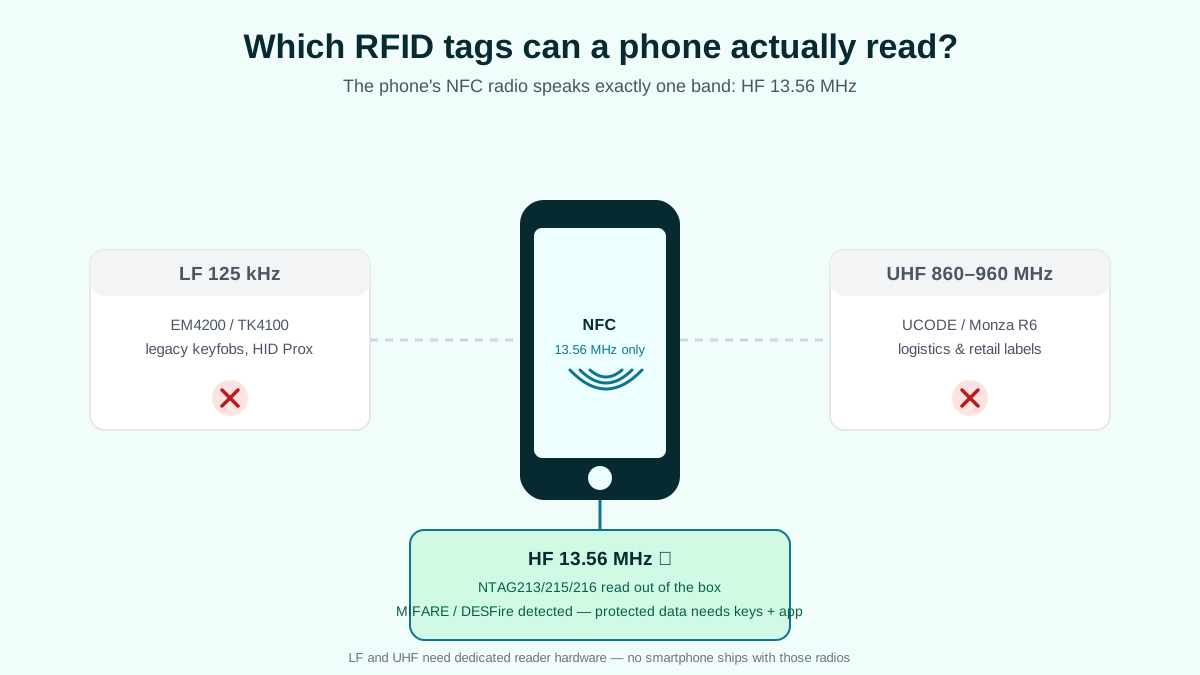
Phones read only HF 13.56 MHz (NFC) tags. NTAG213/215/216 read out of the box on NFC-enabled iPhones and Android devices. MIFARE Classic, Plus and DESFire are detected at the ISO 14443 level, but their protected data opens only with the matching keys and app — and MIFARE Classic data access additionally depends on the phone’s NFC chipset. No phone reads LF 125 kHz keyfobs or UHF 860–960 MHz logistics labels; those bands need dedicated reader hardware.
“Will my customers be able to tap this with their phones?” is one of the most common pre-order questions we receive — and one of the most commonly half-answered on the wider internet.
The confusion has one root: RFID is a family of technologies, and a phone speaks to exactly one member of it. Map that boundary once and every compatibility question becomes easy.
NFC is the slice of RFID your phone speaks
NFC (Near Field Communication) is a subset of HF RFID standardized around 13.56 MHz and the ISO/IEC 14443 and ISO/IEC 15693 air interfaces — the same protocols behind contactless payment and modern access cards.
Every NFC-enabled phone carries a radio for this band and nothing else. That is a hardware fact, not a software setting: no app can teach a phone to hear 125 kHz or 900 MHz.
The background story lives in our NFC technology guide and the RFID frequency guide; the short version is enough here: phone compatibility is decided the moment you pick the chip.
Compatibility matrix: chip family vs iPhone vs Android
| Chip family | iPhone | Android | Notes for buyers |
|---|---|---|---|
| NTAG213 / 215 / 216 | Reads NDEF, no app (background from iPhone XS/XR era); app-based since iPhone 7 / iOS 11 | Reads natively, no app | The safe default for consumer tap experiences |
| NTAG424 DNA | Reads the SUN URL like any NDEF tag | Same | Cryptogram verification happens on your server, not the phone |
| MIFARE Classic 1K/4K | Detects UID; data sectors not accessible for practical purposes | Full data access only on phones with an NXP NFC chipset, and only with the sector keys | Never plan a consumer phone experience around Classic |
| MIFARE DESFire EV2/EV3 | Readable via app (Core NFC, ISO 14443-4) with the right keys | Readable via app (IsoDep) with the right keys | Designed for closed systems — phone access is for your app, not the public |
| ICODE SLIX (ISO 15693) | Readable via app since iOS 13 | Readable via NfcV API | Common in library and vicinity applications |
| LF 125 kHz (EM4200, TK4100, HID Prox) | No | No | No phone has an LF radio — use a desktop or handheld reader |
| UHF EPC Gen2 (UCODE, Monza) | No | No | Needs a UHF reader; Bluetooth sled readers pair with phones as accessories |
Chip-by-chip protocol detail beyond phone questions lives in the chip comparison guide.
iPhone: what Core NFC allows
Apple opened tag reading gradually. iOS 11 (iPhone 7 and later) introduced app-based NDEF reading. From the iPhone XS/XR generation, NDEF-formatted tags trigger background reading — a tap pops the link with no app installed.
iOS 13 widened Core NFC to ISO 15693, ISO 7816, FeliCa and the MIFARE families, so a purpose-built app can talk to DESFire or ICODE directly.
Card emulation is the restricted side: historically Apple Pay only, with HCE APIs opening region by region since iOS 17.4/18.1 under EU rules. If your project needs the phone to be the credential, treat iPhone support as a per-region engineering question, not a checkbox.
Android: broader APIs, one famous exception
Android exposes the full HF stack — NfcA, NfcB, NfcV and IsoDep — plus host card emulation, so an Android phone can both read tags and act as an ISO 14443 credential.
The famous exception is MIFARE Classic. Its Crypto-1 layer sits outside the ISO standard, so full data access requires an NXP NFC controller in the phone. Devices with other chipsets detect the UID and stop there.
This is why “Android reads all HF cards” claims deserve suspicion — detection and data access are different promises, and only one of them is universal.
What no phone can read: LF and UHF
LF 125 kHz keyfobs and cards — the EM4200/TK4100 world of older access systems — are invisible to every phone ever shipped. So are UHF EPC Gen2 labels, the workhorses of retail and logistics.
Both bands need dedicated hardware: a desktop or handheld reader for enrollment and testing, or for UHF, a Bluetooth sled reader that pairs with a phone as an accessory — the phone provides the screen, the sled provides the radio.
If a supplier implies a phone can verify their UHF labels directly, that is a red flag worth pausing on.
What this means when you order tags
Want consumers tapping with their own phones? Specify NTAG213/215/216 — NDEF-encoded, readable everywhere. Step up to NTAG424 DNA when taps must be unforgeable.
Building a closed credential system? DESFire or MIFARE on cards and fobs is fine — phones are irrelevant to the reader fleet, and optional for your own staff app.
Migrating off LF? Phone readability is one more argument for the HF side of the migration, alongside security.
The same logic follows the chip into every form factor. An NTAG216 behaves identically whether it ships inside a card, a sticker, a wristband or an epoxy keyfob — the phone reads the chip, not the housing. What the housing changes is antenna size, and with it how forgiving the tap position is.
When in doubt, put the intended phone experience in the RFQ. It changes the chip recommendation more often than any other single requirement.
Reading is only half the question: what phones can write
Android phones can also encode NDEF tags — write a URL, contact card or text record onto an unlocked NTAG in a second, using free apps. iPhones can write NDEF through third-party apps as well, though the workflow is less common.
That makes a phone a perfectly good tool for small pilots: encode twenty stickers by hand, put them on the wall, and measure whether anyone taps before ordering ten thousand.
It does not scale, and it does not lock. Production programs use factory pre-encoding for a reason: consistent data, verified writes, lock bits set so the public cannot overwrite your tag with their own URL, and a CSV export of every UID shipped.
The rule of thumb, and it holds across every chip family on this page: phones write pilots, factories write production. The two encoding routes are compared in detail here.
Three misconceptions that cause wrong orders
“It says RFID, so my phone should read it.” The word covers four radio bands; phones speak one. The order form should name a chip, not a technology — a spec that says “RFID sticker” without a chip family is a coin flip.
“The phone saw the card, so we are compatible.” Detection proves the frequency matched. Whether your system can use the card depends on protocol, keys and data format — three more layers, each able to fail independently.
“We will just use phones instead of buying readers.” Reasonable for HF consumer touchpoints; impossible for LF legacy fleets and UHF inventory. Budget reader hardware where the physics requires it, and let phones do what they are genuinely good at: the consumer-facing tap.
How to test with your own phone
Order samples of the actual chip and construction — antenna size and material change read behavior, so a bare chip test is not a product test.
On Android, NXP’s TagInfo app shows the chip family, protocol and memory map. On iPhone, any NDEF-encoded NTAG should pop a banner on a locked screen from the XS/XR generation onward.
Test through the real material: a tag behind glass, on a bottle, or inside a badge holder reads differently from one on a desk. Free samples exist exactly for this step — five minutes of tapping beats a page of assumptions.
FAQ
Can a phone read a hotel key card?
It can usually detect one (most are ISO 14443 HF), but the room-access data is keyed to the lock system and stays closed. Detection proves the frequency, not access.
Can a phone clone an access card?
Not one with real security. UID-only systems are spoofable by specialized hardware — which is an argument for DESFire-class credentials, covered in the glossary and chip guide, not a phone capability.
Why does my UHF label read on the warehouse gun but not my phone?
Different radio bands. The gun speaks EPC Gen2 at 860–960 MHz; your phone does not. See how UHF readers and tags negotiate reads for what happens on that side of the fence.
Sources
- Apple Developer — Core NFC framework documentation. developer.apple.com
- Android Developers — NFC basics and advanced NFC (NfcA/NfcB/NfcV/IsoDep). developer.android.com
- NFC Forum — tag type technical specifications. nfc-forum.org
- NXP Semiconductors — NTAG and MIFARE product families. nxp.com
- ISO/IEC 14443 — proximity card air interface. iso.org
Need help turning this guidance into a product shortlist?
Use this next step when the article has narrowed the direction and you now need help choosing chips, formats, samples or the closest product family.
Quick FAQ
Questions buyers often ask after reading this guide
Can any smartphone read RFID tags?
Only the HF 13.56 MHz slice of RFID - the part standardized as NFC (ISO 14443 / ISO 15693). Every NFC-enabled iPhone and Android phone carries a radio for that band and nothing else. LF 125 kHz keyfobs and UHF 860-960 MHz logistics labels are invisible to every phone ever shipped, because no phone contains those radios; they require dedicated reader hardware.
Which NFC chips can phones read without any app?
NDEF-encoded NTAG213/215/216 tags. Android reads them natively, and iPhones from the XS/XR generation onward pop the encoded link via background tag reading with no app installed (iPhone 7 through X can read them through an app since iOS 11). This is why NTAG is the default specification whenever the tag is meant for consumers tapping their own phones.
Can a phone read a MIFARE Classic card?
It can detect the UID, and that is usually where it ends. Full data-sector access requires both the Crypto-1 sector keys and - on Android - a phone whose NFC controller is an NXP chipset, because Classic sits outside the ISO 14443 standard at the data layer. iPhones do not offer practical Classic data access. Never design a consumer phone experience around MIFARE Classic.
Can an iPhone read DESFire or ISO 15693 tags?
Yes, through an app. iOS 13 expanded Core NFC to ISO 7816, ISO 15693, FeliCa and the MIFARE families, so a purpose-built app holding the right keys can talk to DESFire EV2/EV3 or ICODE SLIX directly. What iPhones do not offer is open, app-free access to protected data - the background-reading convenience applies to NDEF content only.
Can a phone read UHF RFID labels used in retail and logistics?
No phone can read UHF EPC Gen2 tags directly - the 860-960 MHz radio simply is not in the hardware. The workable pattern is a Bluetooth UHF sled reader paired with the phone: the sled supplies the radio and antenna, the phone supplies the screen and app. For desktop encoding and testing, a dedicated UHF reader/writer is the standard tool.
Can a phone be used as an access credential instead of a card?
On Android, yes - host card emulation (HCE) lets the phone present itself as an ISO 14443 credential to compatible readers. On iPhone, card emulation was historically Apple Pay only, with HCE APIs opening region by region since iOS 17.4/18.1 under EU rules. Treat iPhone-as-credential as a per-region engineering question, and confirm with your access-control vendor.
How do I test whether my tags are phone-readable before ordering?
Order samples of the real construction, not just the chip - antenna size and mounting material change read behavior. On Android, the NXP TagInfo app reports chip family, protocol and memory map. On iPhone, an NDEF-encoded NTAG should trigger a banner on a locked screen (XS/XR generation onward). Test through the actual material: behind glass, on the bottle, inside the badge holder.
Does phone compatibility affect which chip I should order?
It is often the deciding factor. Consumer tap experiences need NTAG213/215/216 (or NTAG424 DNA when taps must be cryptographically verifiable). Closed credential systems can use DESFire or MIFARE freely, since the reader fleet - not the public - does the reading. State the intended phone experience in your RFQ; it changes the chip recommendation more often than any other single requirement.
Author
RFIDAK RFID Editorial Team
RFID supply editorial team
RFIDAK publishes practical RFID guides to help buyers compare chips, product formats, sampling plans and sourcing options before production.