Skip to content

Pillar Guide

RFID chip comparison: MIFARE, NTAG, Ultralight, DESFire, Impinj and UCODE

Pick the right RFID chip with a security-tier matrix, cost curves at volume, migration paths from legacy chips, and counterfeit risk ranking. For procurement teams already past the frequency decision.

On this page

Key takeaways

  • NXP dominates the HF chip universe — approximately 70% share across MIFARE and NTAG families (NXP Investor Relations, 2024).
  • MIFARE Classic Crypto-1 is broken — Garcia et al. USENIX Security 2008 demonstrated the attack; do not specify Classic for security-sensitive workflows.
  • NTAG424 DNA is the authentication default — AES-128 SUN (Secure Unique NFC) rotating URL per tap defeats cloning and is foundational for EU Digital Product Passport.
  • UHF Gen2 chip market is concentrated — Impinj + NXP UCODE cover roughly 80% of RAIN deployments (IDTechEx, 2024).
  • Chip authenticity matters — gray-market clones of NXP Classic 1K account for an estimated 30% of unauthorized supply (NXP brand protection statement, 2024).

Industry numbers at a glance

70%

NXP share of HF / NFC chips (NXP IR, 2024)

42 B

UHF Gen2 tags shipped in 2024 (RAIN Alliance)

2008

Year MIFARE Classic Crypto-1 cipher broken (USENIX)

8 KB

Max user memory on MIFARE DESFire EV3

$500 B

Annual counterfeit market protected by secure NFC (OECD, 2023)

1. Why the chip decision matters

After frequency (LF, HF, UHF), the chip choice locks three things: security tier, memory profile and reader compatibility. A MIFARE Classic card and a DESFire card are both 13.56 MHz HF, but a Classic-only reader cannot read DESFire and a DESFire-era security audit cannot accept Classic. Chip family is where procurement gets expensive if chosen wrong.

The playbook-correct order is application \u2192 frequency \u2192 chip family \u2192 chip variant \u2192 inlay. Unit price comparisons done at the chip-variant level ("NTAG213 vs NTAG215") only make sense after memory profile and smartphone compatibility are locked.

This pillar covers each major chip family as a procurement decision: the memory profile, the security tier, typical unit cost at three MOQ tiers, counterfeit risk, and which RFIDAK products carry that chip. For the broader systems-level view see the RFID technology pillar; for the frequency-level decision see the frequency pillar.

2. The chip family universe map

Three frequency bands, three main vendor ecosystems, one tree diagram. Chip families group by frequency first, then by manufacturer, then by security tier.

RFID chip universe (2026)
\u2502
\u251C\u2500 LF 125-134 kHz
\u2502   \u251C\u2500 EM Microelectronic: EM4100, EM4102, EM4305, EM4205
\u2502   \u251C\u2500 Atmel (Microchip): T5577 / T55x7 (multi-protocol)
\u2502   \u251C\u2500 NXP: HITAG 1, HITAG S, HITAG 2 (automotive)
\u2502   \u2514\u2500 ISO 11784/11785 FDX-B (livestock, pet)
\u2502
\u251C\u2500 HF / NFC 13.56 MHz
\u2502   \u251C\u2500 NXP MIFARE: Classic, Plus EV2, DESFire EV3, Ultralight EV1/C/Nano
\u2502   \u251C\u2500 NXP NTAG: NTAG210\u00b5 / 213 / 215 / 216, NTAG424 DNA, NTAG424 DNA TT
\u2502   \u251C\u2500 NXP ICODE: SLIX / SLIX2 (ISO 15693 vicinity)
\u2502   \u2514\u2500 Legic, Infineon, Sony FeliCa (regional variants)
\u2502
\u2514\u2500 UHF 860-960 MHz (ISO/IEC 18000-63, EPC Gen2v2)
    \u251C\u2500 Impinj: Monza R6 / R6-P, M730, M750, M770, M780, M800
    \u251C\u2500 NXP UCODE: UCODE 9, UCODE 9xm (on-metal), UCODE DNA (crypto)
    \u251C\u2500 Alien Technology: Higgs 9, Higgs H10
    \u2514\u2500 EM Microelectronic, Fudan FM (emerging)
              

NXP (formerly Philips Semiconductors) dominates the HF / NFC universe with approximately 70% share across MIFARE and NTAG combined (NXP Investor Relations, 2024). The UHF market is concentrated in Impinj and NXP UCODE with roughly 80% combined share (IDTechEx, 2024).

3. MIFARE family (HF secure access)

MIFARE is the dominant HF smart-card chip family, built for secure access, transit, payments and stored-value applications. The family has four branches with very different security tiers \u2014 choosing the wrong variant is the most expensive mistake in B2B HF procurement.

Chip Memory Crypto ISO Typical use $ / unit
MIFARE Classic 1K / 4K 1 KB / 4 KB Crypto-1 (broken) ISO 14443-3A Legacy transit, low-security access; avoid new deployments $0.15 – 0.30
MIFARE Plus EV2 (2K / 4K) 2 KB / 4 KB AES-128 ISO 14443-3A Secure upgrade path from Classic; SL1/SL3 migration modes $0.45 – 0.85
MIFARE DESFire EV3 (2K / 4K / 8K) 2–8 KB AES-128 / 3DES ISO 14443-4 High-security access, transit, payments; FIPS 140-2 validated $0.85 – 1.80
MIFARE Ultralight EV1 48 / 128 bytes Password ISO 14443-3A Single-use ticketing $0.05 – 0.12
MIFARE Ultralight C 144 bytes 3DES ISO 14443-3A Disposable vouchers with lightweight auth $0.08 – 0.18
MIFARE Ultralight Nano 39 bytes (none) ISO 14443-3A Event wristbands, lowest-cost HF ID $0.04 – 0.10

Warning \u2014 MIFARE Classic: The Crypto-1 cipher was broken in 2008 (Garcia et al., "Dismantling MIFARE Classic," USENIX Security 2008). Cloning commercially available hardware can recover keys in seconds. Do not specify Classic for any security-sensitive deployment; keep only for low-stakes legacy systems already in production.

4. NTAG family (NFC consumer + DPP)

NTAG is NXP\u2019s single-chip NFC Forum Type 2 and Type 4 family, built for consumer-facing smartphone tap. The family splits into the open NTAG210\u00b5/213/215/216 line (marketing, smart packaging) and the secure NTAG424 DNA line (anti-counterfeit, warranty, Digital Product Passport).

Chip Memory Crypto Feature Typical use $ / unit
NTAG210µ / 213 / 215 / 216 48 / 144 / 504 / 888 bytes (open) NDEF URL, vCard, rich consumer NFC payload Marketing tap, smart packaging, business card, product info $0.05 – 0.25
NTAG424 DNA (original SUN) 416 bytes AES-128 SUN Per-tap rotating URL, server-verified authenticity Anti-counterfeit, warranty, digital product passport $0.40 – 0.85
NTAG424 DNA TT (Tag Tamper) 416 bytes AES-128 SUN + tamper bit Tamper-evident variant with wire loop detection Luxury goods, wine, spirits, pharma $0.55 – 1.10
NXP ICODE SLIX / SLIX2 128 / 80 bytes Password ISO 15693 vicinity read up to 1 m Library media, industrial asset vicinity reads $0.15 – 0.40

5. UHF Gen2 chips (Impinj, NXP UCODE, Alien)

UHF Gen2v2 chips power retail item-level RFID, logistics, pallet tracking and industrial asset management. Three vendors cover roughly 80% of deployments: Impinj (Monza R6 / M730-M800), NXP (UCODE 9, 9xm, DNA) and Alien (Higgs 9, H10). Choice within each family is driven by read-rate sensitivity, on-metal tolerance, memory profile and regional antenna tuning.

Chip Memory Feature Typical use $ / unit
Impinj Monza R6 / R6-P 96 / 128 bit EPC + 32 bit TID High backscatter sensitivity; strong entry-level Gen2 Apparel retail, high-volume item-level $0.04 – 0.08
Impinj M730 / M750 96 bit EPC + 32 bit TID 2023 gen with improved self-tuning; optimized for liquid-adjacent General retail and logistics workhorse $0.05 – 0.10
Impinj M770 / M780 128 bit EPC + 96 bit user Long-range read for dock-door portals Warehouse, dock-door, pallet $0.06 – 0.12
Impinj M800 128 bit EPC + 96 bit user Flagship 2024 chip, top read rate and sensitivity Premium retail and industrial $0.08 – 0.14
NXP UCODE 9 / 9xm 96 bit EPC + 32 bit TID Self-adjusting, UCODE 9xm optimized for on-metal Apparel, logistics; 9xm for industrial asset $0.05 – 0.10
NXP UCODE DNA 96 bit EPC + 3DES crypto Cryptographic UHF for anti-counterfeit Pharma, high-value goods $0.35 – 0.80
Alien Higgs 9 / H10 96 bit EPC + 128 bit user Specialty long-range and on-metal optimized Industrial, aerospace, defense $0.06 – 0.18

6. LF chips (legacy access and animal ID)

LF chips are a smaller, slower-moving market \u2014 but still essential for legacy access credentials, vehicle immobilizers and livestock / pet ID. Five chip families cover 90% of procurement scenarios.

Chip Memory Feature Typical use $ / unit
EM4100 / EM4102 (read-only) 64 bit Fixed ID; fastest to deploy but not re-writable Legacy building access, simple door entry $0.18 – 0.40
EM4305 / EM4205 (R/W) 512 bit Re-encodable; newer generation EM4305 Asset ID, re-issuable credentials, industrial $0.25 – 0.55
Atmel T5577 / T55x7 330 bit R/W Multi-protocol emulator (EM, HID Prox, Indala, AWID) Programmable bridge cards during reader migration $0.30 – 0.65
HITAG 1 / S / 2 256 – 2048 bit Stronger security than EM; used in automotive Vehicle immobilizer, industrial access $0.40 – 0.95
FDX-B (ISO 11784/11785) 128 bit 134.2 kHz; universal for livestock and pet ID Livestock ear tag, pet microchip $0.35 – 1.20

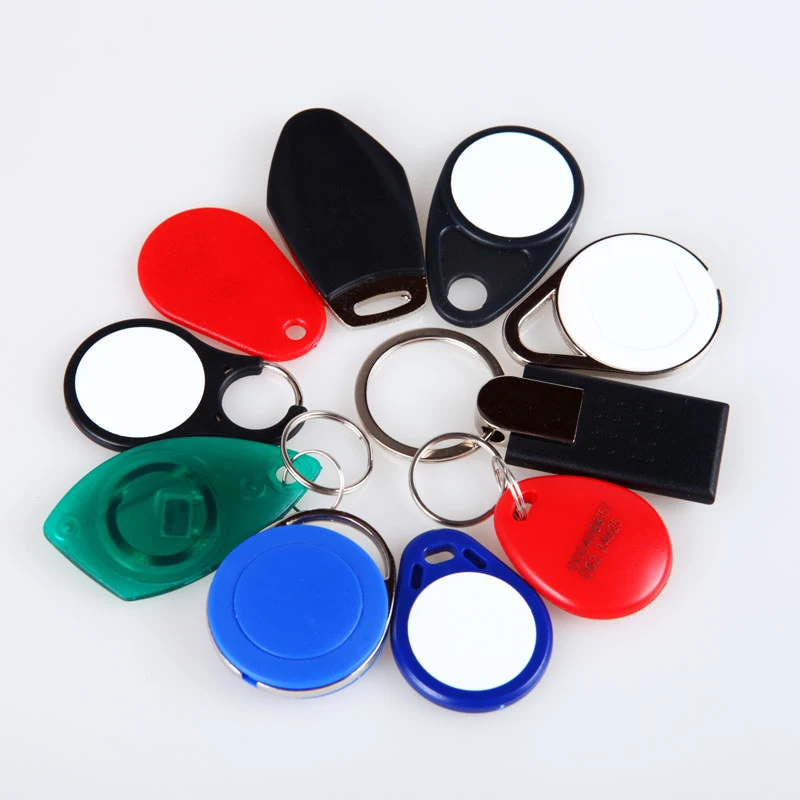
RFIDAK LF products: LF keyfob (EM / T5577) \u2022 LF keyfob range \u2022 LF 125 kHz cards

7. Security tier comparison matrix

Sort chips by security tier, not by marketing tier. This matrix covers the most common B2B secure-access and authentication scenarios. Chips below the "Medium" line should not be used where insurance, audit, payment or regulated identity is involved.

ChipCryptoKey lengthCounterfeit resistanceUse case ceiling
MIFARE Classic 1K/4KCrypto-1 (broken)48-bit— (broken)Low-stakes legacy only
MIFARE Ultralight C3DES112-bitLowLightweight disposable auth
MIFARE Plus EV2AES-128128-bitMediumMid-tier secure access
MIFARE DESFire EV3AES-128 / 3DES128 / 168-bitHigh (FIPS 140-2)High-security access, payments
NTAG213/215/216(open)Open URL, marketing
NTAG424 DNAAES-128 SUN128-bitHigh (per-tap rotation)Anti-counterfeit, DPP
NXP UCODE DNA (UHF)3DES168-bitHighPharma, high-value

FIPS 140-2 validation covers cryptographic module implementation, not raw cipher strength. MIFARE DESFire EV3 FIPS 140-2 certificate: NIST CMVP #3659.

8. Cost curves by chip and volume

Indicative pricing per unit in USD, at three MOQ breakpoints. All prices exclude custom artwork, encoding, lamination and tooling. Cryptographic chips (DESFire EV3, NTAG424 DNA, UCODE DNA) carry a security premium that scales less aggressively with volume than open chips do.

Chip (typical format) MOQ 1,000 MOQ 10,000 MOQ 100,000
MIFARE Classic 1K $0.45 – 0.65 $0.22 – 0.35 $0.15 – 0.22
MIFARE DESFire EV3 2K $1.80 – 2.50 $1.10 – 1.45 $0.85 – 1.05
NTAG213 $0.28 – 0.45 $0.15 – 0.22 $0.10 – 0.14
NTAG424 DNA $1.10 – 1.60 $0.60 – 0.90 $0.40 – 0.55
Impinj Monza M750 inlay $0.18 – 0.28 $0.08 – 0.12 $0.05 – 0.07
NXP UCODE 9 inlay $0.18 – 0.28 $0.08 – 0.12 $0.05 – 0.07
EM4305 card $0.75 – 1.10 $0.45 – 0.60 $0.28 – 0.40

Sources: IDTechEx 2024 RAIN RFID Forecasts; NXP MIFARE and NTAG price lists 2024; RFIDAK 2026 published price book.

9. Migration and upgrade paths

Most real chip decisions in 2026 are migration decisions: replacing an existing chip with a more secure, higher-memory or more performant successor. Five scenarios cover 95% of live migrations at RFIDAK customers.

Migration

from MIFARE Classic 1K

to MIFARE Plus EV2 (SL1 mode)

When: Reader fleet must be retained; security upgrade driven by audit or insurance requirement.

Notes: Plus EV2 in SL1 mode reads on existing Classic readers; flip to SL3 for AES after reader firmware upgrade.

Migration

from MIFARE Classic 1K

to MIFARE DESFire EV3

When: Greenfield modernization or reader refresh cycle; best long-term security + multi-application support.

Notes: Requires new readers supporting ISO 14443-4; budget 30-60% reader hardware increase.

Migration

from NTAG213 (open URL)

to NTAG424 DNA (SUN)

When: Moving from plain marketing tap to anti-counterfeit or DPP requirement.

Notes: Add backend verification endpoint; factory key loading adds 5-8 weeks lead time.

Migration

from EM4100 legacy access

to HF DESFire EV3 or T5577 bridge

When: Multi-year access system refresh; T5577 bridge cards allow dual-technology during rollout.

Notes: Readers must be replaced; T5577 bridge extends Classic-LF while HF readers roll out building-by-building.

Migration

from Impinj Monza R6

to Impinj M730 / M750 / M770

When: Reader firmware refresh + need for better liquid / metal tolerance or read rate.

Notes: M730/M750/M770 are pin-compatible with R6 inlay designs; no tooling change in most cases.

10. Counterfeit and clone risks

Chip-level counterfeit risk determines how seriously you should audit supplier chain and factory encoding. Six risk bands cover the majority of B2B chips. NXP brand protection estimates approximately 30% of unauthorized MIFARE Classic supply is gray-market cloned (NXP statement, 2024).

High

MIFARE Classic

Crypto-1 broken in 2008; keys recoverable in seconds with commercially available hardware. Cloned Classic 1K is the #1 gray-market chip.

Low

MIFARE Plus EV2 / DESFire EV3

AES-128 with secure key management defeats practical cloning. Verify supplier chain to avoid counterfeit NXP ICs.

Medium (for auth use)

NTAG213/215/216

Chip is not broken, but payload is copyable. Fine for marketing, not for authentication.

Low

NTAG424 DNA

AES-128 SUN per-tap token verifies authenticity. Key disclosure risk exists if supplier is not trusted.

Medium

Impinj / UCODE UHF Gen2

TID is factory-unique and hard to clone at chip level, but EPC data is copyable. Use TID binding for authentication workflows.

Very high

EM4100 LF

Read-only 64-bit ID is trivially cloned to blank T5577 chips. Do not use EM4100 for security-sensitive access.

11. Chip selection playbook by industry

The same chip family can deliver very different ROI depending on industry context. Below is the default chip recommendation RFIDAK gives for 8 common B2B verticals — based on installed-base compatibility with existing reader fleets, security tier required by the industry's insurance / compliance landscape, volume economics at the typical program scale, and the practical migration cost from whatever legacy credential is currently deployed. These recommendations reflect what actually ships at scale in 2024-2026 rather than what's theoretically — both matter, but for procurement planning the installed-base reality usually dominates.

Hotels & hospitality

Default chip: MIFARE Plus EV2 2K in classic-emulation mode (compatible with Classic-era readers, AES-128 secure channel when reader firmware is upgraded to SL3 mode). Migration pattern 2023-2025: MIFARE Classic 1K migrating to Plus EV2 driven by insurance cybersecurity audits across Marriott, Hilton, IHG, Accor. New properties launching in 2024-2026 standardize on MIFARE DESFire EV3 for multi-application cards (door key + cashless payment + loyalty + spa booking on one credential). Typical volume: 1,500-3,000 cards per 300-room property with 6-8 month refresh cycle driven by magnetic-stripe wear or encoded-key lifecycle expiry.

Industrial laundry

Default chip: Impinj Monza R6-P or NXP UCODE 9 for 200+ wash-cycle survival. UCODE 9 adds extended memory for garment-history logging. Volume: 500K-5M tags/year per tier-1 processor (Cintas, Elis, Berendsen). Premium subset uses NXP UCODE DNA for anti-clone on high-value rental garments. Unit price $0.18-0.35 for textile format.

Retail & apparel

Default chip: Impinj M730 or M800 on 70x17 mm hangtag inlay. Walmart 2022 mandate and EU Digital Product Passport (ESPR 2024/1781) both require EPC Gen2v2. For luxury and anti-counterfeit: add NTAG424 DNA for smartphone tap. High-volume programs (100M+ tags/year) use Alien Higgs-9 as alternative for price optimization. Unit price $0.04-0.08 at 1M+ MOQ.

Logistics & supply chain

Default chip: NXP UCODE 9 for hardened industrial tags and on-metal deployments where ferrite spacer construction preserves read range despite steel substrate detuning. Extended EPC memory supports multi-stage supply chain events where tag data is updated at each handling checkpoint. Alternative: Alien Higgs-9 for very high-volume cost-optimized programs where memory needs are minimal. Active tags (not chip-based, battery-powered): for high-value containers and cross-border logistics needing real-time GPS or sensor data, use Wiliot or Quuppa BLE-AoA rather than RFID. Typical pallet tag: $0.48-1.45 anti-metal format with 5-10 year field life.

Healthcare & hospital

Default chip mixes format: DESFire EV3 4K for staff access and patient wristbands (AES-128 security for PHI), Impinj Monza R6-P for reusable medical textile tracking under EN 14065, NTAG424 DNA for pharma anti-counterfeit tap-to-verify. FDA UDI rule 2024-2026 expansion drives compliance upgrades. Hospital programs average 20K-200K tags/year per facility.

Access control (enterprise)

Default chip: MIFARE DESFire EV3 4K or 8K with AES-128 and multi-application architecture. Separate keys per service domain (physical access, IT logon PIV sub-app, cafeteria, secure print). Integrated with HID VertX, Mercury Security, Lenel OnGuard, Software House CCure. Auburn University RFID Lab 2024: 72% of > 10K unit orders now specify DESFire EV3 or equivalent AES-128. Migration from Classic 1K is active across Fortune 500.

Library & media

Default chip: ICODE SLIX (ISO/IEC 15693) paper label for book tagging. Vicinity reading at 50-100 cm supports stack-reading multiple books simultaneously at self-checkout kiosks and shelf-inventory drones. SLIX2 variant adds password-protected block for high-security archives. Branch library typical: 50K-500K tags per program. Integrated with Bibliotheca selfCheck, 3M, mk Solutions, D-Tech.

Events & NFC marketing

Default chip split by use case. Festivals (cashless 3-5 day events): Impinj Monza R6 on fabric or vinyl single-use wristbands. NFC marketing programs (luxury anti-counterfeit, loyalty, DPP): NTAG424 DNA for AES-128 SUN messaging compatible with iOS Background Tag Reading (iOS 13+). For open consumer NFC (no security needed): NTAG213/215/216 based on memory requirement (144/504/888 bytes).

12. Chip selection FAQ — 14 questions procurement teams ask

The most frequently asked technical questions RFIDAK sales engineers hear during B2B chip selection conversations, with precise answers suitable for sharing internally across non-RFID stakeholders in your organization — procurement, IT security, compliance, operations, and finance teams who need to understand the technology tradeoffs without becoming RFID specialists themselves. Each answer is written to stand alone as a briefing document, with enough context that a reader coming in cold can follow the logic and make an informed decision or ask the right follow-up question during vendor conversations. Use them as starting points for internal education or copy-paste into your RFP evaluation framework.

1. What's the real cost difference between MIFARE Classic and DESFire EV3 at 10K cards?+

At MOQ 10,000 blank PVC cards: MIFARE Classic 1K $0.38-0.52, MIFARE Plus EV2 2K $0.65-0.85, DESFire EV3 2K $1.10-1.35, DESFire EV3 8K $1.60-2.20. Including encoding: add $0.15-0.30 per card for pre-encoded delivery. Including printing: add $0.15-0.25 for CMYK front+back. So a fully printed and encoded DESFire EV3 2K card lands at approximately $1.55-1.95 per unit — roughly 3x the cost of a printed Classic 1K at $0.68-1.05. Over a 3-year card lifecycle, the security upgrade translates to about $0.25-0.35 per card-year, which is usually trivial compared to the cost of a single cloning-attack incident at a hotel or corporate property.

2. Can I mix DESFire EV2 and EV3 cards in the same reader fleet?+

Yes. EV3 is fully backward compatible with EV2 at the ISO/IEC 14443A protocol layer. Readers that enumerate EV2 cards will enumerate EV3 identically. The differences are on the card side: EV3 adds Secure Messaging (SUN) for smartphone tap integrity, faster AES-128 operations, improved proximity check hardening, and longer key derivation chains. For buyer decisions: if your installed reader fleet is EV2-capable, new EV3 cards drop in without reader firmware updates. If your current fleet is Classic-only, you need both new cards AND reader replacement or firmware upgrade to access AES-128 protections.

3. Which NTAG variant should a luxury brand use for Digital Product Passport?+

NTAG424 DNA is the default choice for luxury DPP (EU ESPR 2024/1781 compliance). The chip adds AES-128 Secure Unique Number (SUN) messaging that generates a unique cryptographic tap URL every time a consumer taps the tag with an iPhone or Android — making counterfeits trivially detectable because each tap produces a unique signature the brand server validates. NTAG213 is too weak for anti-counterfeit (no cryptographic authentication), NTAG215/216 add more memory but not cryptography. For budget-constrained mid-market programs where anti-counterfeit is less critical: NTAG215 with server-side tap tracking delivers 60-70% of the value at 30-40% of the cost.

4. Why would I pick Impinj M800 over M730?+

M800 (released 2024) improves on M730 (released 2021) on three axes: (1) 20-30% faster write speed, useful for encoding lines running at 4K+ cards/hour; (2) extended EPC memory (432 bits vs 128 bits) for programs needing longer serial numbers or multi-field encoding; (3) slightly better read sensitivity in dense-tag fields (warehouse gate reading 200+ tags simultaneously). M730 remains the cost-effective default for retail apparel at $0.04-0.07 per inlay. M800 adds 20-40% premium for the capabilities above — worth paying if you're encoding large EPC or running fast-encode production; not worth paying if you're pure read-only inventory.

5. Is there any real difference between EM4100 and TK4100?+

Functionally near-identical: both are LF 125 kHz read-only chips with 64-bit unique ID, compatible with the vast majority of LF access control readers. Differences: EM4100 is the original chip from EM Microelectronic (Swiss supplier), TK4100 is a second-source compatible chip from multiple Asian foundries. TK4100 typically costs 10-20% less than genuine EM4100. For most buyers, the choice is a supply-availability and cost decision rather than a technical one. Specify "EM4100 OR TK4100 equivalent" in RFP to get the best available pricing without losing compatibility. Avoid EM4100 unless you have a specific reader that is documented to reject second-source chips.

6. Do I need a different chip for each country I sell into?+

Chip itself: no. All modern UHF Gen2 chips are broadband and work across all regional UHF sub-bands (FCC 902-928 / ETSI 865-868 / Japan 916-921 / China 920-925). What changes region to region is the antenna optimization. For export products shipping globally, request "worldwide" antenna design — trades 10-15% peak read range per region for consistent performance across all regulatory regions. For region-locked programs (e.g., EU-only Digital Product Passport, US-only retail mandate), request region-optimized antenna for maximum range. HF chips have no regional variation — 13.56 MHz is globally unified under ISO/IEC 14443. LF chips similarly unified at 125-134 kHz globally.

7. How do I verify a chip is genuine NXP, Impinj, or EM — not a clone?+

Three layers of verification. (1) TID check: every genuine NXP / Impinj / EM chip has a factory-programmed TID (Tag Identifier) in a specific memory bank with a known manufacturer prefix — NXP MIFARE / NTAG starts with 04:xx, Impinj Monza starts with E280:11, etc. Read the TID and verify the prefix. (2) Response timing and behavior patterns: genuine chips respond to standard commands with signature timing; clones often have subtle protocol deviations detectable by specialized test readers. (3) Manufacturer direct procurement: RFIDAK buys chips directly through NXP / Impinj / EM authorized distribution channels, not gray market; request the distributor invoice trail if your procurement policy requires. Clones can pass basic reads but often fail under formal ISO certification testing.

8. What's the fastest path to migrate 50,000 MIFARE Classic cards to AES security?+

Three-stage approach with no downtime. Stage 1 (Month 1): order MIFARE Plus EV2 2K cards pre-encoded with Classic-compatible UIDs. Plus EV2 operates in Classic-compatible mode out of the box — existing readers see them as Classic. Stage 2 (Month 2-3): issue the new Plus EV2 cards to users as natural replacement cycle (lost / damaged / new hire). Stage 3 (Month 6-12): once more than 80% of cards are Plus EV2, schedule a single reader firmware push to enable AES-128 SL3 mode — Classic cards stop working on that day, remaining users get emergency replacements. This approach avoids the "big bang" replacement risk while migrating entirely within one fiscal year.

9. Can I get a chip with both UHF and HF interfaces on one tag?+

Yes — two architectures exist. (1) Dual-chip tag: two separate chips (one UHF, one HF / NFC) share one tag body with two antennas. Cost premium 40-80% vs single-chip. Best for retail programs needing both consumer tap (HF / NFC for smartphone) and warehouse bulk read (UHF for sweep). (2) Dual-interface chip: a single chip with both UHF and HF antennas / logic. Cost premium 50-120% but simpler BOM. Dual-chip architecture dominates in retail; dual-interface chips are emerging for luxury and pharma where anti-counterfeit plus supply chain visibility both matter on one unit. For most programs, pick one frequency and use a separate channel for the other use case.

10. What chip does Walmart's 2022 apparel RFID mandate actually require?+

Walmart's mandate (in force since Q1 2022, expanded in 2023-2024 to additional categories) specifies EPC Gen2v2-compliant UHF passive tags readable at 3-6 meters by standard warehouse readers, with proper EPC encoding under GS1 Tag Data Standard 1.13. The mandate does NOT name a specific chip — suppliers can use any certified Gen2v2 chip. In practice, most apparel brands comply with Impinj M730 for cost reasons or NXP UCODE 8 / 9 for brands wanting more advanced features. Key compliance requirements: valid GS1 Company Prefix in the EPC, tag readable at certified distance on Walmart's standard test rig, and lot-level serialization per garment.

11. How do I evaluate chip lifetime before committing to a 10-year program?+

Four practical checks. (1) Vendor product roadmap: ask NXP / Impinj / EM for the chip's public end-of-life declaration or long-term availability commitment. Major manufacturers typically commit 10-15 years for mainstream chips. (2) Compatible second-source chips: specify "chip X or compatible" in RFP so you have alternatives when production shifts. (3) ISO standard compliance: standards-compliant chips (ISO 14443, 15693, 18000-63) are interchangeable across manufacturers, proprietary chips are not. (4) Re-encoding capability: specify chips that support re-flashing of EPC data, so cards/tags can be repurposed rather than scrapped if business model changes. Program lifetime risk is almost always at the chip level, not the frequency level.

12. Are counterfeit chips really a problem in gray-market purchases?+

Yes, and the problem grew in the 2020-2023 chip shortage. Common failures from gray-market chips: (1) Fail ISO compliance testing silently — pass basic read but misbehave under specific commands, breaking at the integration stage when the customer is already in production. (2) Truncated or missing TID — so anti-counterfeit protection doesn't work. (3) Thermal variance failures — chips fail at boundary temperatures (−20°C or +65°C) that genuine NXP / Impinj parts handle. RFIDAK buys exclusively from authorized NXP / Impinj / EM distribution channels and can provide distributor invoice trails on request. For any high-value program (anti-counterfeit, access control, medical), require this paperwork.

13. How should I handle chip EOL notices in a multi-year program?+

Chip end-of-life (EOL) is a real risk over 5+ year programs. NXP, Impinj, EM and other major vendors publish 12-36 month EOL notices for mainstream chips — typically signaling a production wind-down with a last-buy-opportunity window. Three mitigation moves. (1) Subscribe to vendor EOL notification services (NXP / Impinj both offer email alerts for registered distributor customers). (2) Design your RFP around standards-compliance rather than vendor-locked specs — "any EPC Gen2v2 chip with 128-bit EPC and TID" accepts substitute chips without re-engineering. (3) Hold a 6-12 month safety stock of discontinued chips during transition windows, especially for closed-loop deployments where a single-vendor shortage would halt customer operations. Chip EOL transitions are manageable — just don't let them become surprises. Most B2B programs that got caught off-guard in the 2020-2023 shortage had over-specified a single chip SKU in their procurement contracts.

14. What's the future of RFID chip technology in the next 5 years?+

Four trends visible in 2024-2026 chip roadmaps. (1) Sensor integration — passive chips with integrated temperature, humidity, tilt, or light sensors (EM4325, AMS SL900A, Farsens). Enables cold-chain and condition monitoring without batteries. (2) Battery-assisted passive (BAP) — tiny paper-thin batteries extending UHF range to 20+ m while preserving passive-like cost. (3) Cryptographic UHF — NXP UCODE DNA and the NTAG424 DNA system extending AES-128 security to more use cases. (4) Falling inlay cost floor — as major apparel retailers drive tag volumes higher, the manufacturing cost floor keeps dropping. Procurement note: all trends are chip-family evolutions within existing standards, not new frequency bands, so technology choices made in 2024 remain valid through 2030.

13. Continue your research \u2014 8 deep-dive articles

These eight articles form the cluster around this pillar. Read in any order; each is self-contained and links back here for context.

Whitepaper

14. Download the RFID Buyer’s Guide 2026 (PDF)

28-page PDF companion to all three RFIDAK pillars (Technology + Frequency + Chip Comparison). Includes chip-family tables, security tier matrix, cost curves and procurement checklist.

  • • MIFARE / NTAG / Impinj / UCODE full chip reference
  • • Security tier decision matrix
  • • Cost curves at 1K / 10K / 100K MOQ
  • • Migration and counterfeit risk guide
Request the PDF (free)

Same PDF as Pillar #1 and #2. Localized editions (DE / FR / ES / JP) available on request.

15. Frequently asked questions

Is MIFARE Classic still safe to deploy in 2026? +

No, not for security-sensitive workflows. Crypto-1 has been broken since 2008 (Garcia et al., USENIX Security). Classic remains acceptable only for low-stakes legacy systems already in production. Specify MIFARE Plus EV2 or DESFire EV3 for any new access, payment or regulated identity deployment.

What is the real-world difference between NTAG213 and NTAG424 DNA? +

NTAG213 carries a static 144-byte payload (open URL, vCard). NTAG424 DNA at $0.40-$0.85 adds AES-128 SUN authentication — each tap generates a cryptographic rotating URL token that the brand backend verifies. Use 213 for marketing; use 424 DNA for anti-counterfeit, warranty and DPP.

Can I mix Impinj and NXP UCODE chips in the same deployment? +

Yes — both are ISO/IEC 18000-63 (EPC Gen2v2) compliant and work with the same reader fleet. Test read rate in your specific environment because antenna designs differ slightly. Most retail and logistics deployments use both chip families from different inlay suppliers without issues.

How do I verify my supplier shipped genuine NXP or Impinj chips? +

Three checks: (1) supplier audit trail showing chip source; (2) TID read under a validated reader — factory TID should be globally unique per chip; (3) spot-check with NXP originality check function (available on NTAG and MIFARE) or Impinj chip authentication API. RFIDAK quality control runs all three on every production lot.

When should I specify a cryptographic UHF chip like UCODE DNA? +

When the UHF read scenario requires individual item authentication — pharma, high-value luxury, spare parts, where a cloned EPC would enable counterfeit infiltration. UCODE DNA costs 5-10x a standard UCODE 9 but adds 3DES authentication resistant to chip-level cloning.

Need help locking in the right chip?

Share your application, reader fleet, environment and target volume. We’ll return a chip shortlist + sample request within one business day.

Get Free RFID Samples

Try before you buy. Request free samples of any RFID product from our 50+ SKU catalog. Samples shipped via DHL/FedEx within 1-3 business days worldwide.

Not ready to chat? Just drop your email and we'll send the RFIDAK product catalog (PDF).

We'll only use your email to send the catalog and reply to your inquiry.

WhatsApp Get a Quote