NFC Technology Guide 2026: How It Works, Use Cases & Chip Selection
Near Field Communication (NFC) is a subset of RFID technology that enables short-range wireless communication. Explore the various applications of NFC in modern life, and how NFC differs from the broader RFID family it belongs to.
Quick Answer
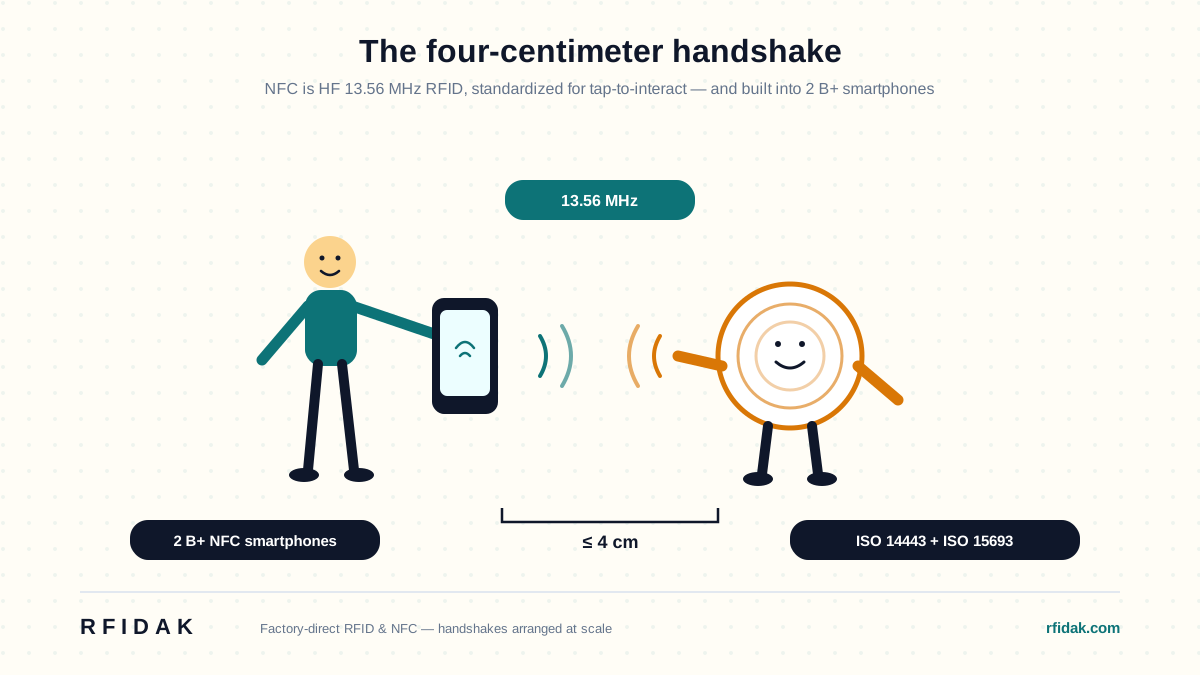
NFC (Near Field Communication) is a subset of HF 13.56 MHz RFID standardized for tap-to-interact use cases at ≤4 cm range. Built on ISO 14443 + ISO 15693, NFC tags work natively with billions of smartphones (iPhone 7+, Android 4.0+) without external readers. Three main use modes: tag read/write (NDEF data), card emulation (payment, transit), and peer-to-peer (device pairing).
What is NFC?
Near Field Communication (NFC) is a set of communication protocols for establishing radio communication between two electronic devices over a distance of 4 cm or less. NFC is a subset of RFID technology, operating specifically at 13.56 MHz frequency.
Unlike traditional RFID which is primarily one-directional (reader to tag), NFC supports two-way communication — less public announcement, more firm handshake. An NFC device can act as both a reader and a tag, enabling peer-to-peer data exchange. Your phone switches between the two roles all day and never mentions it.
2 B+
NFC-enabled smartphones worldwide
13.56
MHz operating frequency
< 4 cm
Max communication range
How NFC Works
NFC uses electromagnetic induction between two loop antennas. When two NFC-enabled devices are brought within range, they establish a communication channel — a four-centimeter conversation nobody else is invited to. There are three operating modes:
- Reader/Writer Mode: The NFC device reads or writes data to NFC tags
- Peer-to-Peer Mode: Two NFC devices exchange data directly
- Card Emulation Mode: The NFC device behaves like a contactless smart card
NFC Standards Stack: NFC Forum Type 1 / 2 / 4 / 5
The NFC Forum publishes five tag-type specifications that map physical chip families to NDEF data formats. Think of it as a casting sheet: five archetypes, each typecast for a reason. Picking the right type up-front determines smartphone compatibility, NDEF write protection, and per-tag cost — recasting after production is the expensive kind of drama.
| Type | Underlying Standard | Typical Chip | Best For |
|---|---|---|---|
| Type 1 | ISO 14443A (Topaz) | Innovision Topaz 512 | Legacy — rare in new builds |
| Type 2 | ISO 14443A | NTAG 213/215/216, MIFARE Ultralight | Marketing, smart packaging, business cards |
| Type 3 | JIS X 6319-4 (FeliCa) | Sony FeliCa | Japan transit (Suica, Pasmo, Octopus) |
| Type 4 | ISO 14443A/B | MIFARE DESFire EV2/EV3, NTAG 424 DNA | Payment, transit, secure access, anti-counterfeit |
| Type 5 | ISO 15693 | NXP ICODE SLIX/SLIX2 | Library, healthcare, longer-range HF |
For consumer-tap workflows on smartphones, Type 2 (NTAG 213/215/216) covers ~80% of deployments — cheap, NDEF-compatible, universally readable by iPhone and Android. For payment, transit, and any project that needs cryptographic guarantees, Type 4 (DESFire / NTAG 424 DNA) is the default.
NFC vs Traditional RFID
While NFC is built on RFID technology, there are key differences:
| Feature | NFC | Traditional RFID |
|---|---|---|
| Frequency | 13.56 MHz only | 125 kHz – 960 MHz+ |
| Range | < 10 cm | Up to 12 m (passive UHF) |
| Communication | Two-way (peer-to-peer) | One-way (tag → reader) |
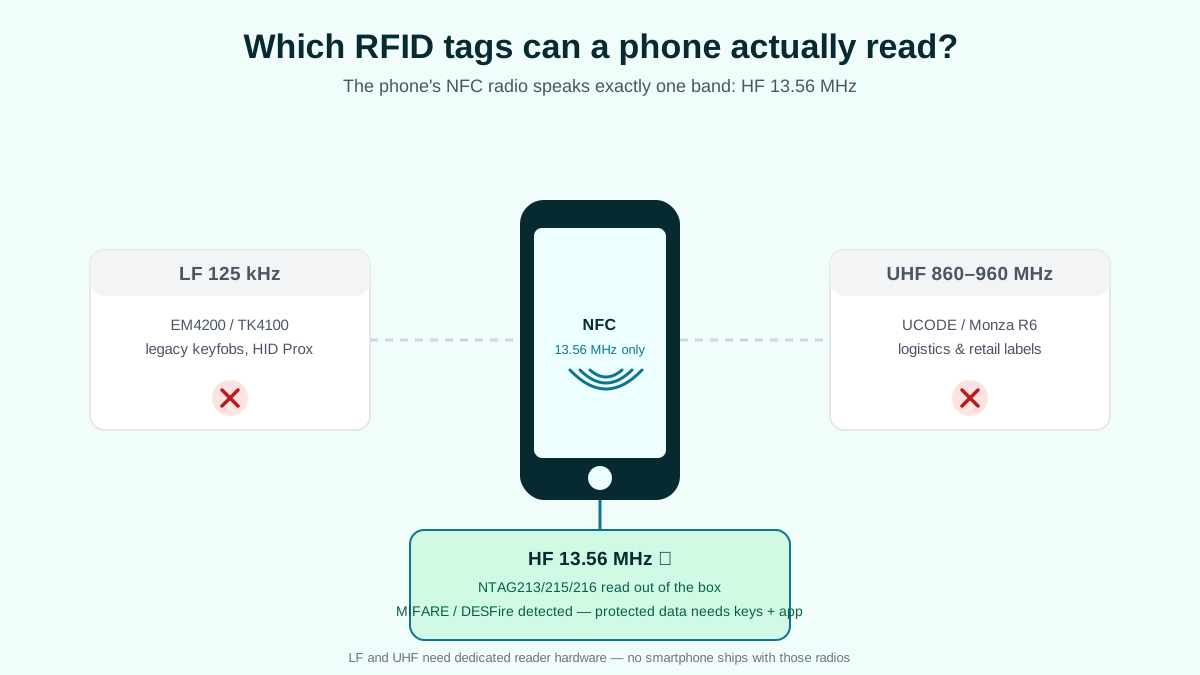
| Phone support | Built into smartphones | Requires dedicated readers |
| Best for | Payments, authentication, tap | Inventory, logistics, tracking |
For a deeper frequency comparison, read our RFID frequency selection guide or the RFID vs Barcode comparison.
NFC Security: From Open NDEF to Cryptographic Tap
NFC chip security exists on a four-tier scale, running from “front door left open” to “bank vault with a rotating combination” — pick the tier that matches the consequence of cloning or tampering. The default for marketing tags is Tier 1; the default for anti-counterfeit and transit is Tier 4.
- Tier 1 — Open NDEF. A public URL or vCard is readable and copyable by compatible NFC devices. Use it for marketing or information access, not as an unprotected authentication credential. Example chip: NTAG213.
- Tier 2 — Password-protected NDEF. Read access stays open; write access requires a 4-byte password. Stops casual re-writing but can be brute-forced. Chip: NTAG 215/216 (PWD_AUTH).
- Tier 3 — AES authentication (mutual auth on access). Reader proves it knows the AES-128 key before the tag releases data. Cannot be cloned without the key. Chip: MIFARE DESFire EV2/EV3, used in transit and payment.
- Tier 4 — Cryptographic tap with rotating URL (SUN). Each tap generates a different URL containing an AES-CMAC signature plus a monotonic counter. Brand server verifies signature + non-replay. Chip: NTAG 424 DNA; the standard for anti-counterfeit and digital product passports. See our NTAG 424 DNA guide.
Misjudging the tier costs money in opposite directions: spec'ing DESFire for a marketing campaign overpays 5× (a bank vault guarding a lunch menu); spec'ing open NDEF for product authentication invites trivial cloning attacks (a lunch menu guarding a bank vault).
Applications of NFC Technology
Contactless Payments
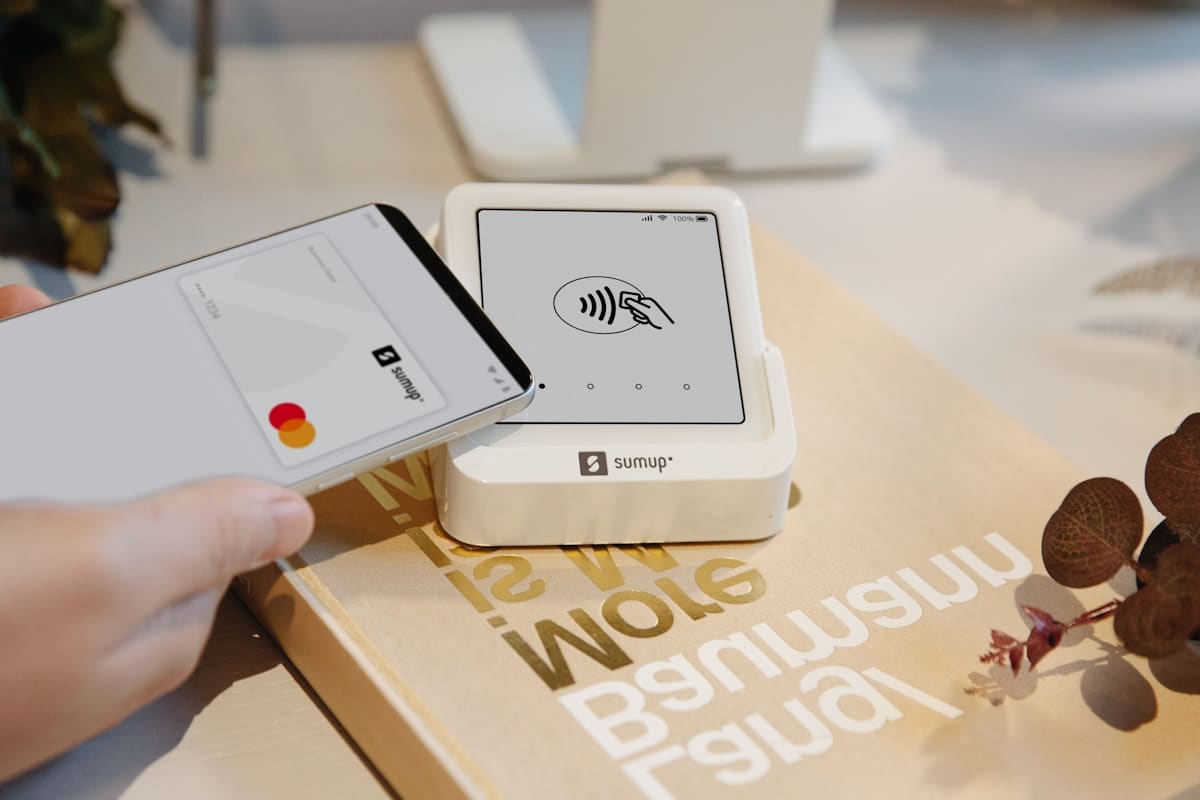
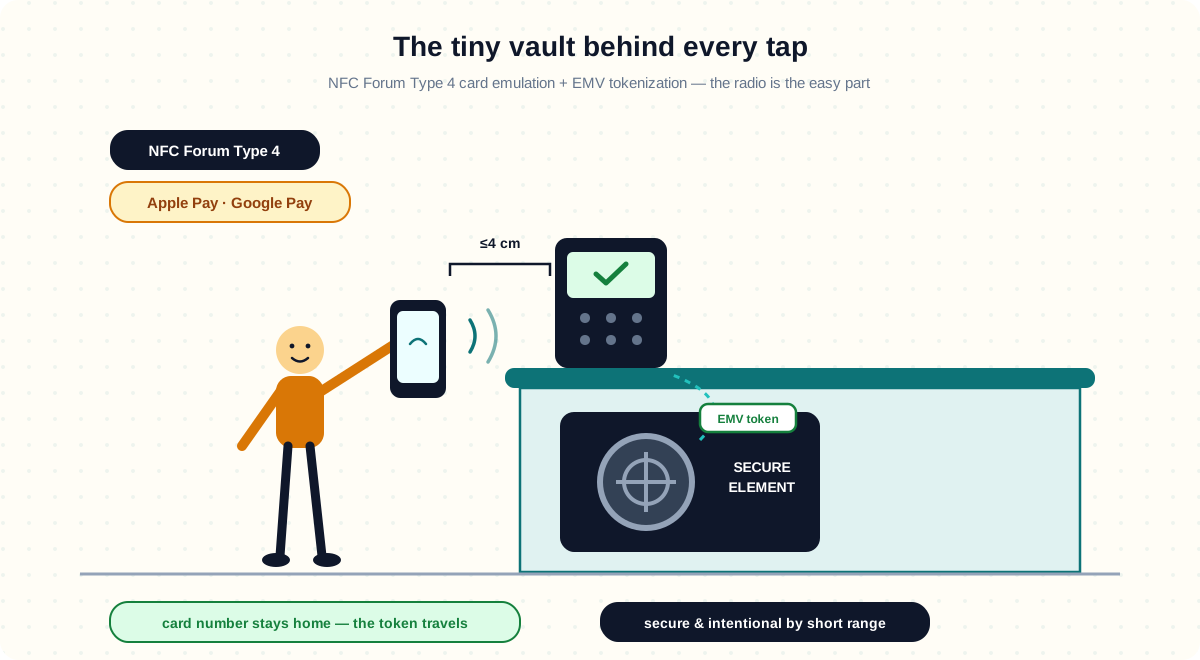
NFC is the technology behind Apple Pay, Google Pay, and contactless credit/debit cards. The short range of NFC ensures that payment transactions are secure and intentional — you cannot accidentally buy an espresso from across the room, which is either a safety feature or a missed business opportunity depending on your relationship with espresso.
Access Control
NFC-enabled smart cards and keyfobs are widely used for building access, hotel room keys, and secure area entry. The convenience of tapping instead of swiping makes NFC ideal for high-traffic areas.
Smart Marketing
NFC tags embedded in posters, product packaging, and retail displays can trigger website visits, app downloads, or promotional content when tapped with a smartphone. Check out our 10 NFC business use cases for practical examples.
Product Authentication
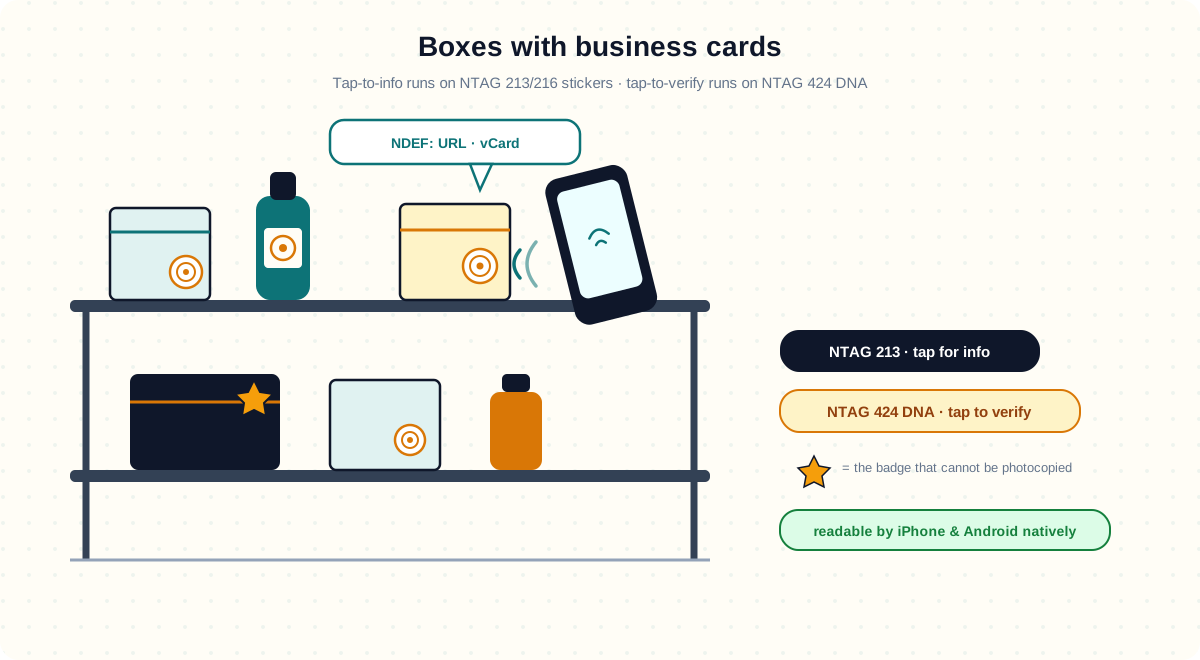
Luxury brands and pharmaceutical companies use NFC tags to verify product authenticity. Each tag contains a unique identifier that can be verified through a mobile app. Learn more in our NFC anti-counterfeit tags guide.
Emerging use case: Digital Product Passports
The EU is developing product-specific Digital Product Passport requirements under ESPR. Separate battery-passport rules apply to covered battery categories. A future textile or electronics requirement does not automatically mandate NFC; the final carrier and data rules must be checked for each product group. See our DPP guide for details.
How to Choose an NFC Chip for Your Use Case
Picking the wrong chip is the #1 source of failed NFC pilots — the hardware equivalent of hiring a nightclub bouncer to hand out flyers. Walk through the chip matrix below in order — environment first, security second, smartphone-first or reader-first third — and the right chip falls out.
- How much data do you need to encode? URL only → 144 bytes (NTAG 213) is enough. Multiple records, vCard + URL + mime types → 504 bytes (NTAG 215). Rich payload, multi-record, future expansion → 888 bytes (NTAG 216).
- What level of security do you need? Marketing → open NDEF (NTAG 213). Anti-tamper for write protection → password-protected (NTAG 215+). Anti-counterfeit / payment / transit → AES authentication (DESFire EV3 or NTAG 424 DNA).
- Smartphone-first or reader-first? Pure consumer tap → NTAG family. Closed-loop with proprietary reader (gym, hotel, transit) → MIFARE family. Both → NTAG 424 DNA hits the middle.
- Will the tag survive its environment? Indoor, dry → standard inlay. Outdoor / industrial / on metal → ABS or PCB hard tag with anti-metal layer.
- Volume and budget? Compare delivered quotes for the chosen chip, inlay, encoding and order size. A simple NTAG URL tag and an AES-enabled authentication tag solve different security problems; price the finished construction after confirming the workflow.
Common NFC Chip Comparison
| Chip | Memory | URL Length | Best For |
|---|---|---|---|
| NTAG213 | 144 bytes | ~132 characters | URLs, vCards, small data |
| NTAG215 | 504 bytes | ~492 characters | Gaming figurines, longer URLs |
| NTAG216 | 888 bytes | ~854 characters | Rich data, multi-record |
| Mifare Ultralight | 64 bytes | ~48 characters | Disposable tickets |
NFC Tap Distance: Why Phone Sweet Spot Matters
NFC's "≤4 cm" range is a theoretical maximum, in the same way a sofa's weight limit is a theoretical maximum. In real consumer-tap workflows, the practical distance is closer to 1–2 cm — and the iPhone’s NFC antenna sits at the top edge of the phone, while most Androids place it on the back-centre. Two phone tribes, two tap rituals. Designing your tag location without accounting for this is the most common reason "the tag doesn’t work on my iPhone."
- Smart packaging design tip — place the NFC sticker in a position where users naturally hold the package, with a printed "tap here" indicator at the antenna location.
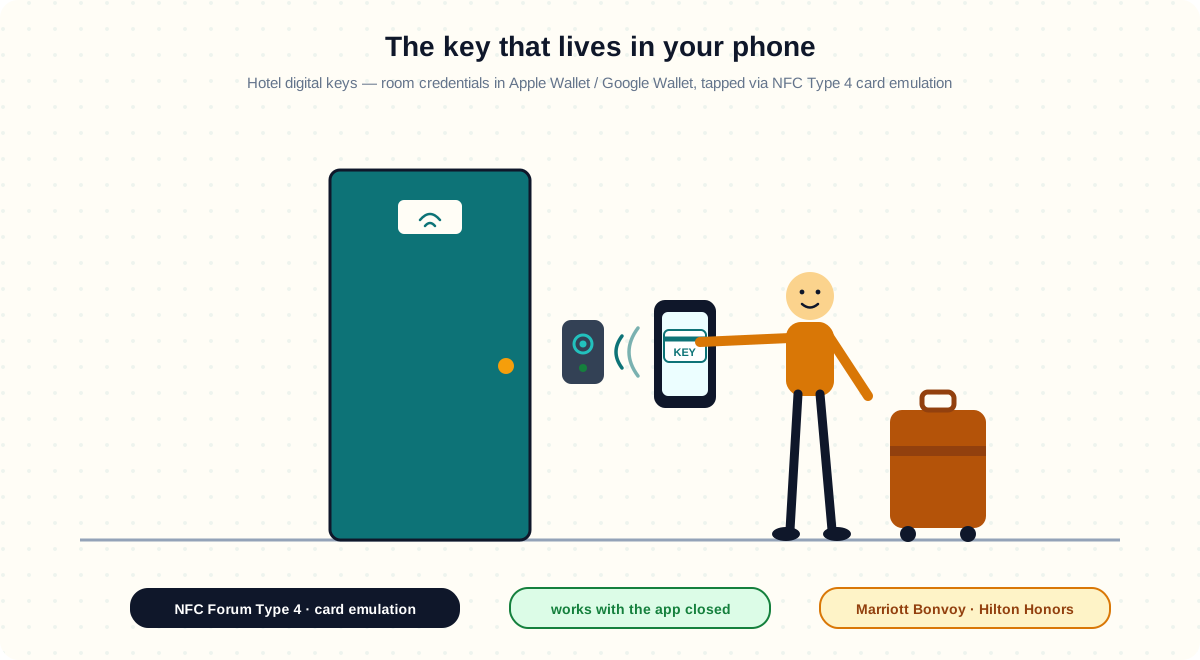
- Hotel digital key tip — test the exact phone models, wallet or app credentials and installed lock readers at the property before setting tap instructions.
- Tap-to-verify tip — for NTAG 424 DNA tap-to-verify on luxury goods, embed the tag at a location free of conductive materials (foil, metallic ink) within a 1 cm radius to avoid detuning.
NFC deployment patterns to evaluate
Phone-tap marketing, hotel access, product verification and Digital Product Passports each need a different combination of chip, reader, data owner and software. Start from the required phone or reader action and test a representative finished tag. For a secure verification flow, agree key custody and server-side checks; for hotel access, obtain the installed lock system's credential requirements; for EU product-passport planning, wait for the applicable product-specific rules before claiming compliance.
RFIDAK NFC Products
RFIDAK supplies a full range of NFC products for diverse applications — the same 13.56 MHz physics in four different outfits:
- NFC Stickers — self-adhesive, ideal for marketing, product tagging, and authentication
- NFC Epoxy Cards — durable, waterproof, custom-shaped for brand promotions
- NFC Coins — compact, easy to embed in products or furniture
- NFC Smart Cards — ISO standard PVC cards for access, loyalty, and identity
Key Takeaways
- NFC = HF 13.56 MHz RFID on ISO 14443A/B and ISO 15693, with read range ≤4 cm.
- Smartphone NFC reading: iPhone 7+ (iOS 11+), Android 4.0+ — no external reader hardware needed.
- Three modes: read/write (NDEF tag), card emulation (Apple Pay, transit cards), peer-to-peer (device pairing).
- Common chips: NTAG213/215/216 (read/write), MIFARE Classic/DESFire (card emulation), Type 2/4/5 (NDEF formats).
- Anti-counterfeit: NTAG424 DNA adds AES-128 plus SUN URL rotation for tap-to-verify product authentication.
⚠️ Common pitfall
iOS background NFC reading was disabled before iOS 11 and is gated behind app permissions even today. For consumer-tap workflows, design a clear “hold the phone here” visual cue and account for the iPhone’s small antenna sweet spot near the top edge.
NFC FAQ
Is NFC the same as RFID?
NFC is a subset of HF (13.56 MHz) RFID, standardised under ISO/IEC 14443 and 18092 with a tighter NDEF data format and tap-distance ceiling. Every NFC tag is RFID, but UHF and LF RFID tags cannot be read by phones — they are not NFC.
Why doesn’t my Android read my NFC tag?
Three common causes: (1) NFC is disabled in Android Settings → Connected devices → NFC; (2) the phone’s antenna is at the back-centre and you’re tapping with the top edge; (3) the tag uses an NFC Forum format the phone OS doesn’t auto-handle (e.g., raw mime types). Switch on NFC and align the back-centre over the tag.
How long do NFC tags last?
NFC tags are passive (no battery) and last 10+ years in normal use. The chip’s EEPROM is rated for 100,000+ write cycles per NXP datasheet; the limiting factor is usually the inlay substrate (PET, paper) under UV / abrasion, not the chip.
Can NFC be hacked or cloned?
An open NDEF URL can be copied to another compatible tag. Password protection can limit casual rewriting but is not a substitute for cryptographic authentication. NTAG 424 DNA and suitable DESFire implementations support stronger authentication when keys and the verification service are managed correctly.
What is the cheapest NFC chip?
NTAG213, NTAG215 and NTAG216 provide different memory capacities; NTAG424 DNA adds cryptographic features. Select by payload and security requirements, then request a current quote for chip, antenna, substrate, encoding and volume. No one chip is appropriate for a fixed share of deployments.
Sources
- ISO/IEC 18092:2013 — Near Field Communication Interface and Protocol (NFCIP-1). iso.org/standard/56692.html
- ISO/IEC 14443-1..4:2018 — Identification cards / contactless integrated circuit cards / proximity cards (HF 13.56 MHz). iso.org/standard/73598.html
- NFC Forum — Tag Type Technical Specifications (Type 1–5). nfc-forum.org/specifications
- NXP Semiconductors — NTAG 213/215/216 product datasheet. nxp.com/NTAG-FOR-TAGS-AND-LABELS
- NXP Semiconductors — NTAG 424 DNA datasheet (SUN URL feature). nxp.com/NTAG424DNA
- Apple Developer — Core NFC framework documentation. developer.apple.com/corenfc
- NFC Forum — "NFC: Where to use it" market reports. nfc-forum.org
All our NFC products are compatible with NTAG213, NTAG215, NTAG216, and MIFARE series chips. Contact us for samples and custom NFC solutions.
Need help turning this guidance into a product shortlist?
Use this next step when the article has narrowed the direction and you now need help choosing chips, formats, samples or the closest product family.
Comparison Pages
Compare the closest alternatives before you request samples
Open one of these if the article clarified the topic but the team still needs a cleaner format, chip or frequency decision.
Quick FAQ
Questions buyers often ask after reading this guide
How does NFC technology actually work?
NFC technology operates at 13.56 MHz under ISO/IEC 14443A and 18092, exchanging data through electromagnetic induction within roughly 4 cm. The reader (usually a smartphone) energizes the passive tag through its antenna; the tag responds by load-modulating the carrier wave. Three modes are defined: reader/writer, peer-to-peer (largely deprecated since iOS 13), and card emulation for payments. Range is intentionally short to require user intent and limit eavesdropping, which is why every Apple Pay or transit tap requires the phone almost touching the terminal.
What is the difference between NTAG213, NTAG215 and NTAG216?
NXP lists 144, 504 and 888 bytes of user memory respectively for NTAG213, NTAG215 and NTAG216. Choose after encoding the actual NDEF record and testing the target phones; URL length is not equal to user-memory bytes because NDEF formatting adds overhead. Price depends on the finished inlay and quantity.
When should I use NTAG424 DNA instead of NTAG213?
Use NTAG 424 DNA when a phone-readable message must be cryptographically checked by a configured backend and the team can manage keys and replay protection. NTAG213 suits an open URL without tag-level authentication. Neither chip alone establishes EU DPP compliance or proves the physical product is genuine; compare a finished-tag and verifier quote.
Is NFC the same as RFID?
NFC is a subset of HF RFID, not a separate technology. Both operate at 13.56 MHz and follow ISO/IEC 14443. The differences are practical: NFC supports two-way peer-to-peer and card emulation, NFC range is intentionally limited to about 4 cm, and every modern smartphone embeds an NFC controller. Traditional RFID broadly covers LF (125-134 kHz), HF (13.56 MHz including NFC), UHF (860-960 MHz) and microwave bands, and usually requires dedicated readers. UHF RFID is what retailers use for 12 m item-level inventory.
Which iPhones support NFC tag reading?
Every iPhone since the iPhone 7 supports NFC reading through an installed app. Background Tag Reading (no app required, automatic URL launch) works from iPhone XS onward running iOS 12 or later. The tag must contain a NDEF URL record using https; http URLs are silently ignored. Apple Pay card emulation works on every iPhone since the iPhone 6. For Android, native NDEF reading has been standard since Android 9 (2018) on virtually every mainstream device.
How much does an NFC tag cost in 2026?
Unit price depends on the exact chip and inlay, finished construction, approved quantity per design, printing, encoding, packaging and QC requirements. Request a dated itemized quote showing sample and setup charges, unit tiers, freight and lead time; a generic chip or tag price does not establish the cost of the approved product.
Why does my NFC tag work on Android but not on iPhone?
The most common cause is an http URL where iOS Background Tag Reading requires https. Other causes: the chip is locked to a custom MIME type that iOS does not auto-launch, the URL exceeds NTAG213 capacity and got truncated during encoding, or the user has NFC tag scanning disabled in Control Center on iOS 14 or later. Test by switching the URL to https, re-encoding on a freshly formatted NTAG215, and confirming the iPhone is iPhone XS or newer running iOS 12+.
What is the minimum order quantity for custom NFC tags?
RFIDAK's published standard tags-and-labels MOQ baseline is 1,000 pieces. Confirm the exact chip, antenna, construction, print, encoding and quantity per design in a written quote. Free stock samples (up to 5 pieces) — buyer covers DHL/FedEx freight ($25–60), refunded 1:1 against the first production order over $500. Larger evaluation lots, custom samples, production timing and delivery are agreed separately for the selected configuration.
Author
RFIDAK RFID Editorial Team
RFID supply editorial team
RFIDAK publishes practical RFID guides to help buyers compare chips, product formats, sampling plans and sourcing options before production.