Medical Device RFID & UDI 2026: Compliance, Tracking & Sterilization
A practical guide to RFID in medical-device tracking, including how UDI rules shape labeling, when direct marking matters, and where RFID helps beyond barcode-only compliance. Includes a practical starting scope for device makers.
Topic Cluster
Continue this topic with the next closest guides
These are the articles buyers usually need next when they are moving from basic research into a real shortlist, pilot or compliance discussion.
DSCSA RFID 2026: Pharma Traceability, Serialization & Anti-Counterfeit
DSCSA pharmaceutical traceability guide: regulated product identifiers and data exchange, plus a cautious framework...
Read this nextRFID TECHNOLOGYNFC Anti-Counterfeit Tags 2026: NTAG 424 DNA, SUN & Brand Protection
A buyer guide to secure NFC authentication. Covers when plain URL tags are not enough, how cryptographic NFC works,...
Read this next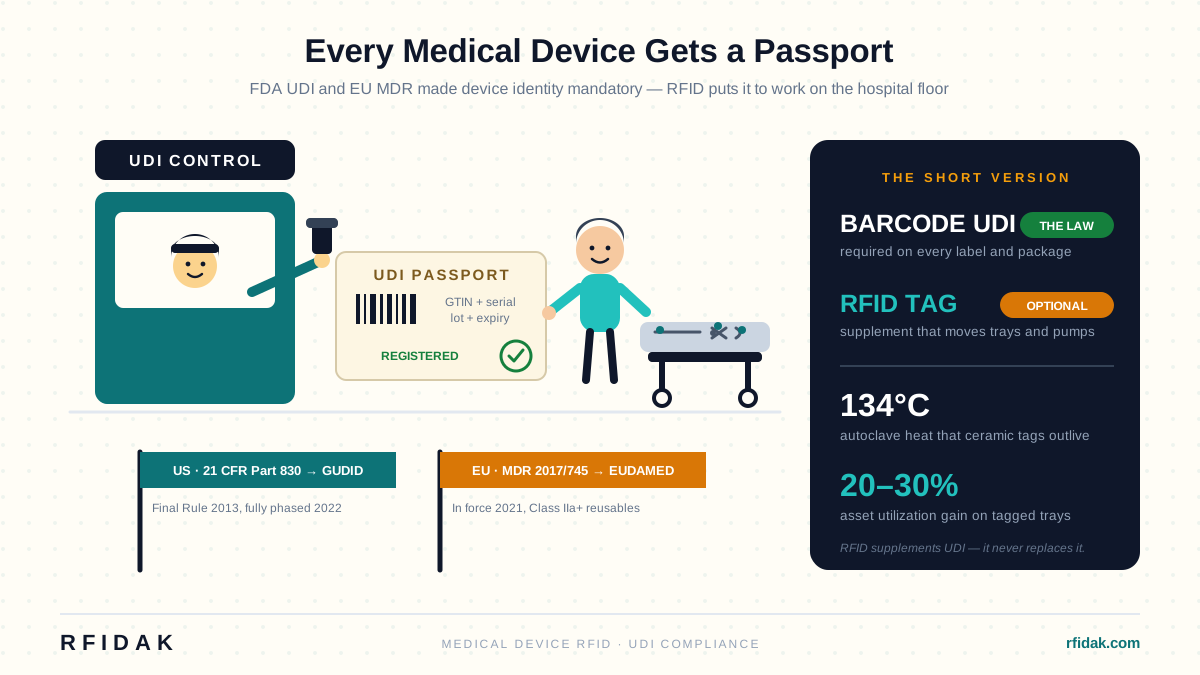
Quick Answer
FDA UDI (Unique Device Identifier) mandates medical device manufacturers attach machine-readable identifiers (1D or 2D barcode minimum, RFID optional) for traceability through hospital use, recall, and post-market surveillance. RFID supplements UDI with hospital-floor real-time tracking — high-value devices (surgical instruments, implants, mobile equipment) get UHF or HF RFID tags for asset tracking on top of mandatory barcode UDI.
Why UDI keeps medical-device tracking relevant
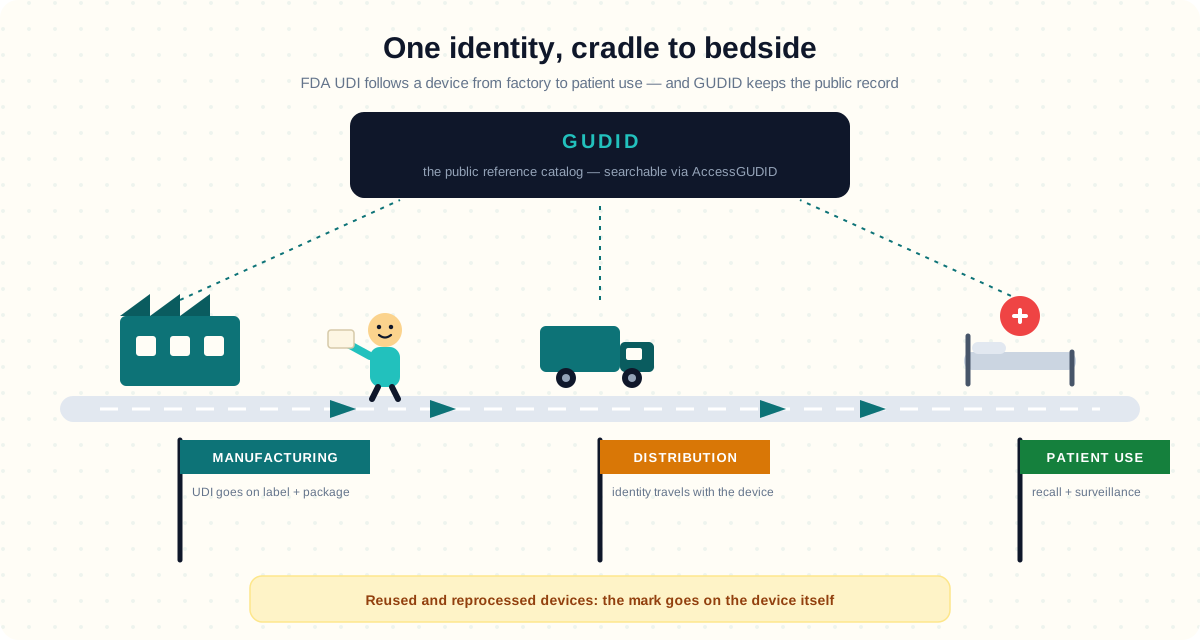
The FDA established the UDI system to identify medical devices sold in the United States from manufacturing through distribution to patient use — in effect, a passport office for every scalpel, retractor and infusion pump. That alone keeps device identification a live priority for manufacturers, hospitals and reprocessors. But compliance is only the opening act. Once teams begin structuring device identity properly, a quieter question follows: if every instrument already has a name, why is anyone still hunting for one by hand? That is where RFID comes in — internal handling, reusable instruments, sterilization workflows and asset visibility.
That is why medical device RFID remains a strong topic in 2026. UDI created the framework; operational visibility keeps expanding the use case. The passport was mandatory — the frequent-flyer program turned out to be the part everyone actually wanted.
What FDA requires at a high level
At a high level, FDA UDI rules require device labelers to place a unique device identifier on labels and packages and to submit device information to GUDID. For devices intended to be used more than once and reprocessed before each use, the FDA also requires direct marking on the device itself in many cases.
For manufacturers, this means the conversation often starts with barcode and label compliance — and then, like most compliance conversations, refuses to stay in its lane. Permanent marking, internal traceability and hospital-side usability all follow it into the room.
FDA UDI vs EU MDR: Two Regulatory Frameworks
Medical device manufacturers shipping into both the US and EU face two parallel regulatory regimes. They share a common goal (per-device identity for traceability) but differ in scope, timeline, and database mechanics. Buyers selling internationally need to comply with both:
| Dimension | FDA UDI (US) | EU MDR (Europe) |
|---|---|---|
| Legal basis | 21 CFR Part 830 (2013, fully phased 2022) | Regulation (EU) 2017/745 (in force 2021) |
| Database | GUDID (Global UDI Database) | EUDAMED |
| Required carrier | 1D or 2D barcode (HRI text) | Same: 1D / 2D barcode (AIDC) |
| Direct marking on device | Required for reusable, reprocessed | Required for Class IIa+ reusable |
| RFID position | Optional supplement | Optional supplement |
| Issuing agency | GS1, HIBCC, ICCBBA | GS1, HIBCC, ICCBBA, IFA |
Both frameworks accept GS1 as an issuing agency, which is why most multinational manufacturers use GS1 GTIN-based UDI carriers. RFID is supplemental in both; neither regime mandates RFID, but both leave room for manufacturers to add RFID alongside the required barcode for operational benefit.
Where barcode-only programs run into limits
Barcodes are essential and will remain part of UDI. But a barcode behaves like a flashlight beam: it needs line-of-sight scanning and clean presentation, one item at a time, aimed just so. In hospitals, labs and sterile-processing environments, that can become a bottleneck — nobody enjoys excavating a dense tray to show a scanner one label. Repeated handling and reprocessing conditions create workflows where automatic or faster identification becomes attractive.
RFID does not replace UDI — it reports to it. What RFID strengthens is how the device or instrument is located, counted and managed in real-world operations.
Where RFID helps most in medical workflows
- Reusable instrument and tray tracking — the roll call nobody wants to run by hand
- Sterile-processing and reprocessing workflows — fast-moving, gloved, and allergic to clipboards
- Hospital asset management for pumps, carts and mobile devices — the equipment with a gift for wandering
- Cabinet, room or procedural kit visibility — knowing what is inside without opening anything
- Faster inventory and exception handling — count in seconds, chase only the outliers
These are the environments where a hybrid barcode + RFID design often makes more sense than treating them as competing systems. The barcode satisfies the regulator; the tag satisfies the person pushing the cart.
Medical Device RFID Use Case Map
Healthcare RFID adoption clusters into five distinct workflows, each with characteristic tag formats and read patterns:
| Use Case | Tag Format | Sterilization | Read Pattern |
|---|---|---|---|
| Surgical instrument trays | Ceramic mini-tag (UHF/HF) | Autoclave 134°C | SPD tunnel + OR tray scan |
| Mobile equipment (pumps, beds) | FR4 hard tag (UHF) | Surface wipe-down | RTLS / room-level reads |
| Pharmacy & drug cabinet | UHF inlay on box | N/A (room temp) | Cabinet door + dispense gate |
| Implant identity | HF NFC mini-tag (in pkg) | Sterile-pack only | Pre-implant tap + log |
| Disposable kits / single-use | UHF inlay on packaging | Pre-sterilized supply | Receiving + dispense |
Direct marking changes the hardware question
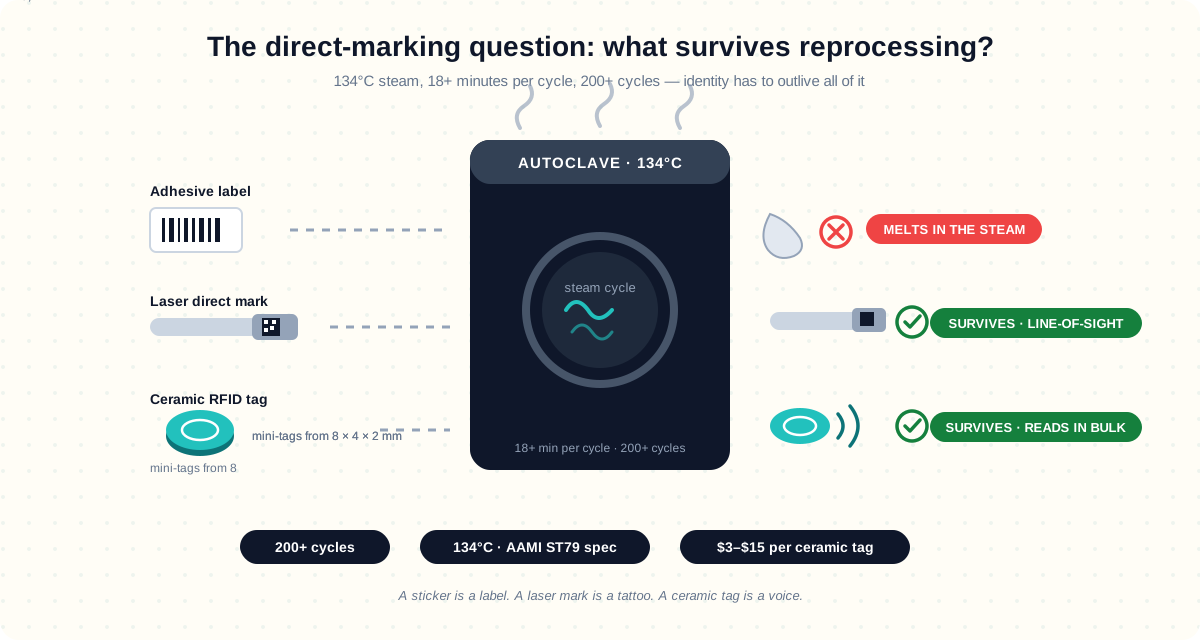
When a device must be directly marked because it is reused and reprocessed, the conversation shifts from a simple packaging label to a more durable identity strategy — a sticker does not survive a career of steam baths. Some items will still rely on direct part marking plus conventional scanning. Others may justify RFID if the workflow depends on repeated handling, tray association or non-line-of-sight visibility.
The key buyer question is whether the item only needs to comply, or whether it also needs to move efficiently through a real-use environment.
What GUDID and AccessGUDID mean for teams
FDA's GUDID acts as the reference catalog for devices with a UDI, and AccessGUDID makes that information publicly searchable — the phone book, if phone books were mandatory and audited. This matters because structured device identity is no longer only an internal manufacturing issue. It affects downstream lookup, device records and how device data is understood across the market.
Questions to answer before evaluating RFID
- Is the project only about UDI labeling, or about operational tracking too?
- Is the device disposable, packaged, reusable or directly reprocessed?
- Does the device need direct marking, tray-level tracking or both?
- Will the tag or marker face sterilization, high-level disinfection or repeated wash cycles?
- Who needs to read the item: manufacturing, hospital SPD, clinical staff or all three?
A practical pilot path
Start with one workflow, not the whole hospital or product catalog — pilots that try to boil the ocean mostly fog the room. Test the device or tray in the actual handling environment, including reprocessing, storage and issue points. If the item is metal-heavy or very small, tag construction and mounting method matter immediately. In many cases, the first pilot should focus on whether the chosen identity method actually reduces friction rather than simply proving the technology can be read: a tag that scans beautifully but saves nobody a minute is just a very durable souvenir.
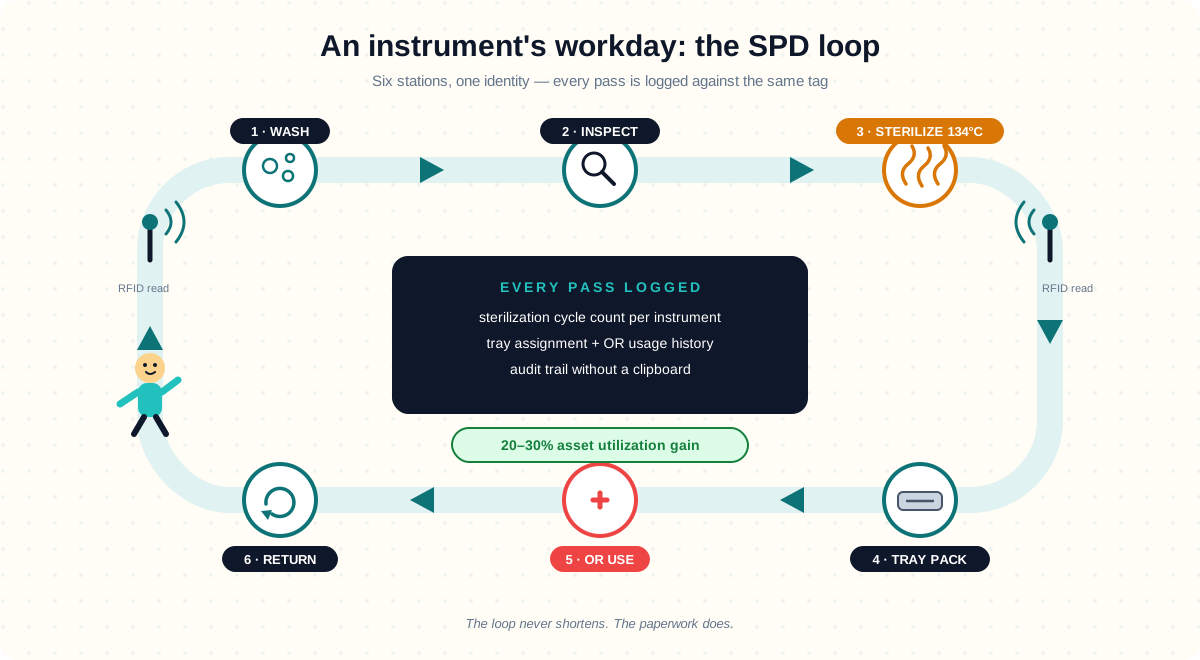
Illustrative healthcare evaluations
For surgical trays or reusable instruments, first define the facility's approved cleaning, sterilization and asset-record workflow. Have the responsible clinical and sterile-processing teams assess attachment safety, repeat-cycle durability and read points on the actual finished article. For mobile equipment, measure search time and inventory accuracy before and after a limited pilot. These are evaluation scenarios, not claims about a named hospital or a device's regulatory status. FDA UDI requirements must be assessed separately for the covered device and labeler.
Final takeaway
Recommended tags for medical devices
Ceramic tags — request model-specific sterilization and mounting evidence
High-temperature tags — test the finished assembly against the specified process
UHF labels — disposable device packaging
See also: DSCSA pharma traceability guide
Key Takeaways
- Regulation: FDA UDI Final Rule (2013), full implementation 2022.
- Required: check the device-specific FDA UDI label, package and direct-marking rules; UDI generally includes human-readable and AIDC forms.
- Optional add-on: UHF or HF RFID for hospital-floor real-time tracking.
- Tag types: evaluate only finished articles approved for the intended asset and process; an HF chip is not an implant approval.
- ROI: measure search time, cycle records, rework and replacements in a facility-specific pilot.
⚠️ Common pitfall
FDA UDI requires barcode — RFID alone is NOT compliant. Always pair RFID with the FDA-required barcode UDI; RFID is supplemental for asset tracking, not a substitute for compliance.
Medical Device RFID FAQ
Can RFID tags survive autoclave sterilization?
Yes — ceramic over-molded UHF tags and PPS button tags are rated for steam autoclave at 134°C for 18+ minutes per cycle across 200+ cycles. Avoid plain ABS tags (deform around 80°C) and standard adhesive labels (adhesive degrades in steam). Always specify autoclave compatibility per AAMI ST79 in the RFQ.
Can RFID tags be used inside the body for implants?
Direct in-body RFID is rare and tightly regulated. The more common pattern is RFID on the implant’s sterile package for pre-implant verification and post-implant logging. Veterinary microchipping (LF 134.2 kHz under ISO 11784/11785) shows in-body RFID is possible, but for human implants the regulatory bar is higher and only a few specialty devices have FDA approval.
What is the smallest RFID tag for a surgical instrument?
Small on-metal tags are available, but read distance falls with antenna area and depends on mounting and reader setup. Specify the available footprint and required read point, then test the smallest candidate on the real asset.
Are RFID tags MRI-compatible?
Standard RFID tags are NOT MRI-safe — the metal antenna and chip can heat up dangerously in MRI fields and disrupt imaging. For MRI environments, use MR-conditional RFID tags (specially designed without ferromagnetic content) or remove tagged items from the MRI suite. Always validate MR compatibility before deploying RFID near MRI scanners.
How does RFID cost compare to barcode-only UDI compliance?
UDI labeling and data preparation have their own costs. An optional RFID program also needs the selected finished tags, attachment validation, readers, integration, maintenance and process training. Use current quotes and a facility-specific pilot to estimate cost and benefit; there is no transferable SPD budget or payback period.
Sources
- FDA — UDI Final Rule (21 CFR Part 830). fda.gov/medical-devices/udi
- FDA AccessGUDID — Global UDI Database. accessgudid.nlm.nih.gov
- EU MDR — Regulation (EU) 2017/745. eur-lex.europa.eu/eli/reg/2017/745
- ISO 13485 — Medical devices Quality Management Systems. iso.org/standard/59752.html
- AAMI ST79 — Steam sterilization in healthcare facilities. aami.org
- AHRMM — Healthcare supply chain best practices. ahrmm.org
- IDTechEx — Healthcare RFID forecasts and case studies. idtechex.com
UDI established the baseline. RFIDAK can help buyers compare durable tag formats and reader hardware for medical workflows. Contact us for device or tray program guidance.
Discuss a regulated RFID workflow before you sample
Use this next step when the project touches UDI, DSCSA or other controlled environments and the team needs a safer pilot path.
Comparison Pages
Compare the closest alternatives before you request samples
Open one of these if the article clarified the topic but the team still needs a cleaner format, chip or frequency decision.
Quick FAQ
Questions buyers often ask after reading this guide
Does FDA UDI require RFID on medical devices?
No. FDA UDI generally requires a UDI on covered device labels and packages in easily readable text and an automatic-identification-and-data-capture form; the device labeler submits required device-identifier information to GUDID. RFID is optional. If added for tray, instrument or asset operations, validate that its data mapping and finished construction fit the device workflow; an RFID tag does not itself make a device UDI-compliant.
What RFID tag survives medical autoclave sterilization?
No chip material or housing guarantees autoclave life on its own. Obtain a finished-tag specification for the selected sterilization method, temperature, pressure, chemicals, number of cycles and attachment method. Test the tagged instrument or tray through the complete approved process and document RF performance, physical integrity and any patient-contact or cleaning requirements before procurement.
Which medical workflows benefit most from RFID?
Potential pilot workflows include instrument-tray association, reusable-equipment location, stock checks and expiry review. Select one workflow with known baseline counts and clear ownership, then measure identification rate, exception time and record completeness. Clinical safety, sterile-processing and regulatory requirements must be assessed separately for the exact item and tag construction.
How does GUDID work with RFID?
FDA GUDID stores identifying information for a device model keyed by its device identifier (DI); it does not store each unit’s production identifier, patient use or inventory events. An optional RFID identifier may be mapped in a local system to the relevant UDI and operational record. Validate that mapping and the labeler’s UDI obligations independently.
Which chip should I use for surgical instrument RFID?
Start with the instrument or tray, attachment point, metal exposure, required read point, cleaning and sterilization process, and the facility’s safety and data requirements. Select a complete tag construction and reader combination for that workflow, then test it through repeated approved processing. A chip name or bare-chip temperature rating does not qualify a surgical-instrument tag.
Can I track implants with RFID without affecting patient safety?
Do not add RFID to an implant or its sterile barrier based on a generic tag specification. The device manufacturer and clinical/regulatory team must assess material contact, sterilization, imaging, device performance and labeling for the exact design. Tracking the outer package, tray or inventory record may be a separate operational project; it still requires validation of the identifier and handling workflow.
How do I start an RFID pilot in a hospital?
Choose a bounded non-patient-contact workflow, such as equipment inventory or instrument-tray movement, with the hospital’s clinical engineering and sterile-processing teams. Establish baseline counts, record requirements, read points and safety constraints. Test a small approved sample through the real handling and cleaning process, document misses and exceptions, and expand only after the responsible teams approve the results.
What is the minimum order for medical device RFID tags?
RFIDAK's published standard tags-and-labels MOQ baseline is 1,000 pieces. Confirm the exact chip, antenna, construction, print, encoding and quantity per design in a written quote. Free stock samples (up to 5 pieces) — buyer covers DHL/FedEx freight ($25–60), refunded 1:1 against the first production order over $500. Larger evaluation lots, custom samples, production timing and delivery are agreed separately for the selected configuration. For medical, food, pharmaceutical or battery applications, define the applicable product and process requirements before testing. A tag sample or chip specification does not establish regulatory compliance, sterilization performance or safety of the finished assembly.
Author
RFIDAK RFID Editorial Team
RFID supply editorial team
RFIDAK publishes practical RFID guides to help buyers compare chips, product formats, sampling plans and sourcing options before production.