NFC Anti-Counterfeit Tags 2026: NTAG 424 DNA, SUN & Brand Protection
A buyer guide to secure NFC authentication. Covers when plain URL tags are not enough, how cryptographic NFC works, and what brands should compare before choosing anti-counterfeit labels.
Topic Cluster
Continue this topic with the next closest guides
These are the articles buyers usually need next when they are moving from basic research into a real shortlist, pilot or compliance discussion.
Medical Device RFID & UDI 2026: Compliance, Tracking & Sterilization
A practical guide to RFID in medical-device tracking, including how UDI rules shape labeling, when direct marking...
Read this nextRFID APPLICATIONSDSCSA RFID 2026: Pharma Traceability, Serialization & Anti-Counterfeit
DSCSA pharmaceutical traceability guide: regulated product identifiers and data exchange, plus a cautious framework...
Read this next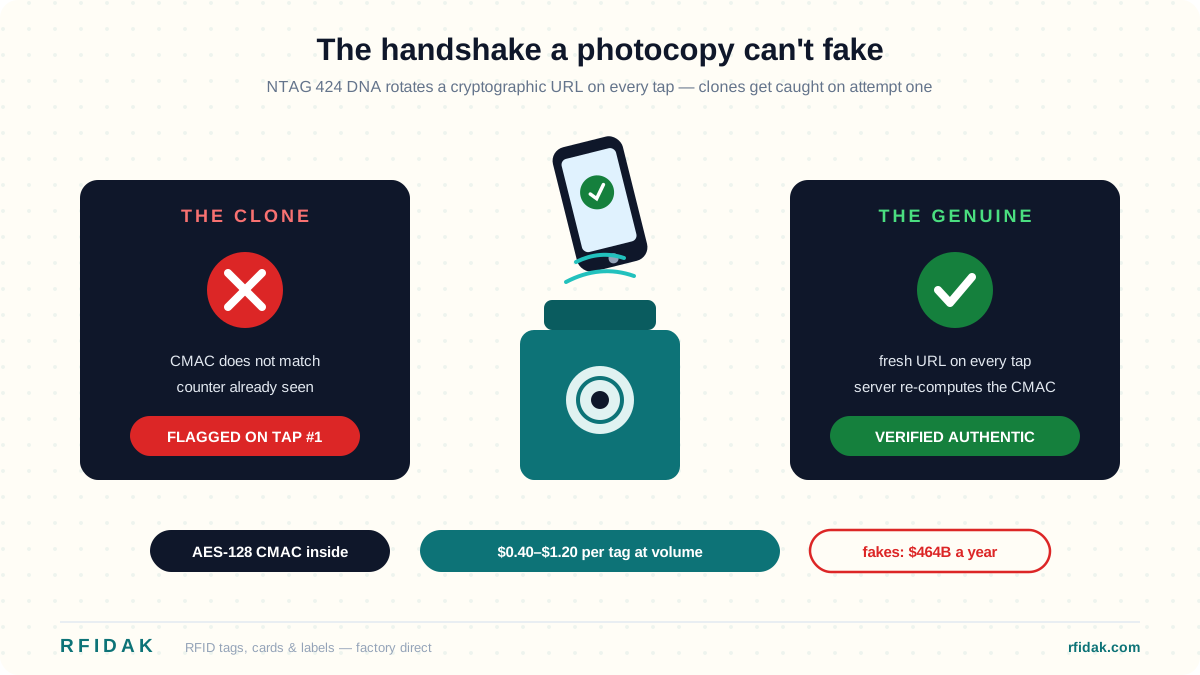
Quick Answer
NFC anti-counterfeit tags use NTAG424 DNA (NXP) chip with AES-128 encryption and SUN (Secure Unique NFC) URL rotation. Each tap generates a unique cryptographic URL the brand verifies server-side, making counterfeits detectable on first attempt. Used by luxury fashion (LVMH, Kering), pharmaceuticals, wine/spirits, and electronics for tap-to-verify product authentication.
Why secure NFC has become a hot topic
Counterfeit protection is no longer a luxury-handbag-and-whisky problem. Cosmetics, supplements, electronics accessories, spare parts and branded collectibles are all facing stronger demands for authenticity, traceability and consumer trust — the fakes, annoyingly, have diversified their portfolio. At the same time, smartphone tap behavior is now normal enough that brands can deploy authentication without asking customers to install specialized hardware. The verification terminal is already in everyone's pocket.
That is why secure NFC is growing faster than simple redirect tags. Buyers increasingly want one physical label that can support authenticity, service access, loyalty and product history in the same interaction — one sticker, four jobs, zero extra apps.
Plain NFC versus secure NFC
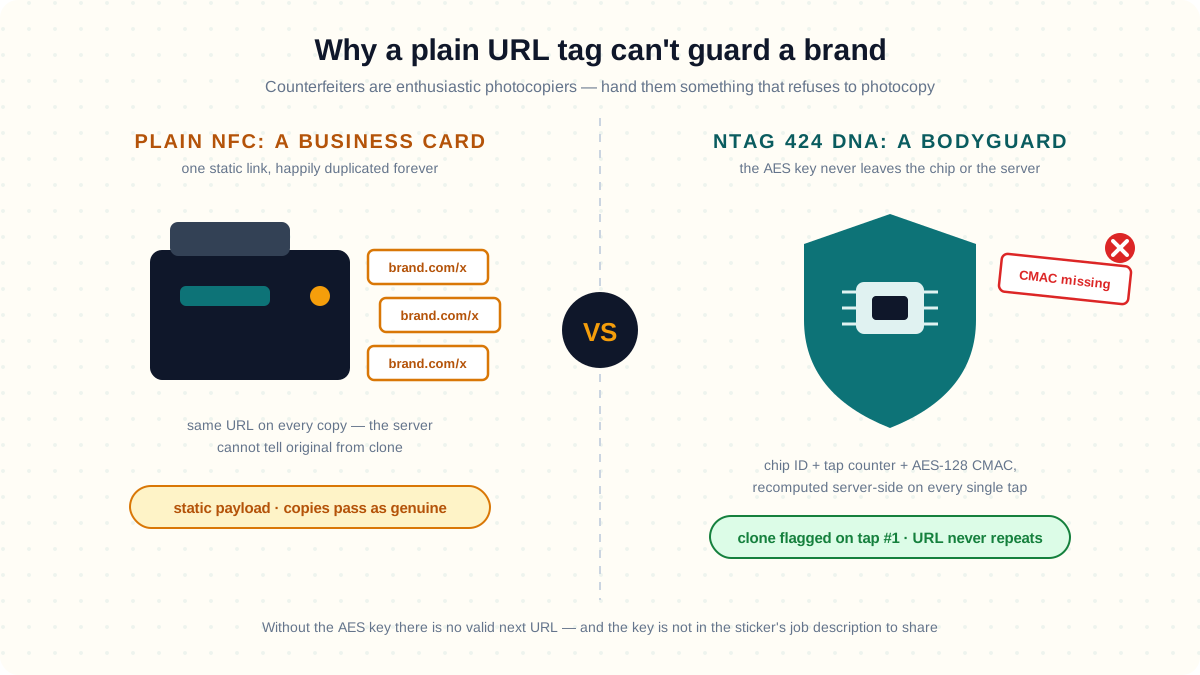
A standard NFC sticker is a business card: it can open a webpage or transfer a simple data record, which is fine for marketing, menus or quick product information. But a plain URL tag is not a strong anti-counterfeit system because the payload can be copied if the project relies only on a static link — and counterfeiters are, above all else, enthusiastic photocopiers.
Secure NFC is the bodyguard: chip-level features such as originality signatures, encrypted unique IDs, secure unique messages and mutual authentication. The result is a tap that can do more than redirect. It can help the backend check whether the tag is genuine, cloned, reused in the wrong geography or behaving in a suspicious way — and it makes that call on the very first tap.
How NTAG 424 DNA SUN Authentication Works
NTAG 424 DNA’s Secure Unique NFC (SUN) feature is the workhorse of consumer-tap anti-counterfeit — a secret handshake performed in public, millions of times a day. The mechanism in three steps:
- Each tap generates a different URL — the chip embeds three dynamic fields into the URL on every tap: a unique chip ID, a counter (incremented on each tap), and a CMAC (AES-128 message authentication code) computed over both. The URL changes every single tap; replaying an old URL fails verification.
- Brand server verifies CMAC + counter — the server holds the same AES-128 key that’s baked into the chip at manufacturing. It re-computes the CMAC over the chip ID + counter and compares to the value in the URL. The server also rejects URLs with counter values lower than the highest counter previously seen for that chip.
- Consumer sees verified result — if CMAC matches and counter is fresh, the consumer gets “Verified Authentic” + product info. If CMAC fails or counter is stale, the consumer sees a counterfeit warning, and the brand gets a fraud alert with location data.
A simplified SUN URL looks like:
The cryptographic guarantee: without the AES key, an attacker cannot forge a valid SUN URL even with full knowledge of the chip ID and counter. The key never leaves the chip or the brand server. This is why NTAG 424 DNA SUN is considered cryptographically uncloneable as of 2026.
Counterfeit Market: Why $500B+ Drives This Investment
If counterfeiting were a country, its trade balance would be the envy of most finance ministers. The OECD/EUIPO 2021 report estimated global trade in counterfeit and pirated goods at $464 billion per year, equivalent to ~2.5% of global trade. The market is growing despite enforcement, driven by e-commerce platforms, cross-border shipping, and sophisticated counterfeiter networks. Major affected categories:
- Luxury fashion & accessories — handbags, watches, footwear, sunglasses. Top counterfeit category by value.
- Pharmaceuticals — the highest-stakes category; counterfeit medication causes documented patient deaths. Driver behind DSCSA serialization.
- Cosmetics & personal care — counterfeit cosmetics often contain lead, mercury, or bacterial contamination.
- Wine & spirits — counterfeit aged wines and premium spirits, often refilled into authentic empty bottles.
- Electronics & spare parts — counterfeit phone chargers, batteries, automotive parts; safety-critical category.
Against that backdrop, the cost of NTAG 424 DNA tags ($0.40–$1.20 per piece) is small compared to the cost of brand erosion + product liability + customer returns triggered by counterfeit incidents — one settled lawsuit funds a great many tags. Industries like pharma and cosmetics also face direct regulatory pressure to deploy anti-counterfeit verification.
Where the newest secure-tag conversations are heading
Current market momentum is moving toward tags that moonlight — combining three roles at once:
- Customer-facing tap experience
- Authenticity verification
- Digital product passport or after-sales content
That is why brands are paying more attention to secure families such as NTAG 424 DNA and newer NXP secure-tag options positioned for DPP, originality checks and consumer interaction. Why hire three stickers when one can work three shifts?
When anti-counterfeit NFC makes the most sense
Secure NFC is strongest when the item is sold one by one and the brand cares about individual verification — products with a name, not just a SKU. Common examples include beauty products, wine, premium food, electronics accessories, official merchandise, limited releases and warranty-sensitive components.
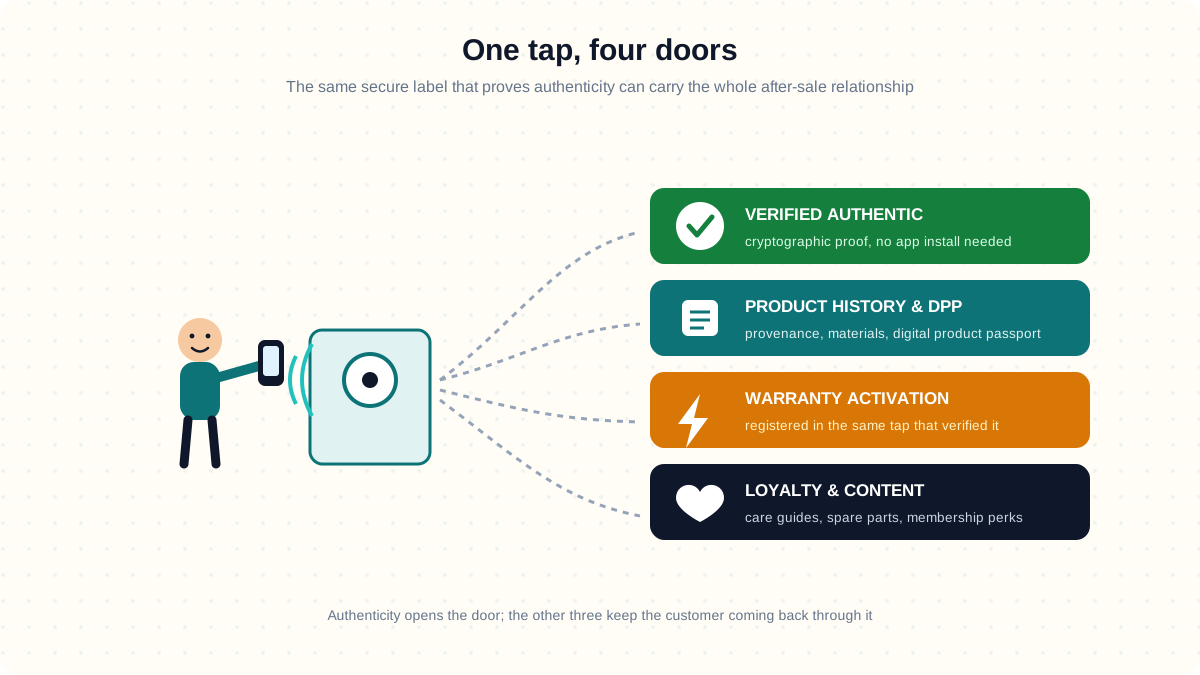
It is also useful when the brand wants post-sale engagement on the same label. After a genuine tap is confirmed, the same interaction can open care guides, warranty activation, spare-part ordering or membership content.
What tamper evidence adds
Authentication and tamper evidence are not identical — one proves who the product is, the other tattles on what happened to it. A cryptographic NFC tag helps verify identity, but some projects also need visible or electrical evidence that the label was removed or the seal was broken. That matters for refill fraud, package substitution and parallel-market repacking.
For those programs, buyers should compare whether they need a standard secure label, a destructible label, or a tamper-detect design that changes the backend response after opening.
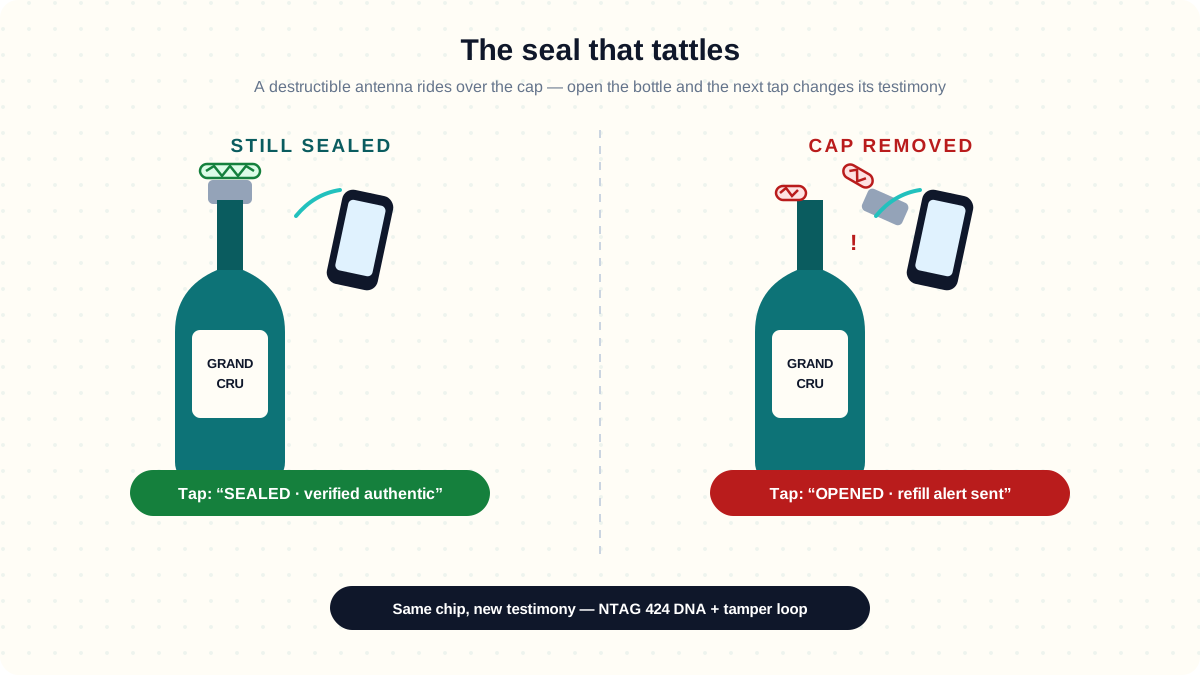
Architecture choices buyers should compare
| Approach | Best fit | Main limitation |
|---|---|---|
| Plain NFC URL tag | Marketing and basic engagement | Weak anti-cloning protection |
| Secure NFC authentication tag | Brand protection and consumer verification | Higher unit cost and backend setup |
| Secure NFC + tamper layer | Sealed products and refill-sensitive goods | More label-design complexity |
| Secure NFC + DPP flow | Brands combining compliance and authenticity | Needs stronger data governance |
Questions to answer before you buy samples
- Is the tag for marketing, authentication or both?
- What should happen after a first tap, second tap or suspicious tap?
- Does the product need visible tamper evidence?
- Will the label be applied to glass, plastic, foil pouch or curved packaging?
- Do you need the same label to support future DPP workflows?
How to run a strong anti-counterfeit pilot
Do not test secure NFC only on a conference table — conference tables are famously free of glass bottles, foil pouches and impatient customers. A real pilot should include label application, packaging material, smartphone compatibility, backend verification logic, duplicate-scan scenarios and service-team response when a suspicious tap appears. This is also the stage to compare chip availability and long-term supply continuity, not only first-sample performance.
Illustrative authentication pilots
For a packaged product, test the finished label on actual materials, the target phones and a controlled verification service. Include repeated and copied-message attempts, tag transfer, damaged seals, service outages and customer-support handling. For regulated medicines, check DSCSA product-identifier and tracing obligations separately; NFC is optional and a tag does not establish compliance.
Final takeaway
NFC authentication tag options
NFC stickers — tamper-evident, custom print, NTAG 424 DNA support
Tamper-proof tags — destructible antenna, void detection
Clear NFC tags — transparent, blends into premium packaging
Key Takeaways
- Chip: NXP NTAG424 DNA with AES-128, SUN URL rotation, message authentication code (MAC).
- Workflow: each tap generates unique URL → brand server validates → consumer sees “verified authentic”.
- vs static QR codes: NTAG424 generates fresh URL per tap; static QR is photocopied and replayable.
- Selection: require a documented threat model, finished-label tests, key custody and a maintained verifier before making product-authentication claims.
- Cost: compare the finished secure label, personalization, verifier service, operations and tamper-evident packaging against the measured risk and benefit.
⚠️ Common pitfall
NTAG424 DNA SUN feature requires server-side AES-128 verification. Buying bare NTAG424 chips without setting up backend validation defeats the purpose — confirm verification infrastructure BEFORE volume tag purchase.
NFC Anti-Counterfeit FAQ
Can NTAG 424 DNA be cloned?
Cryptographically, no. The chip’s AES-128 key is stored in protected on-chip memory and cannot be read out. A counterfeit chip cannot generate matching CMAC signatures without that key, and the SUN URL changes per tap so URLs cannot be replayed. As of 2026, there is no published practical attack against NTAG 424 DNA SUN in production silicon. Physical UID copying is still possible but the dynamic CMAC defeats it.
How does NTAG 424 DNA cost compare to a static QR code?
Static QR is essentially free ($0.001 printed). NTAG 424 DNA tags run $0.40–$1.20 per piece at 100K+ MOQ. The 400–1,200× cost premium is justifiable when: (a) the product retail value exceeds $50–$100, (b) counterfeit risk is meaningful, (c) the brand needs cryptographic proof rather than a verifiable lookup. For mass-market low-value goods, static QR + Digital Link is usually better.
Does the consumer need an app or is the browser enough?
Browser-only is enough — that’s a key feature. The chip generates a standard HTTPS URL, the phone opens it in the default browser, and the brand server returns either a verification page or a counterfeit warning. No app install required. iPhone (iOS 13+) and Android both handle this natively via NFC tap.
What if a counterfeiter just copies the URL the first tap returns?
The URL contains a counter that increments every tap. The brand server tracks the highest counter seen for each chip ID and rejects URLs with lower counter values. If a counterfeiter captures and replays an old URL, the server detects the counter as “already seen” and flags it. The cryptographic CMAC also prevents the counterfeiter from forging a higher counter value without the AES key.
Does NTAG 424 DNA work without internet connection?
No — SUN verification requires the brand server to validate the CMAC. Without internet, the consumer’s phone can read the URL but cannot reach the verification server. For offline use cases, alternative approaches include MIFARE DESFire EV3 with reader-side authentication, or simpler signature-based verification embedded in the URL itself (less secure but partially offline-capable).
Sources
- NXP Semiconductors — NTAG 424 DNA datasheet (SUN authentication). nxp.com/NTAG424DNA
- OECD/EUIPO — "Trade in Counterfeit and Pirated Goods" 2021 Report. oecd.org
- AURA Blockchain Consortium (LVMH, Prada, Cartier, Mercedes-Benz). auraconsortium.com
- NIST Special Publication 800-38B — CMAC mode for AES. csrc.nist.gov/sp/800-38b
- ISO/IEC 14443-1..4:2018 — HF NFC proximity cards. iso.org/standard/73598.html
- ISO/IEC 18092 — NFC Forum NFCIP-1. iso.org/standard/56692.html
- IDTechEx — Anti-counterfeit market forecasts. idtechex.com
The highest-value NFC authenticity programs turn one secure tap into trust, service and repeat engagement. If you are also evaluating DPP, see our digital product passport guide or contact us for a secure-label shortlist.
Turn this identity strategy into a tag shortlist
Best for teams deciding between QR, NFC and RFID and now needing help with tag placement, material fit, sample options or pilot scope.
Comparison Pages
Compare the closest alternatives before you request samples
Open one of these if the article clarified the topic but the team still needs a cleaner format, chip or frequency decision.
Quick FAQ
Questions buyers often ask after reading this guide
Can a normal NFC URL tag stop counterfeiting?
A plain URL can be copied and cannot authenticate a physical product by itself. A secure NFC system can verify configured messages through a backend, but must also address key custody, replay, tag transfer and product attachment. Test the complete workflow before making anti-counterfeit claims.
What is NTAG424 DNA SUN authentication?
NTAG424 DNA is a secure NFC chip from NXP with Secure Messaging (SDM) feature. Each tap generates a Secure Unique NFC URL containing an AES-128 cryptographic token that rotates per tap. The brand backend decrypts and verifies the token: if the tag is genuine and first-read, the response is positive; if the token is replayed from a cloned tag, the backend detects it. SUN works without an app through iOS Background Tag Reading and Android native NFC. This is the de facto anti-counterfeit standard for premium brands.
When do brands need secure NFC instead of QR codes?
Secure NFC is an optional design choice when a project needs cryptographic per-tap authentication and can operate the required key and verification service. A printed QR code is easier to copy, but EU DPP legislation does not generally mandate secure NFC, including for textiles or the battery categories covered from 18 February 2027. Choose the carrier against the applicable product rules and the real authentication workflow.
How much does an NFC anti-counterfeit tag cost?
Unit price depends on the exact chip and inlay, finished construction, approved quantity per design, printing, encoding, packaging and QC requirements. Request a dated itemized quote showing sample and setup charges, unit tiers, freight and lead time; a generic chip or tag price does not establish the cost of the approved product.
Should anti-counterfeit NFC also include tamper evidence?
Consider tamper evidence when opening or transfer would undermine the verification result. Choose a finished label or electronic loop whose break behavior is tested on the actual package. A valid NFC message alone does not prove a seal is intact.
How does NFC anti-counterfeit work from a consumer perspective?
The consumer taps an NFC-enabled smartphone (any iPhone XS+ or Android 9+) against the product tag. The phone reads the Secure Unique NFC URL and launches it in the browser. The brand backend decrypts the AES-128 token, verifies authenticity and tap history, and returns a page: first-time tap on a genuine tag shows authentic product plus warranty or content; duplicate tap or suspicious pattern shows warning or fraud response. No app required for most workflows with https URL records.
Which industries benefit most from NFC anti-counterfeit?
Authentication can be useful where product identity, diversion or tampering causes a measurable loss. Define the threat, user action, backend verification and package attachment for each product category; there is no reliable universal industry-volume ranking.
What is the minimum order for NFC anti-counterfeit tags?
RFIDAK's published standard tags-and-labels MOQ baseline is 1,000 pieces. Confirm the exact chip, antenna, construction, print, encoding and quantity per design in a written quote. Free stock samples (up to 5 pieces) — buyer covers DHL/FedEx freight ($25–60), refunded 1:1 against the first production order over $500. Larger evaluation lots, custom samples, production timing and delivery are agreed separately for the selected configuration.
Author
RFIDAK RFID Editorial Team
RFID supply editorial team
RFIDAK publishes practical RFID guides to help buyers compare chips, product formats, sampling plans and sourcing options before production.