Retail RFID Inventory: Labels, Encoding & Pilot Checks
Plan retail UHF inventory from the item label to the stock record. Check retailer requirements, EPC capacity, reader and printer fit, and a measurable pilot before ordering.
On this page
The buying decision
Retail RFID inventory uses UHF labels and external readers to identify individual items, then software turns those observations into stock records. A workable purchase starts with the reading task, retailer specification, finished inlay and EPC encoding. Approve samples on the real item, verify the data in the receiving system and define acceptance criteria before ordering. Labels alone do not deliver inventory accuracy, checkout integration or a complete retail solution.
How a label becomes an inventory record
A reader observing an EPC is the start of an event. It does not by itself establish whether an item was received, sold, returned or moved. Define the intended workflow and assign an owner to each step:
- Identify the item. Apply the approved label and encode its assigned identifier. Keep the item, printed barcode and EPC mapping together.
- Collect observations. A compatible UHF reader reports EPCs with available reader, antenna and time information. Confirm the installation country, settings and physical read zone.
- Interpret the event. Reader software or middleware groups repeated observations, applies zone and workflow rules, and sends exceptions for review. An item read repeatedly is still one item.
- Update the business system. An agreed interface maps the item and event to inventory, POS, WMS or ERP records. Test acknowledgement, failed updates, retries and reconciliation with the system owner.
Start with one defined task: receiving against a known shipment, counting a sales-floor zone, finding a particular item, or verifying a return. A receiving portal and a staff-operated count can require different read zones, exception rules and acceptance tests. Choose the first deployment from the operating problem and evidence gathered in the pilot.
Phone NFC is a different buying route. A phone's built-in NFC reader does not read these UHF EPC Gen2 labels. A phone can be part of the workflow when paired with compatible external UHF hardware and software. For consumer taps to a website, evaluate NFC stickers and test the intended phone experience separately.
Check the retailer's category before choosing the inlay
A chip name is not a retailer approval. Auburn's ARC specifications consider the use case, product or packaging, environment and RFID infrastructure; approved inlays are assigned against those specifications. Obtain the requirement for the actual selling unit and category, then identify the exact proposed inlay on the appropriate list. See Auburn's explanation of ARC specifications.
For a Walmart project, start from the current Walmart category and inlay lookup at Auburn. Confirm the applicable requirement with the program owner instead of relying on a general list of covered categories or an old supplier presentation. A list entry for another category does not establish suitability for your product.
Then validate the finished, encoded sample and its placement. Where the retailer requires ALEC validation, Auburn's submission process checks the approved inlay, tagging location, encoding and other end-user requirements. Confirm the applicable submission instructions and keep the resulting status with the order record. Supplier availability and a successful desk read do not replace that process. See Auburn ALEC validation.
Keep a dated approval record: retailer and category, requirement version or retrieval date, inlay maker and model, label drawing, placement photograph, encoding example and validation reference. Recheck the relevant requirements when the item, packaging, label or inlay changes. For a US sourcing brief, use the US retail UHF label purchasing page.
Match the EPC scheme before choosing chip capacity
In an SGTIN, the GTIN identifies a trade-item class and the serial distinguishes individual units sharing that GTIN. Keep the tag's TID separate from the EPC used to identify the item. The GS1 EPC Tag Data Standard defines these encodings and memory roles.
SGTIN-96 and SGTIN-198 have different capacity and serial-format requirements. SGTIN-96 uses a numeric serial with defined limits; SGTIN-198 supports a longer alphanumeric representation and needs 198 bits for that EPC encoding. It cannot fit into a chip offering only 96 or 128 EPC bits. Obtain representative serial values and the required scheme before approving the part.
Use this table to check capacity and supply questions. It compares IC characteristics, not finished-label read performance or retailer approval.
Swipe the table to compare chip and order checks.
| Chip | Memory boundary | Before ordering |
|---|---|---|
| Impinj Monza R6 | Up to 96 bits EPC; no user memory | Confirm the EPC format fits. This chip has no Access or Kill password and is not killable; do not apply R6-P specifications. |
| Impinj M730 | 128 bits EPC; no user memory | Check the approved inlay and encoding. Access and Kill share a 32-bit password; approve the exact controls before production. |
| NXP UCODE 8 | 128 bits EPC; no user memory | NXP marks UCODE 8 / 8m No Longer Manufactured. Confirm traceable supply and a repeat-order plan; UCODE 8m has different memory. |
Confirm who owns identifier allocation, which data file is authoritative and how replacements avoid duplicate item identities. Read back an encoded sample and have the receiving system decode it. Compare the result with the intended item and visible barcode. Approve supported lock or password settings for the exact chip; do not apply permanent changes before this check.
Chip references: Impinj Monza R6 documentation, Impinj M700 specifications and NXP UCODE 8 specifications and manufacturing status.
Specify the finished label, reader and printer together
- Item and attachment: provide the label area, curvature, packaging layers, nearby metal, foil and contents. Test liquid-filled products at representative fill levels. Select a suitable UHF on-metal construction when needed; a standard sticker or NFC isolation layer is not an interchangeable solution.
- Finished construction: name the chip and inlay, then approve the label outline, face material, adhesive, liner and application position. Include handling and exposure requirements that need documented performance or testing.
- Reader setup: identify the country, reader model, antenna, settings, orientation, item density, movement and read window. A handheld result does not establish portal performance or a guaranteed range.
- Printer and encoder: confirm the exact printer model and installed UHF RFID option, supported inlay, firmware and software. Approve print stock, inlay position, label pitch, liner width, roll core, outer diameter and winding on a sample roll.
- Supply responsibility: distinguish blank labels, printed labels awaiting your encoding, and printed-and-encoded labels. Assign artwork, data allocation, write verification, reject handling and acceptance records to named teams.
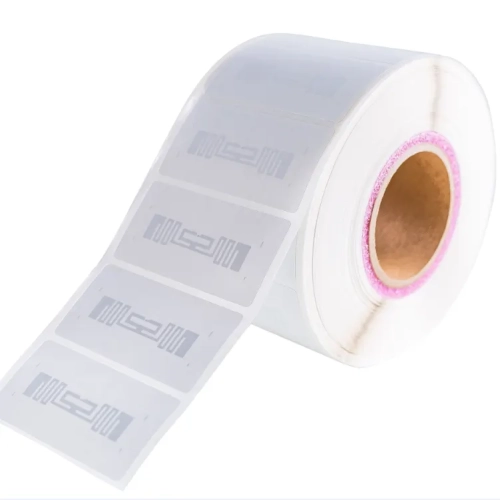
The UHF sticker product page brings these label and roll requirements into one sample request. Reusing a familiar chip does not remove the need to approve a different antenna, adhesive, packaging or printer setup.
Run a pilot that can explain its failures
Use a physically checked test population and a saved expected-EPC list. Record the item mix and label coverage before testing; untagged items cannot appear in the RFID population. Include representative difficult items, intended stacks and orientations, and items just outside the target zone. Keep the original result when a retry is required.
- Agree the protocol. Define the task, boundary, expected items, start and stop conditions, operator route and allowed retries. Freeze movements or log them so the physical reference remains meaningful.
- Save observations and exceptions. Keep the reader configuration, raw observations and grouped unique EPCs. Separate expected items missed from unintended nearby items observed.
- Verify identifiers physically. Investigate missing, unknown or mismatched records. Two labels bearing the same EPC are an encoding defect; repeated reads of one correctly identified item are normal observations that software must handle.
- Follow the event to inventory. Check the right item and location, successful update, retry behavior, rejected events and manual correction history. Review a return or replacement if that operation is in scope.
- Repeat after a controlled change. Change one relevant factor, such as placement or reader setting, retain the previous record, and compare the same measures. Agree the final acceptance criteria before production.
An illustrative pilot record: 200 items, not 1,250 reads
This is a hypothetical worked example, not an RFIDAK customer result or an acceptance promise. Assume a closed test zone contains 200 individually verified items, each with one different, correctly mapped EPC. No item moves during the test. The reader reports 1,250 observations, which software reduces to 199 distinct EPCs: 197 expected and two outside the expected list.
Swipe the table to read each measure and its meaning.
| Measure | Recorded result | Meaning and next check |
|---|---|---|
| Expected item population | 200 distinct item EPCs | An independently checked physical reference, fixed for this test. |
| Raw observations | 1,250 | Includes repeated observations. This is not an item count. |
| Expected EPCs observed | 197 / 200 = 98.5% | Expected-item detection for this trial. Three expected EPCs were missed. |
| Unexpected unique EPCs | 2 | Investigate neighboring items, wrong mappings or reference-list errors; do not add them to the intended zone without verification. |
| Repeat observations | 1,250 − 199 = 1,051 | Additional observations beyond the first observation of each distinct EPC. These do not prove duplicate-encoded physical labels. |
| Unexpected share of unique reads | 2 / 199 ≈ 1.01% | The denominator is all unique EPCs observed, not the 200 expected items. |
| Correct records accepted by inventory | 196 of the 197 observed expected items | One observed item failed the system update. End-to-end coverage is 196 / 200 = 98.0% for this test. |
| Elapsed time and decision | Record actual time; apply agreed criteria | The example does not supply a target or pass result. Resolve missed items, unwanted reads and the failed update before sign-off. |
A read-rate percentage is not an inventory-accuracy percentage. Compare system stock with a separate physical audit at a defined time. For example, if your metric is exact SKU-location count agreement, its denominator is the number of SKU-location records audited. It is different from detecting expected EPCs. Log items without tags, duplicate-encoded items, reservations, damaged stock and movement exceptions rather than hiding them inside one favorable percentage.
Compare the full cost over the same operating scope
Request prices for the same label, data work, quantities per design and delivery terms. Then build the project budget separately. A lower label unit price does not establish a lower deployed cost.
Swipe the table to compare purchasing cost categories.
| Cost line | What to request or measure |
|---|---|
| Recurring labels | Approved chip, inlay and finished construction; print coverage; quantity per design; replacement and rework assumptions. |
| Encoding and setup | Separate recurring encoding and verification from artwork, tooling, data preparation, sample work and any required validation. |
| Equipment and software | Readers, antennas, printer-encoders, accessories, installation, licenses, support and maintenance. |
| Integration and operations | Interface development, testing, training, counting, exception handling and reconciliation labor. |
| Delivery | Sample and production freight, quoted trade terms and destination-dependent landed charges. |
A useful planning formula is: project cost = setup and integration + equipment + recurring labels and encoding + operating and software costs + delivery costs, measured over one declared period. Compare it with the cost and measured outcomes of the existing process over that same period, item population and scope.
For labor, compare completed counting and reconciliation hours multiplied by your own loaded hourly cost. Include retry and exception time. A business case can also track verified stock corrections or fulfillment outcomes, but do not infer a sales or shrinkage benefit directly from read rate or count the same benefit twice.
What to send with a retail label RFQ
Send the retailer and selling country; current category or inlay specification; item and packaging photos; proposed attachment position; chip and inlay if specified; EPC scheme and sample data; printer and reader details; label and roll drawing; quantities per design; and destination. Share the pilot's failed cases as well as its best result so the supplier can assess the construction that needs to change.
RFIDAK's role in this request is label supply and the agreed printing, encoding and sample work. Confirm system design, installation, software integration and retailer validation responsibilities with the relevant teams. A label quotation should not imply that those services or approvals are included.
The standard tags-and-labels order baseline is 1,000 pieces. The quote confirms the exact configuration, quantities per design, availability, sample charges and production schedule; freight and arrival planning depend on the destination. Review the sample policy before agreeing the test shipment.
Ready to define the label?
Bring the item, inlay requirement and data workflow into a sample and quotation review.
Prepare a retail UHF label inquiry →The contact page opens an editable retail inquiry draft. Nothing is sent until you submit it.
Quick FAQ
Questions buyers often ask after reading this guide
What equipment does retail UHF RFID inventory need?
A retail UHF inventory workflow needs suitable labels, compatible external UHF readers and antennas, software that interprets the observations, and an agreed connection to the inventory system. The software must map each identifier to an item, handle repeated reads and exceptions, and record the intended business event. Buying labels alone does not provide a working stock-control system.
Can staff check retail UHF labels with a phone?
A phone's built-in NFC reader cannot read UHF EPC Gen2 inventory labels. Staff need a compatible external UHF reader, such as a handheld or phone accessory, with the appropriate application and regional configuration. NFC labels are a separate option for consumer phone-tap links. Verify the complete hardware and software arrangement before ordering labels.
Does an ARC-approved inlay make a finished label retailer-approved?
An inlay must match the specification assigned to the retailer's current item category. That selection does not replace checks on the finished label, placement and encoding. Where the retailer requires ALEC validation, Auburn's submission process separately checks these requirements for the supplied samples. Confirm the current program, exact inlay and required submission evidence before production; approval for another category or construction is insufficient.
Can SGTIN-198 be encoded in a 96-bit or 128-bit EPC chip?
No. SGTIN-198 needs 198 bits for that EPC encoding. Monza R6 provides up to 96 bits of EPC memory, while M730 and UCODE 8 provide 128 bits. These capacities do not fit SGTIN-198. Obtain the required scheme and representative serial values before chip selection. A scheme change needs approval from the receiving system or program owner.
What is the difference between EPC, GTIN, serial number and TID?
For an SGTIN identifier, the GTIN identifies the trade-item class and the serial distinguishes individual units sharing that GTIN. EPC is the encoded item identifier used by the RFID workflow. TID identifies the tag IC and is separate from the writable EPC; it does not replace an approved item-serialization plan. The system must maintain the intended relationship between the item, tag and printed label.
How should a retail RFID pilot measure missed and unwanted reads?
Prepare an independently checked list of expected item EPCs for a defined zone and read window. Count expected unique EPCs observed, expected EPCs missed and unexpected unique EPCs observed separately. Repeated observations of one EPC are not extra items. Also investigate two physical items carrying the same EPC, incorrect item mappings and records that fail to reach the inventory system. These are different failure types.
Does a high RFID read rate prove inventory accuracy or ROI?
No. Read rate describes a defined reading test. Inventory record accuracy also depends on tagging coverage, item mappings, locations, movement, reservations, returns and successful system updates. Compare system records with an independent physical audit using a declared metric. Estimate financial benefit only from measured operating results and costs over the same scope and period, without assuming a universal payback.
What should a retail RFID label quote include?
Request the exact chip and finished inlay, label construction, quantities per design, printing, serial allocation, encoding verification, roll format and destination. Separate labels and recurring encoding from setup, sample work, reader or printer hardware, software, integration and freight. RFIDAK's standard tags-and-labels MOQ baseline is 1,000 pieces; the selected configuration, availability, sample charges and delivery schedule are confirmed in the quote.
Author
RFIDAK RFID Editorial Team
RFID supply editorial team
RFIDAK publishes practical RFID guides to help buyers compare chips, product formats, sampling plans and sourcing options before production.