Skip to content
RFID Readers

RFID Reader Writer

Need hardware that can read or encode the exact chip family you plan to deploy?

MOQ
1 pc (eval)

Stock SKU. Custom tooling from 2,000 pcs.

Lead time
7–15 days

Standard; rush possible on request.

Free sample
Ships in 1–3 days

Stock samples via DHL / FedEx.

Use this hardware when the project needs enrollment, encoding, or compatibility testing around a specific chip family and interface. Confirm protocol support, SDK expectations, and deployment style before the shortlist is locked.

What buyers usually confirm first

swipe →

Protocol

Which chip, frequency, and standard must the reader support?

Compatibility with the credential comes first, especially for access, enrollment, and encoding workflows.

Form Factor

Desktop device, reader-writer, fixed reader, or OEM module?

Choose the hardware style around the operator workflow, not only the protocol.

Integration

What operating system, SDK, or interface does your team expect?

Reader projects move faster when interface expectations are confirmed before sampling.

Spec Check

What to confirm before hardware testing

Chip protocol, operating system, interface, and SDK expectations should all be clear before a reader sample is approved.

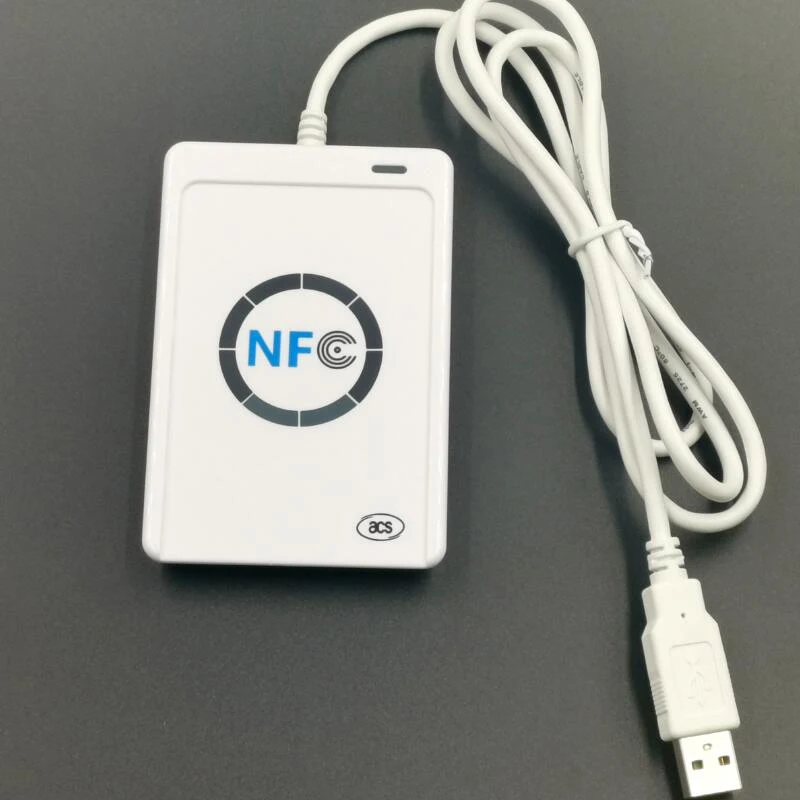
Product Name RFID Reader/Writer (Desktop / OEM Module)
Form Factor Desktop enclosure 86x54x12 mm / OEM board 62x42 mm / UART module 28x18 mm
Weight Desktop 38 g / OEM board 12 g / UART module 6 g
Communication Interface TCP/IP (Ethernet), USB 2.0, UART TTL, RS232 (optional)
Power Supply 5V DC regulated or PoE (IEEE 802.3af); max operating current 400 mA
Supported OS Windows 10/11, Windows Server, Linux (Ubuntu/Debian/RHEL), Android 8.0+, macOS 11+, Raspberry Pi OS
RF Protocol ISO/IEC 14443 Type A, Type B (optional), ISO/IEC 15693 (optional), ISO 18092 (NFC)
Supported Cards NXP MIFARE Classic 1K/4K, Ultralight EV1/C/Nano, DESFire EV1/EV2/EV3, MIFARE Plus EV2; NTAG213/215/216, NTAG424 DNA; Type A/B CPU / Java Card / SmartMX; ICODE SLIX/SLIX2
Communication Speed 106, 212, 424, 848 Kbit/s
Read Range Up to 5 cm (typical 3-4 cm for cards)
Cryptography AES-128, 3DES, session keys, NTAG424 DNA SUN verification (SDK helper)
SDK Free, open-source examples in C, C++, Java, Python; community bindings for Node.js, Go, C#
Certifications CE RED, FCC Part 15, RoHS 3, REACH
Operating Temperature -10 deg C to +55 deg C
Storage Temperature -25 deg C to +70 deg C
Humidity 10-90% RH non-condensing
LED Indicators Power, link, activity, encoding success/fail
Warranty 2 years standard; extendable to 3 or 5 years
MOQ 10 units for evaluation; production pricing at 100+

Shortlist Logic

Why this reader setup makes the shortlist

Hardware usually stays in consideration when it reduces integration risk and supports the exact credential workflow being planned.

Free SDK with source code examples in C, C++, Java, and Python - reduces OEM integration time from weeks to days for custom RFID applications
TCP/IP communication with PoE power supply option - single Ethernet cable provides both data and power for simplified network deployment
Multi-speed: 106, 212, 424, 848 Kbit/s - supports high-speed card encoding for hotel check-in and transit ticket issuance throughput
ISO/IEC 14443 Type A + Type B + ISO/IEC 15693 covers MIFARE, DESFire, CPU cards, and ICODE library tags in a single reader
Windows, Linux, Android compatible - deploys on desktop PCs, industrial terminals, Raspberry Pi, and Android kiosks without driver issues
Custom firmware development available - The engineering team supports protocol modifications and OEM-specific feature requests

Use Cases

Where teams usually use this reader setup

Deployment context helps determine whether this hardware belongs at a desk, in a kiosk, in a gate, or inside a device.

Access control door readers

encode and read employee badges for building entry systems with TCP/IP-networked controllers

Self-service kiosk integration

embedded reader module for payment, ticketing, and visitor check-in kiosk hardware

Library self-checkout stations

read and write ICODE SLIX tags per ISO/IEC 15693 for patron self-service and EAS deactivation

Hotel check-in terminals

encode MIFARE and DESFire room key cards at front desk and self-service check-in kiosks

Industrial workstation authentication

operator login and data logging via card tap at manufacturing terminals

OEM hardware integration

embed reader modules into custom-designed terminals, gates, and vending machines

Desktop RFID Reader vs USB NFC Dongle — How To Choose

Multi-frequency industrial reader or consumer NFC stick? Pick by frequency + use case

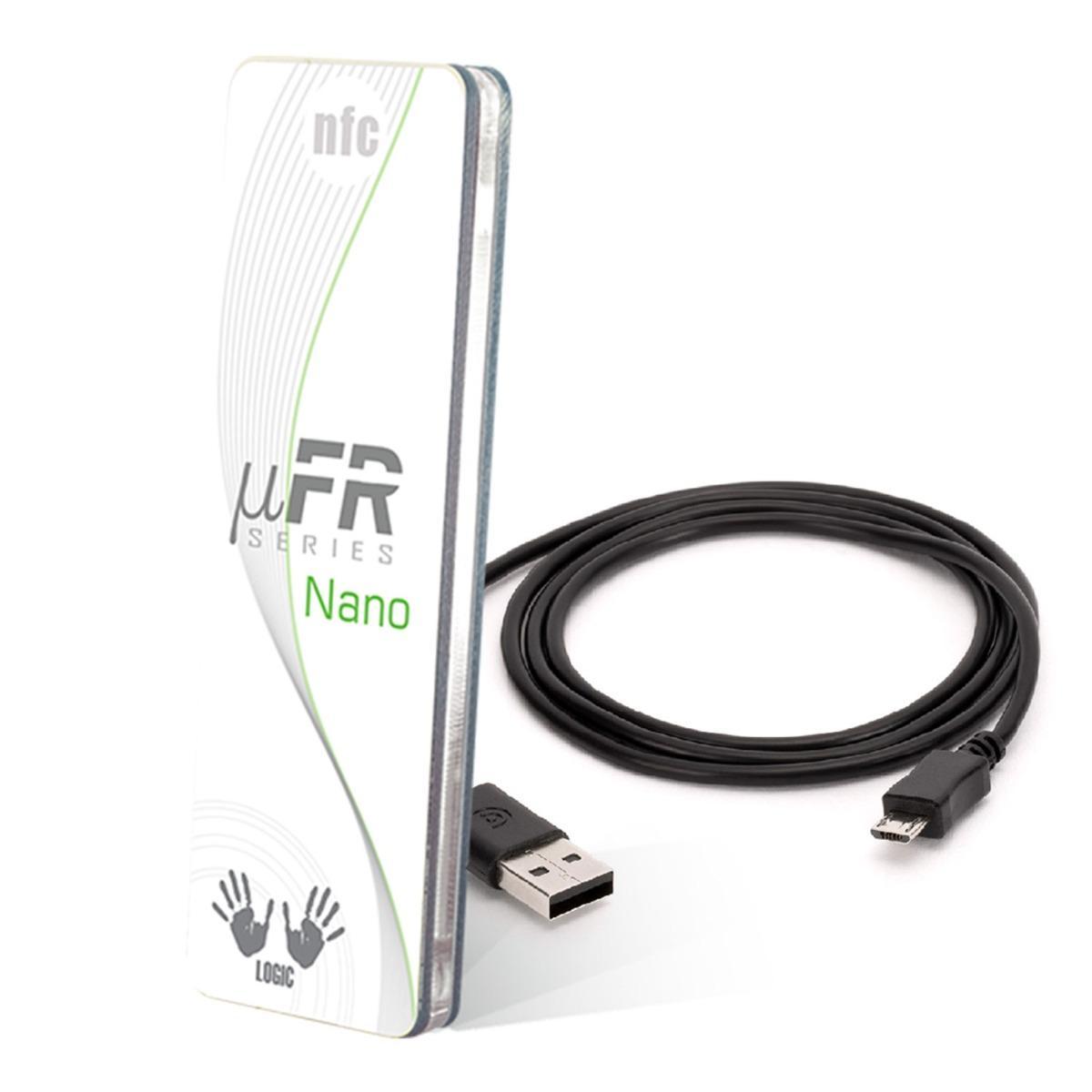
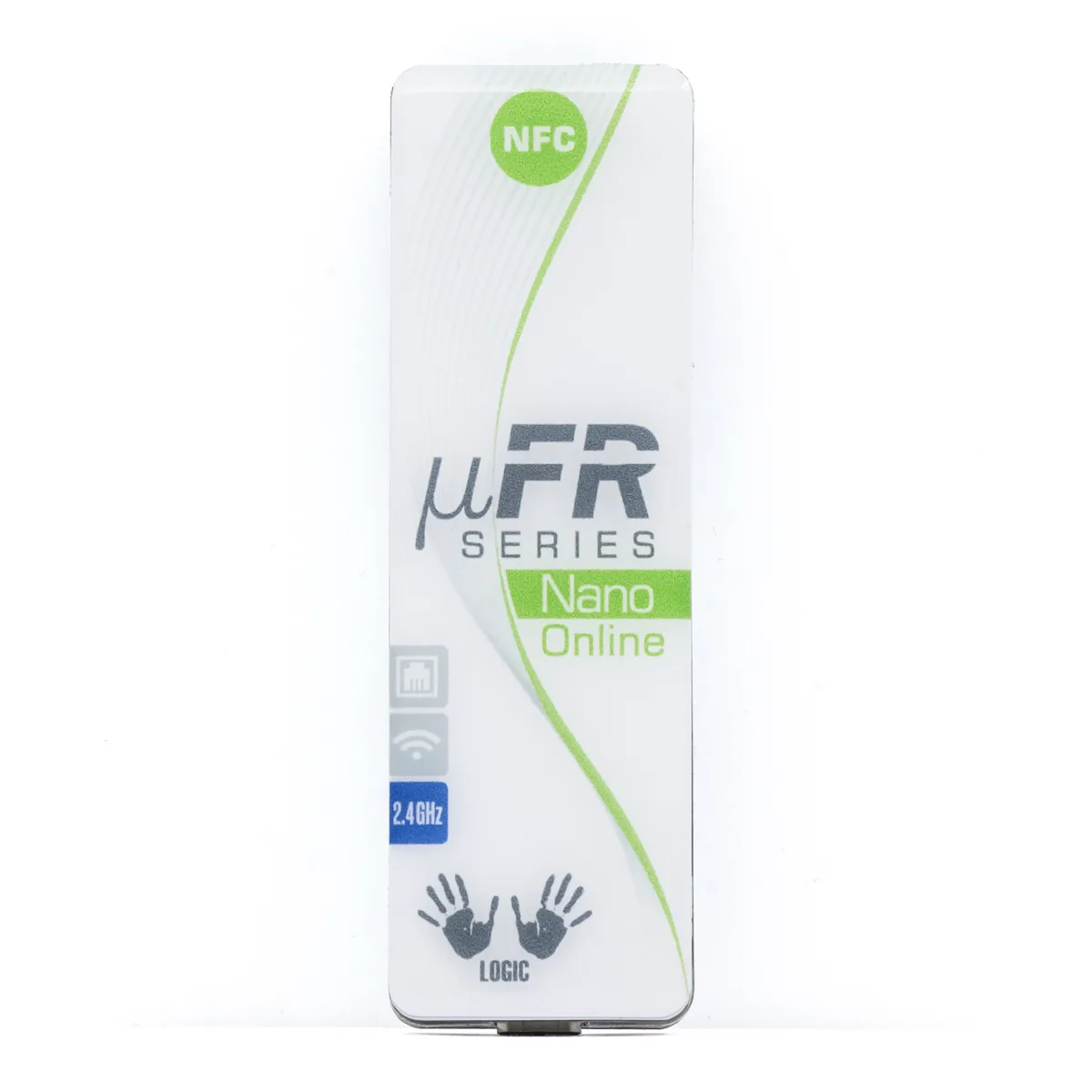
These serve different buyers entirely. Desktop RFID reader-writers support multi-frequency (LF 125 kHz + HF 13.56 MHz + UHF) for industrial card encoding workflows. USB NFC dongles (like µFR Nano) are HF-only compact units for consumer-grade NFC tap development, smartphone pairing, and basic enrollment. Pick by whether you need UHF range or just HF tap.

RFIDAK RFID reader-writer — multi-frequency desktop unit supporting LF 125 kHz, HF 13.56 MHz, and UHF with USB + Ethernet for card encoding and industrial enrollment Option A

Desktop RFID Reader-Writer (this product — multi-band)

Multi-frequency, USB + Ethernet, industrial

Frequencies
LF / HF / UHF (model-dependent)
Host interface
USB + Ethernet + RS232
Read range
2-5 cm (HF) / 10-30 cm (UHF)
Price point
$185 – 680

Best for

  • Card issuance lines (hotel PMS, access control enrollment)
  • Industrial encoding workstations
  • Multi-protocol test labs
RFIDAK µFR Nano USB NFC reader — compact desktop HF 13.56 MHz reader-writer for MIFARE, NTAG, DESFire development and enrollment Option B

µFR Nano USB NFC Reader (sibling — HF only)

Compact USB NFC, developer-friendly

Frequencies
HF 13.56 MHz (NFC only)
Host interface
USB
Read range
2-5 cm
Price point
$45 – 120

Best for

  • NFC app development and testing
  • Small-office HF card enrollment
  • Smartphone / MIFARE pair-up development

Quick decision tip — If your workflow requires UHF (long-range inventory, encoding UHF tags) or multi-band (LF Prox + HF MIFARE + UHF in one device), desktop reader-writer (Option A) is the industrial-grade choice at $185-680. If you only need HF / NFC for MIFARE / NTAG / DESFire reading and writing in an office setup, µFR Nano (Option B) is the compact USB tool at 1/4 the cost.

RFID Reader Writer Types

1 Should I choose the The Reader/Writer for my project?

Yes if you are an OEM, system integrator, or in-house product team building a kiosk, access control terminal, card encoder, or industrial HMI that needs reliable HF (13.56MHz) card reading and writing with a real free SDK. The The reader/writer delivers TCP/IP + PoE connectivity, sub-5-cm read range, ISO/IEC 14443 Type A/B and 15693 protocol coverage, and tested SDK libraries in C / C++ / Java / Python that ship with source-code examples the combination that removes most of the integration debugging time NFC projects typically suffer.

Pick a different reader if you need UHF Gen2 (use a handheld or portal reader instead), sub-meter BLE location (use a BLE gateway), or mobile phone NFC (the phone itself is the reader). Pick this reader if the workflow needs: issuing hotel key cards, encoding access badges, powering a kiosk, running a library self-checkout, or feeding authenticated card data to a Windows / Linux / Android host system over Ethernet.

2 Spec decision matrix desktop RFID reader/writer alternatives

Side-by-side comparison across the five reader classes system integrators typically evaluate. All prices indicative at MOQ 10 units; volume discounts negotiable above 100 units.

ClassInterfaceProtocolsSDK qualityBest fitUnit price
The HF Reader/WriterTCP/IP + PoE + USBISO 14443 A/B + 15693Full (source code, 4 languages)OEM, kiosk, hotel encoding, access control$85 $180
ACS ACR122UUSB onlyISO 14443 A/B + 15693 + NFC P2POpen-source libs (libnfc)Developer prototyping, desktop apps$35 $55
HID OMNIKEY 5427CKUSB / BLEISO 14443 A/B + 15693 + iCLASSClosed SDK, commercial supportEnterprise access control, iCLASS-specific workflows$120 $220
Feig MR102 / CPRUSB / RS232 / EthernetISO 14443 A/B + 15693 + specialtyClosed SDK, professional servicesLibrary / transit / specialty$200 $450
Impinj Speedway R420 / R700Ethernet + GPIOUHF ISO 18000-63 (Gen2) not HFLLRP + Octane SDKRetail / warehouse UHF different use case$1,400 $2,200

Verdict: The wins for OEMs who need a real SDK with source code; ACR122U wins on unit price but has no PoE; HID and Feig win if the project must support iCLASS or specialty protocols out-of-box.

3 Typical deployment pattern - hotel front-desk encoding

Hotel groups deploy desktop reader/writers at front desks as the card-encoding station tied to the PMS: reception encodes a room credential at check-in, and the same reader handles re-encodes, extensions, and lost-card invalidation. TCP/IP plus PoE models drop into the property network with a single cable run.

SDK quality decides integration time. Readers shipping compiled sample code in the integrator's language get wired into a PMS in days, not weeks.

4 Compatibility reference supported chips and host systems

Verified compatibility across HF chip families and host operating systems. Updated quarterly based on firmware revisions and customer deployment reports.

CategorySupportedNotes
NXP MIFARE chipsClassic 1K / 4K, Plus EV2, Ultralight EV1 / C / Nano, DESFire EV1 / EV2 / EV3AES-128 and 3DES session keys; multi-app DESFire fully supported
NXP NTAG chipsNTAG213 / 215 / 216, NTAG424 DNA (SUN auth)SUN message verification via SDK helper
ISO 15693 chipsNXP ICODE SLIX / SLIX2, ST LRI / LRIS seriesOptional firmware module specify at order
CPU cardsISO 14443 Type A / B, Java Card (JCOP), SmartMXSupports APDU passthrough for custom applets
Hotel lock systemsSaflok, VingCard (Assa Abloy), SALTO, Onity, TESA, KabaTested via customer integrations; encoding format per lock vendor spec
Access control panelsHID VertX, Mercury, Lenel, Software House, GenetecWiegand passthrough via accessory module
Host operating systemsWindows 10 / 11, Windows Server, Linux (Ubuntu 20.04+, Debian, RHEL), Android 8.0+, macOS 11+, Raspberry Pi OSSDK binaries ship for all listed platforms
Languages / runtimesC, C++, Java, Python, C#, Node.js, Go (via C binding)Sample code in first four; community bindings for others
Network deploymentTCP/IP (static, DHCP), PoE (IEEE 802.3af class 2)Multi-reader per subnet; MQTT bridge available on request

5 Cost at volume FAQ

How much does the The Reader/Writer cost at 10K pcs? At MOQ 10,000 units, the desktop USB + TCP/IP model lands at $85-95 per unit; the OEM board-only variant lands at $58-65 per unit; the UART module drops to $42-48 per unit. All prices in USD, EXW Shenzhen, excluding duties and shipping.

What about smaller orders? MOQ 10 units for evaluation at $165-180 per unit; MOQ 100 units at $125-140 per unit; MOQ 1,000 units at $95-110 per unit. Custom firmware development engagements start at $2,500 (one-time NRE) with per-unit pricing unchanged.

What drives the unit price up or down? Up: ISO 15693 firmware module (+$8-12), custom enclosure tooling (NRE $1,800-3,500), pre-loaded encryption keys (+$4-7 per unit), FCC / CE retest for modified hardware. Down: volume above 10K, UART-only OEM variant, stock ABS enclosure reuse, bulk firmware image deployment.

How is it priced vs ACR122U? ACR122U is lower sticker price ($35-55) but lacks PoE, has no SDK source code, no technical support channel, and a much smaller MIFARE DESFire AES helper library. For production deployments above MOQ 500 units, The TCO beats ACR122U once integration labor and field support cost are factored in.

What does PoE save? PoE eliminates 1 power adapter per reader (saves $8-15 CAPEX per unit at deploy) plus 1 outlet and 1 cable run per front-desk position (saves $80-180 per install in electrician labor at US / EU prevailing rates).

6 Market context - why SDK quality drives reader purchases

Integrators consistently report that SDK documentation and firmware maturity, not unit price, determine how long an NFC reader project takes: a reader with compiled sample code in your language gets integrated in days, while a reader with only a datasheet can stall a project for weeks. That is why experienced buyers evaluate the SDK before the spec sheet.

On the demand side, access-control modernization (Classic to DESFire migrations), hotel lock refresh cycles, and self-service kiosks keep desktop and embedded HF readers growing, with Ethernet plus PoE increasingly preferred for enterprise deployments.

For the broader chip-level decision driving reader choice, see the RFID Chip Comparison pillar and the guide to choosing RFID readers and writers.

Supplier Fit

Why buyers source RFID Reader Writer from RFIDAK

Once the format is right, most teams still need confidence in manufacturing control, sample support, and repeat-order reliability.

ISO 9001

Quality-focused manufacturing and sample support for custom RFID projects.

Since 2008

RFID manufacturing experience across cards, tags, labels, wristbands and readers.

Free Samples

Test product compatibility before bulk purchasing and customization decisions.

Commercial Fit

How buyers usually move this product from shortlist to sample

Most inquiry-ready visitors want to know whether this product matches their workflow, region and approval stage. These cues help them move faster without leaving the product page.

System integrators

Usually need reader compatibility, interface clarity and sample hardware that matches the planned deployment.

Device and kiosk makers

Often looking for OEM-ready modules or development-friendly reader hardware with practical integration support.

Enrollment and IT teams

Typically focused on workstation issuance, desktop testing and reader plus credential matching.

Quote Checklist

What to send us for a faster recommendation

  • Chip family, frequency and protocol you need the reader to support.
  • Operating system, interface and whether you need SDK or integration notes.
  • Desktop, handheld, fixed or embedded form factor based on the real workflow.
  • Sample quantity, application scenario and whether matching tags or cards are needed too.

Market Notes

Regional conversations often tied to this category

North America

Desktop enrollment, access-control replacement and asset-reading workflows often require clear driver and interface expectations.

Europe

Reader projects commonly involve NFC development, kiosk integration and bundled supply with matching tags or cards.

Middle East and Southeast Asia

Attendance, access-control and hospitality rollouts often prioritize simple deployment and dependable hardware pairing.

Before You Order

Procurement guides every RFID Readers buyer reads first

Five short reads on the procurement-side topics every B2B RFID buyer wants answered before signing a quote — MOQ thresholds, lead time reality, pricing transparency, sample policy, and how to audit a Chinese factory before your first order.

Buyer Questions

Questions buyers usually ask before sample approval

These FAQs cover the points that usually come up between a first shortlist and a real sample or quote request.

What is the minimum order quantity (MOQ) for RFID Reader Writer? +

For RFID Reader Writer, the standard MOQ starts at 1 piece (for evaluation); 10+ for bulk order on stock SKUs. Custom shapes, molds or non-standard materials typically move MOQ to 2,000–5,000 pieces to cover tooling setup. Exact MOQ and unit pricing are quoted per project once chip, customization and packaging are confirmed.

Does RFIDAK provide free samples of RFID Reader Writer? +

Yes. Stock rfid readers samples of RFID Reader Writer are typically free; we only ask buyers to cover DHL/FedEx express shipping. Samples ship in 1–3 business days after your order is confirmed and arrive in 2–5 days to most countries. Custom samples (new chip, new size, printed artwork) usually take 3–7 additional days.

What is the production lead time for RFID Reader Writer? +

Standard RFID Reader Writer orders ship in 7–15 business days after PO confirmation and artwork approval. Large runs (>100k units) or orders with complex encoding / custom molds may take 15–25 business days. Rush production is available on request for time-sensitive launches; confirm MOQ and artwork early to protect the timeline.

Can RFID Reader Writer be customized for my brand or project? +

Yes. RFID Reader Writer supports end-to-end customization: full-color CMYK / silk-screen / UV printing, laser engraving, serial numbering, custom chip encoding (UID write, NDEF, sector locking), custom shape / size (subject to tooling MOQ), and packaging. Share your artwork, chip requirement and quantity and we will return a spec sheet + price within 24 hours.

Is RFID Reader Writer compatible with my existing reader or system? +

Compatibility depends on the frequency band (LF 125 kHz / HF 13.56 MHz / UHF 860–960 MHz) and chip family used by your reader or installed system. Send a photo of your current card / reader model and we will recommend the matching chip + test a sample before bulk order.

What certifications and quality control does RFIDAK apply to RFID Reader Writer? +

RFIDAK operates under ISO 9001:2015 (Quality Management) and ISO 14001 (Environmental Management), audited by SGS. RFID Reader Writer is subject to incoming material inspection, in-process QC at every lamination / bonding / encoding step, and 100% electrical performance testing before shipment. Products meet CE, FCC, RoHS and REACH as applicable by market. Full test reports are available on request for buyer audits.

Does RFID Reader Writer ship with an SDK or sample code? +

Yes. RFID Reader Writer ships with SDK and sample code (Windows / Linux / Android where applicable), plus USB-HID keyboard-emulation mode for zero-integration deployments. Request the developer bundle at inquiry stage and we will include it with the evaluation unit.

How does RFIDAK ship RFID Reader Writer internationally? +

RFIDAK ships RFID Reader Writer via DHL / FedEx / UPS (door-to-door, 3–5 days to most countries), air cargo (5–7 days for heavier orders), or sea freight (20–35 days for bulk over 500 kg). Standard Incoterms are EXW, FOB Shenzhen and DDP; choose based on customs clearance preferences. Commercial invoice, packing list and CoC / MSDS are included automatically.

How does RFIDAK handle repeat orders of RFID Reader Writer? +

For repeat buyers, RFIDAK locks tooling, artwork and chip encoding on file so subsequent POs ship faster — typically 5–10 business days for stock chip types at previously-run quantities. Price is adjusted transparently per chip market rate and FX movement; we flag any chip shortage (e.g., DESFire EV3) before quotation so the project plan stays realistic.

Get Free RFID Samples

Try before you buy. Request free samples of any RFID product from our 50+ SKU catalog. Samples shipped via DHL/FedEx within 1-3 business days worldwide.

Not ready to chat? Just drop your email and we'll send the RFIDAK product catalog (PDF).

We'll only use your email to send the catalog and reply to your inquiry.

WhatsApp Get a Quote