FSMA 204 & RFID: Food Traceability Pilot Guide for 2028 Deadline
A practical FSMA 204 guide with the FDA timeline, CTE/KDE record planning and an optional RFID-versus-barcode pilot framework for covered foods.
Topic Cluster
Continue this topic with the next closest guides
These are the articles buyers usually need next when they are moving from basic research into a real shortlist, pilot or compliance discussion.
RFID Fresh Food Retail 2026: Bakery, Meat, Deli & FSMA 204 Ready
Why fresh food has become one of RFID's hottest retail topics. Covers what grocers should compare when tagging bakery,...
Read this nextRFID APPLICATIONSRFID for Returns & Reverse Logistics 2026: $200B Recovery Playbook
Why reverse logistics has become one of retail’s hottest topics, and how RFID can improve returns visibility, item...
Read this nextRFID APPLICATIONSRetail RFID Inventory: Labels, Encoding & Pilot Checks
Plan retail UHF inventory from the item label to the stock record. Check retailer requirements, EPC capacity, reader...
Read this next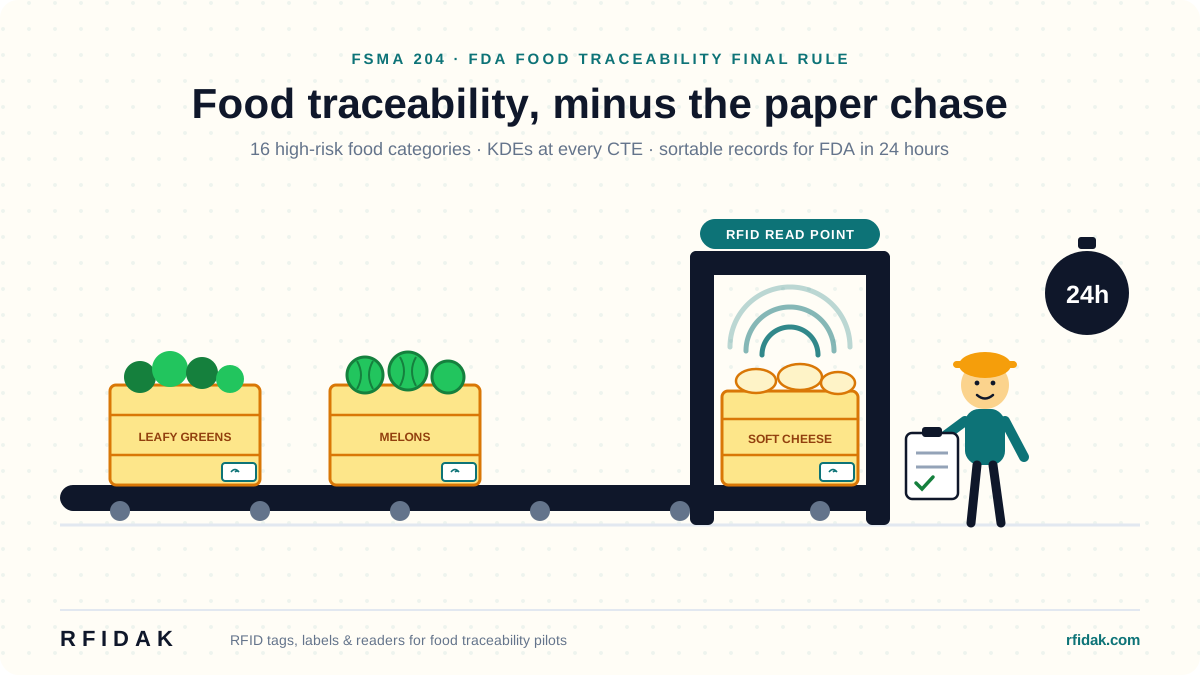
Quick Answer
FSMA 204 (FDA Food Traceability Final Rule, Sep 2022) requires fresh food shippers, processors, and retailers to maintain electronic records for 16 high-risk foods (leafy greens, soft cheese, deli salads, fresh herbs, peppers, sprouts, melons, tomatoes, ready-to-eat pasta and tropical fruits) by Jan 2026. RFID is the only practical way to capture KDE (Key Data Elements) at every CTE (Critical Tracking Event).
Why FSMA 204 keeps showing up in RFID conversations
FSMA 204 is the rare regulation that arrives with both a snooze button and an alarm. The FDA has clarified that it intends to align non-enforcement of the Food Traceability Rule with July 20, 2028 — which sounds like a reprieve until you notice what did not move: covered entities still need to manage traceability lot codes, critical tracking events and key data elements across real, messy operations. The deadline stretched; the homework did not shrink.
Enter RFID, stage left. The rule does not require it — the FDA is studiously technology-neutral — but RFID can make food movement and record capture dramatically easier in exactly the environments where manual scanning and paperwork start to break down: wet, cold, fast, and staffed by humans with better things to do than retype lot codes.
Why food traceability matters
48M
Americans affected by foodborne illness annually
128K
Hospitalizations from contaminated food each year
72%
Of global food recalls originate from traceability gaps
What the FDA actually requires
Strip away the acronym soup and the rule is almost polite. For foods on the Food Traceability List (FTL), firms must maintain records tied to specific Critical Tracking Events (CTEs) and Key Data Elements (KDEs), and hand the information to FDA within 24 hours of a request. That is it — the rule is fundamentally about traceability records and data sharing, not about mandating one physical carrier. The FDA wants the spreadsheet; it does not care how the spreadsheet was born.
That distinction matters more than any vendor pitch. You do not buy RFID to comply with FSMA 204 by itself. You buy it if it helps your business capture, maintain and act on the traceability data more reliably — compliance is the floor, not the sales brochure.
Critical Tracking Events and Key Data Elements at a glance
Think of it as a relay race where the baton is a number. The FDA defines a CTE as any event involving the harvesting, cooling, initial packing, shipping, receiving, or transformation of a food on the FTL. At each of those six handoffs, firms must record specific KDEs and link them to a Traceability Lot Code (TLC) — the same baton, passed cleanly, from field to shelf.
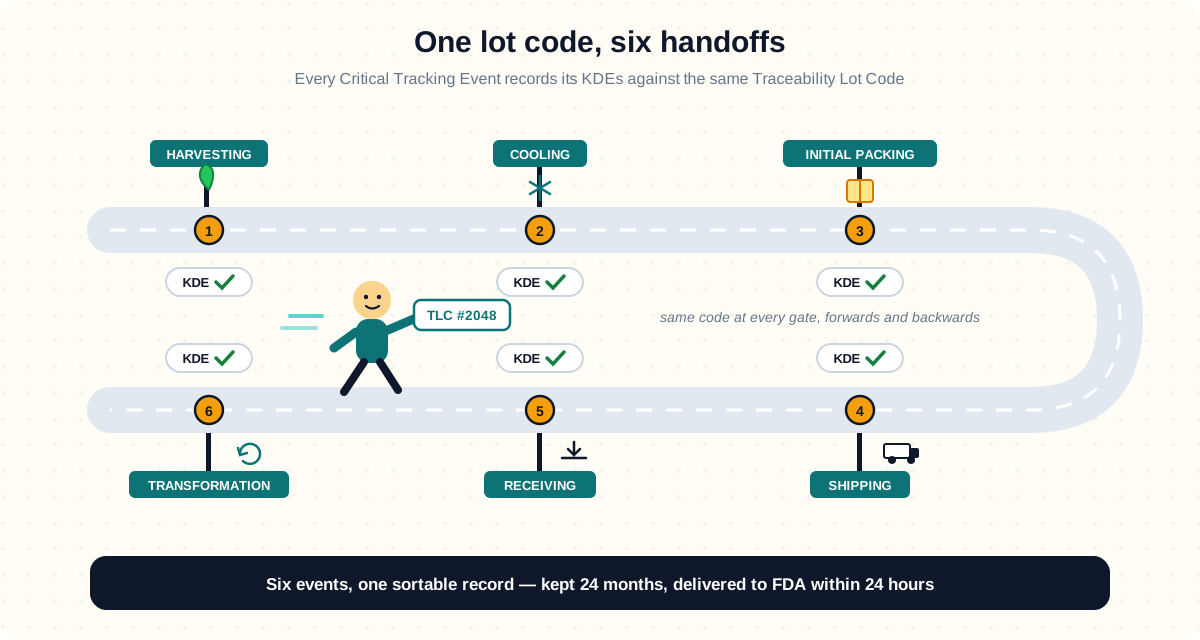
Records must be retained for 24 months and delivered to FDA in a sortable electronic format within 24 hours of request. RFID's advantage is that it can capture many of these KDEs automatically during physical movement, reducing manual entry errors.
Which foods are on the Food Traceability List?
The FTL is category-based and reads like a farmers'-market shopping list curated by an epidemiologist: it targets the foods with the highest risk profiles according to the FDA's risk-ranking model. The main categories include:
Fresh produce
Leafy greens, tomatoes, peppers, cucumbers, melons, sprouts, herbs, tropical tree fruits, fresh-cut fruits and vegetables
Seafood
Finfish (including smoked), crustaceans, and molluscan shellfish (oysters, clams, mussels, scallops)
Dairy & eggs
Soft and semi-soft cheeses (brie, feta, mozzarella, queso fresco, ricotta), shell eggs
Nut butters & deli
Peanut and tree-nut butters, ready-to-eat deli salads
If your supply chain handles any of these categories, the traceability recordkeeping requirements apply — and RFID can help capture the required data faster and more reliably.
FSMA 204 compliance timeline
Where barcode-only systems get stressed
Barcodes are the reliable sedan of data capture: necessary, common, and entirely dependent on road conditions. They rely on clean presentation and repeated manual scans, and food environments — especially those with wet packaging, chilled product, mixed cases and high receiving speed — are where line-of-sight discipline becomes a bottleneck. A label that fogs, a scan that gets skipped at 6 a.m., a case buried mid-pallet: lose a few of those and the association between lot data and physical movement quietly unravels, and traceability confidence drops fast.
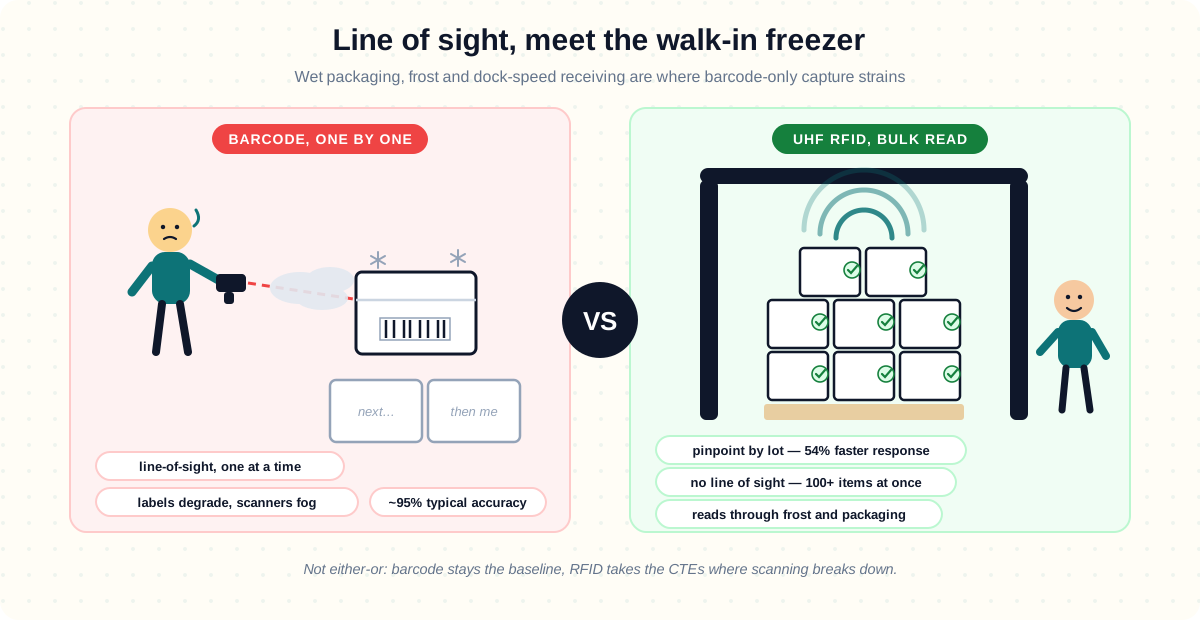
RFID vs barcode for food traceability
The practical conclusion: barcode and RFID are not either-or, and anyone selling you a holy war is selling you hardware. Many food operations will keep barcode as the baseline and add RFID at the specific CTEs where speed, volume, or environmental conditions expose the limits of manual scanning — pay for radio waves only where line of sight is losing.
Where RFID can help most
- Receiving and shipping (the crowd scenes) — bulk-read cases and pallets at dock doors instead of scanning one by one. Pallet RFID tags are especially effective for cold-chain logistics
- Cold storage and backroom movements (the frost line) — RFID reads through frost, condensation, and packaging where barcode labels degrade. Consider temperature-resistant tags for extreme environments
- Reusable containers and totes: a durable RFID hard tag can be evaluated if the exact model passes the container's cleaning, chill and read-point tests.
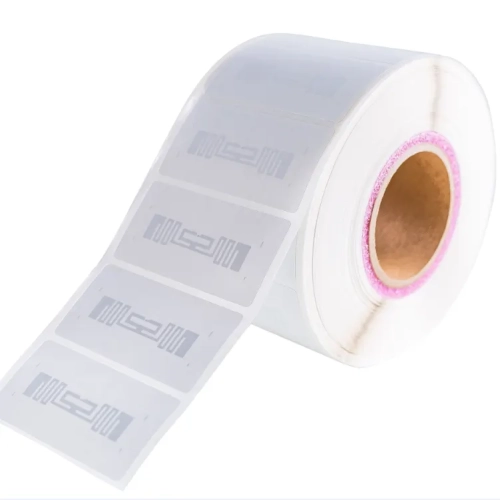
- Selected item- or case-level pilots (the audition) — UHF sticker labels encoded at pack lines for higher-value categories
- Recall isolation: test whether captured item, case or pallet identifiers improve the time needed to locate affected lots in the actual traceability system.
RFID is often strongest when it supports the physical movement layer while the traceability database remains the official system of record. The tags do the legwork; the database keeps the diary.
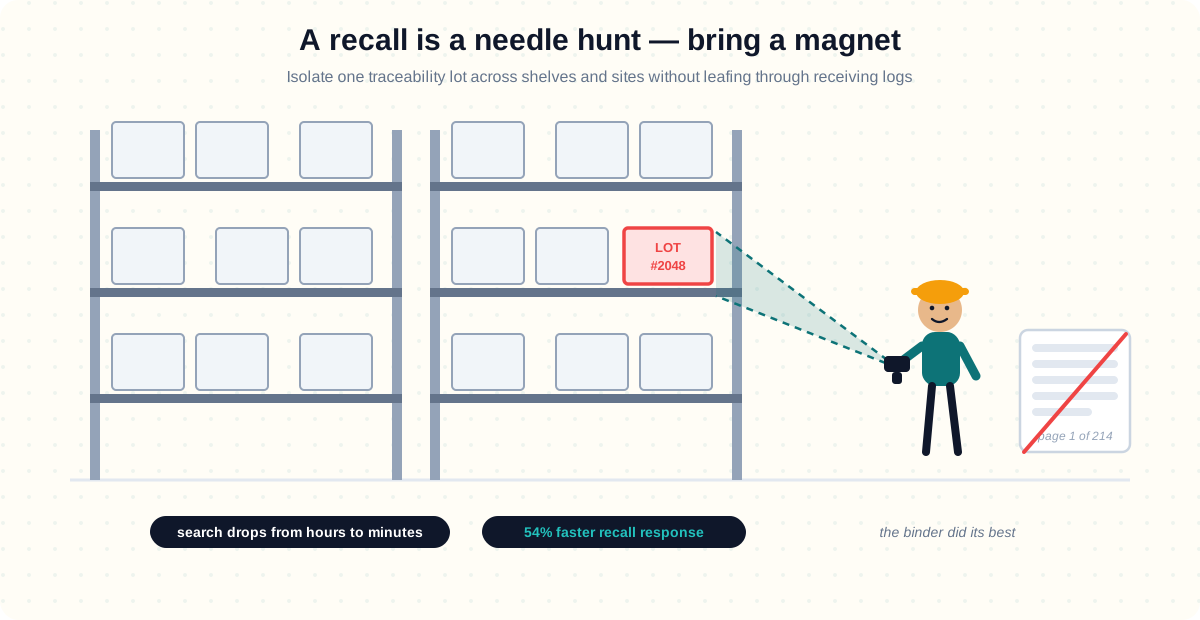
RFID impact on food operations
54%
Faster recall response time with digital traceability systems
29%
Improvement in pallet-level accuracy over barcode-only systems
20%
Waste reduction reported by grocers in RFID pilot projects
80%
Improvement in shipping and picking accuracy with RFID adoption
What public food-sector evidence supports a pilot?
Walmart and Avery Dennison announced fresh-food RFID work for meat, bakery and deli in October 2025. The announcement does not make RFID an FSMA 204 requirement or publish a universal store count or waste reduction. Before planning a food-traceability pilot, separate operational reads from the FDA-required CTE and KDE records, then test whether the complete system captures the relevant lot, location and event data.
Which food teams should pilot first
Teams handling foods already on the Food Traceability List, or products with repeated handling and cold-chain complexity, are usually the best pilot candidates. Seafood, fresh-cut produce, deli workflows and selected refrigerated products expose the limits of purely manual data capture much faster than shelf-stable categories — a can of beans will forgive your clipboard; a case of oysters will not.
Market context
For covered foods, plan around the applicable FDA requirements and published enforcement policy. Measure receiving, rotation, exception and record-retrieval performance on your own products; an unsourced market-size estimate does not establish a tag purchase decision.
Which RFID products fit food traceability pilots
Different CTEs call for different tag formats — casting one tag in every role is how pilots end up blaming physics. Here is how common RFIDAK products map to typical food-traceability scenarios:
For a broader comparison of label-style versus hard-mount formats, see our RFID labels vs hard tags guide.
Questions to answer before selecting a tag path
- Is the pilot focused on case, item, tote or pallet identification?
- Will the label face moisture, condensation, abrasion or chill-chain stress?
- Does the business need faster recall readiness, labor reduction or both?
- Which CTEs create the most data gaps today: receiving, transformation, shipping or internal transfer?
- Will supplier, DC and store systems all be able to consume the same data?
- Can you meet the 24-hour FDA data request window with your current systems?
A practical pilot path
Start embarrassingly small: one commodity, one packaging format, one traceability pain point. Test whether RFID improves identification at the actual critical tracking event where data quality is weakest — not the one nearest the conference room. If the category also intersects with freshness or replenishment, connect the pilot to our fresh-food RFID guide rather than treating compliance and operations as separate projects that happen to share a warehouse.
Pilot checklist
- Pick one FTL commodity with known traceability gaps (e.g. fresh-cut produce, deli)
- Choose the CTE where manual scanning is most error-prone (often receiving or transformation)
- Select a tag format — UHF labels for cases or pallet tags for logistics units
- Test read accuracy, KDE capture rate, and data integration with your traceability platform
- Compare cost-per-event against current manual process before scaling
FSMA 204 & RFID FAQ
When does FSMA 204 enforcement actually start?
The FDA Food Traceability Final Rule was published November 2022. Original compliance was January 20, 2026; in March 2025 Congress directed FDA not to enforce before July 20, 2028. The rule itself remains law — only the enforcement date moved. Audits and recall investigations can still surface gaps before that date.
Does the rule require RFID specifically?
No. FSMA 204 is technology-neutral. It requires that Key Data Elements (KDEs) be captured at every Critical Tracking Event (CTE) for foods on the Food Traceability List, and that records be available to FDA in sortable electronic format within 24 hours. RFID, 2D barcode + GS1 SGTIN, and ERP-driven manual capture all qualify if the data quality holds up.
What is a Traceability Lot Code (TLC)?
The TLC is the descriptor a Traceability Lot Code Source assigns to a food at the originating CTE (harvest, initial pack, or transformation). All downstream KDEs — receiving, shipping, transformation — must reference the TLC so the food can be traced both forwards and backwards through the supply chain.
Can a single RFID tag cover all CTEs from harvest to retail?
Rarely. A pallet UHF tag survives shipping and receiving but is removed at case break. A case label survives DC handling but is opened for store replenishment. Most realistic FSMA 204 architectures use multiple tag types — case label, pallet tag, reusable tote tag — each linked to the same TLC inside the EPCIS / ERP record.
What format must records be delivered in?
FDA expects records in “an electronic, sortable spreadsheet” (CSV / XLSX) within 24 hours of request. Unstructured PDF dumps or paper logs do not satisfy the requirement. Most teams export from their EPCIS event store or ERP traceability module on demand.
Sources
- FDA — FSMA Section 204 Food Traceability Final Rule
- FDA — Food Traceability List (FTL) categories
- GS1 EPCIS 2.0 — food traceability event data standard
- IFT Global Food Traceability Center — pilot benchmarks
- Auburn University RFID Lab — food traceability research
- Produce Traceability Initiative (PTI) — case-level labeling
- RAIN RFID Alliance — UHF food traceability ecosystem
Final takeaway
FSMA 204 calls for traceability records for covered foods and does not force one tagging technology. RFID earns its place when a tested workflow reduces data-capture effort or errors. Start with a small pilot that connects actual read events to the required records, then decide whether the cost and reliability justify wider use.
Key Takeaways
- Regulation: FSMA 204, FDA Sep 2022, enforcement Jan 2026.
- Scope: 16 high-risk food categories on the Food Traceability List.
- Required: KDE at each CTE (originator, transformer, packer, shipper, receiver) within 24 hours of FDA request.
- Tech: barcode (GS1 SGTIN) + UHF RFID for warehouse-scale capture + EPCIS event database.
- Compliance gap: most fresh-food shippers in 2025 use paper or partial digital — Jan 2026 forces electronic.
⚠️ Common pitfall
FSMA 204 records must be retrievable in “electronic, sortable spreadsheet” format within 24 hours of FDA request. Many retailers comply at receive but fail at internal handoffs (warehouse-to-store) — cover the full CTE chain.
RFIDAK can help buyers compare moisture-tolerant RFID labels, pallet tags, durable container tags, warehouse reader hardware and sample strategies for food-traceability pilots. Contact us if you want help choosing a first pilot category.
Build a practical food-traceability pilot
Send your packaging material, cold-chain conditions and read points and we can narrow the right label path for a first pilot.
Comparison Pages
Compare the closest alternatives before you request samples
Open one of these if the article clarified the topic but the team still needs a cleaner format, chip or frequency decision.
Quick FAQ
Questions buyers often ask after reading this guide
Does FSMA 204 require RFID tags?
No. FDA’s Food Traceability Rule focuses on records for covered foods and events, not on a mandatory RFID carrier. Map the applicable critical tracking events and key data elements, then choose a barcode, RFID or other system that captures and retrieves the required records. FDA has stated it will not enforce the rule before July 20, 2028.
When does FSMA 204 compliance take effect?
FDA currently states it will not enforce the Food Traceability Rule before July 20, 2028. Coverage and required critical tracking events and key data elements depend on the listed food, activity and any exemption. Check current FDA guidance for the exact operation; no public basis establishes that most supply-chain partners are already running pilots.
What is a Critical Tracking Event (CTE) in FSMA 204?
A critical tracking event is a covered food-supply-chain step for which the FDA rule specifies records, such as initial packing, shipping, receiving or transformation when applicable. Each event has its own key data elements. Map the exact food and operator duties using FDA guidance; RFID is optional and does not automatically capture the required business data.
Which RFID tag works for food traceability?
Select a finished tag from the packaged food or reusable container, surface moisture, temperature, reader location and traceability identifier. Test the label adhesive and RF performance on production-representative packaging. The FDA Food Traceability Rule does not require RFID, and a chip or tag price cannot establish the cost or compliance of the complete recordkeeping workflow.
Which foods are on the Food Traceability List?
The FDA FTL includes 16 categories chosen for higher outbreak risk: cheeses (except hard cheeses), shell eggs, nut butters, cucumbers, fresh herbs, leafy greens, melons, peppers, sprouts, tomatoes, tropical tree fruits, fresh-cut fruit and vegetables, molluscan shellfish, finfish, crustaceans, and certain ready-to-eat foods. The list can be updated by FDA. Covered entities handling any FTL item must maintain CTE/KDE records for the item and for non-FTL items combined or transformed with FTL items.
Which food workflows benefit most from RFID pilot?
A pilot may examine receiving, case aggregation, replenishment or reusable-container tracking where repeated manual scans cause measurable work or errors. For FSMA 204, first map the required records for the covered food and event; then test whether RFID captures the needed identifiers and exceptions reliably. Compare against the current barcode or manual method without assuming a labor-saving percentage.
Has any major retailer deployed RFID for FSMA 204?
Do not treat a retailer's RFID inventory project as proof that it uses RFID for FSMA 204 compliance. The FDA rule concerns traceability records, not a required carrier. Walmart and Avery Dennison publicly announced fresh-food RFID work for meat, bakery and deli, but their announcement does not establish an FSMA 204 RFID requirement. Validate any named case against a direct source and document the actual data-capture workflow.
What is the minimum order for food traceability RFID?
RFIDAK's published standard tags-and-labels MOQ baseline is 1,000 pieces. Confirm the exact chip, antenna, construction, print, encoding and quantity per design in a written quote. Free stock samples (up to 5 pieces) — buyer covers DHL/FedEx freight ($25–60), refunded 1:1 against the first production order over $500. Larger evaluation lots, custom samples, production timing and delivery are agreed separately for the selected configuration. For medical, food, pharmaceutical or battery applications, define the applicable product and process requirements before testing. A tag sample or chip specification does not establish regulatory compliance, sterilization performance or safety of the finished assembly.
Author
RFIDAK RFID Editorial Team
RFID supply editorial team
RFIDAK publishes practical RFID guides to help buyers compare chips, product formats, sampling plans and sourcing options before production.