
RFID Baggage Tracking: IATA 753 Tags & Airport Pilot Guide
A practical guide to IATA Resolution 753, the four baggage tracking points, RFID bag-tag choices, reader planning, RFQ inputs and airport pilot testing. Written for airport and ground-handling teams starting IATA 753 compliance.
Topic Cluster
Continue this topic with the next closest guides
These are the articles buyers usually need next when they are moving from basic research into a real shortlist, pilot or compliance discussion.
RFID for Returns & Reverse Logistics 2026: $200B Recovery Playbook
Why reverse logistics has become one of retail’s hottest topics, and how RFID can improve returns visibility, item...
Read this nextRFID APPLICATIONSRetail RFID Inventory: Labels, Encoding & Pilot Checks
Plan retail UHF inventory from the item label to the stock record. Check retailer requirements, EPC capacity, reader...
Read this next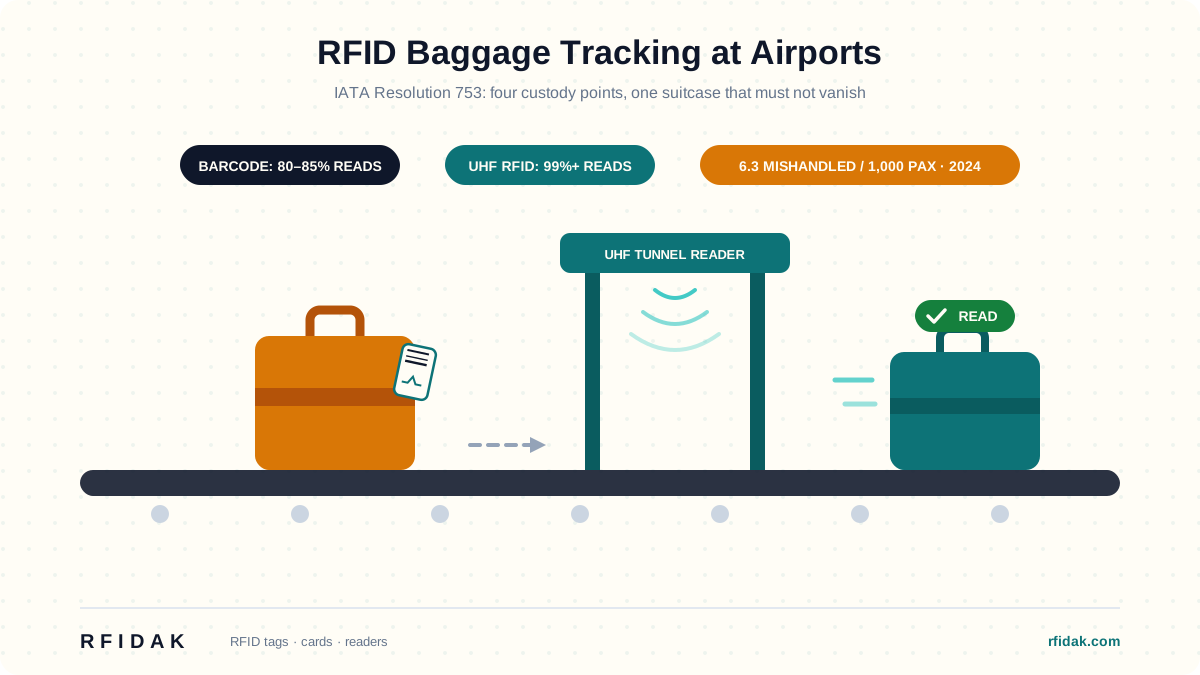
Quick Answer
IATA Resolution 753 has been active since June 2018 and applies to IATA member airlines. It requires an accurate baggage inventory by recording baggage acquisition and delivery when custody changes, commonly explained through four core journey points: passenger handover, aircraft loading, transfer delivery and return to the passenger. The resolution does not mandate RFID. RFID is one acceptable capture method alongside optical barcode scanning, manual capture and OCR; the right design may combine them. See IATA’s Resolution 753 Implementation Guide for the operational framework.
Planning a baggage RFID pilot?
Request a bag-tag inlay and pilot shortlist matched to your tag stock, printer/encoder and test checkpoints.
What IATA Resolution 753 requires
Resolution 753 is a custody-tracking requirement, not an RFID mandate. The accountable carrier needs a reliable record of when it acquires or delivers a bag as custody changes. That distinction matters: the compliance objective is an accurate baggage inventory, while RFID, barcode, manual scanning and OCR are possible ways to capture the event.
The official IATA baggage-tracking page describes four core journey points used to explain the requirement:
| Journey point | Custody event to record | Pilot checkpoint |
|---|---|---|
| 1. Passenger handover | The airline acquires the bag from the passenger or an agent. | Confirm the bag identity is created and associated with the journey. |
| 2. Aircraft loading | The bag is recorded as loaded for the operating flight. | Test the actual loading workflow, reader placement and exception path. |
| 3. Transfer delivery | Custody or operational responsibility changes during a connection. | Include interline and no-read handling where they are in scope. |
| 4. Passenger return | The bag is delivered back to the passenger. | Verify how arrival delivery and exceptions are recorded. |
Use the four points to define the event model before selecting tags or readers. IATA’s implementation guide is the better reference for assigning responsibilities and mapping acquisition and delivery events in a specific operation.
What airport baggage RFID adds to barcode capture
RFID should be evaluated as an additional capture layer, not described as a universal barcode replacement. Printed barcodes and human-readable data remain useful for visual checks, compatibility and exception handling. A passive UHF inlay can add capture at fixed zones with less dependence on line of sight, but its performance still depends on tag construction, reader antennas, bag orientation, conveyor conditions and software rules.
| Decision area | Barcode / optical capture | Passive UHF RFID layer |
|---|---|---|
| Read condition | Needs a usable printed symbol and optical view. | Can reduce dependence on optical line of sight within a designed read zone. |
| Existing workflow | Often already built into baggage tag printing and handling. | Requires compatible inlays, encoding, readers and event integration. |
| Best comparison | Measure successful event capture and exception effort in the current process. | Measure the same outcomes at the same checkpoints with the RFID layer enabled. |
For a broader technology comparison, see RFID vs barcode. Buyers evaluating the physical layer can also compare UHF inlay and label formats and RFID reader/writer options.
RFID bag-tag formats to compare
Disposable printed RFID bag tags
A disposable format combines the visible print area with an embedded passive UHF inlay. Qualification should focus on the complete construction: inlay position, tag stock, adhesive or laminate, dimensions, print quality, encoding workflow, roll build and performance on representative bags. Do not select an inlay from free-air read distance alone.
Electronic Bag Tags (EBT)
An Electronic Bag Tag (EBT) is a reusable device that displays trip information electronically. It is a separate product and passenger workflow from a disposable printed RFID tag. If an EBT program is in scope, confirm airline application support, display and update workflow, acceptance at each participating airport, and how the device is identified at the four journey points. Do not assume that an EBT automatically supplies the same RFID capture method as the proposed disposable tag.
Tray, cart and handling-asset tags
Tags on trays, carts or containers solve an asset-tracking problem. Keep those identities and events separate from the passenger bag identity, then decide where the two records need to be associated in the baggage handling system.
Reader and integration planning
The tag, reader zone and software event must be tested as one system. Reader antenna geometry, conveyor layout, nearby metal, bag spacing, orientation and speed can change results. The pilot should also define duplicate-read handling, no-read handling, reconciliation and the handoff into airline, airport and baggage-handling applications.
A site survey is more useful than a generic hardware estimate. Scope the number and type of read zones, antenna mounting constraints, network and power, environmental protection, interfaces, installation access and commissioning requirements before asking for an infrastructure quote.
RFQ checklist for a meaningful bag-tag quote
A unit-price request without a build specification is not comparable. Send suppliers the same inputs:
- Inlay/chip or performance target: name the approved inlay/chip, or describe the read zone and target outcome if the inlay is still open.
- Tag stock and dimensions: face stock, liner, adhesive or laminate, finished width and length, and inlay position.
- Printer/encoder: manufacturer, model, firmware if relevant, and available print/encode settings.
- Encoding and data format: required memory content, identifier structure, variable-data source, lock settings and verification output.
- Roll and core: winding direction, labels per roll, core size, outer-diameter limit and splice rules.
- Quantity: pilot quantity, forecast production quantity and requested volume breaks.
- Test checkpoints: which of the four journey points, plus any sortation, transfer or exception zones included in acceptance.
- Destination: ship-to city/country and requested Incoterm so freight, duties and responsibilities can be compared.
Tag price, minimum order, sample charges and lead time depend on chip allocation, construction, conversion, printing, encoding, packaging, quantity and destination. Reader and retrofit pricing depends on the site design, installation scope, interfaces and commissioning. Ask for an itemized, quote-specific response instead of relying on generic ranges. Review the sample process and shipping and Incoterms guide before comparing landed offers.
Airport RFID pilot checklist
- Define custody events. Map the four Resolution 753 journey points, accountable party, system of record and exception owner.
- Baseline current capture. Record successful event capture, no-reads, manual interventions and reconciliation effort at the selected checkpoints.
- Shortlist complete tag builds. Test the inlay inside the proposed tag stock, with the intended dimensions and print/encode process.
- Validate printing and encoding. Check visible data, barcode usability, RFID encoding, verification records and reject handling.
- Test representative bags. Include varied materials, orientations, spacing and loading patterns from the real operation.
- Test each selected read zone. Use production-like conveyor, loading, transfer and arrival conditions rather than a tabletop read-distance demo.
- Exercise exceptions. Include no-read, duplicate-read, wrong-flight, damaged-tag and manual-recovery scenarios.
- Set acceptance criteria before testing. Agree on event-capture, false-read, exception-time, data-quality and operational-safety measures, then compare against the baseline.
- Document the scale decision. Record the approved tag build, reader settings, software rules, ownership, commercial assumptions and next checkpoint for rollout.
Pilot decision rule
Choose the combination of tag, reader zone and capture method that records the required custody events reliably in your operation. Keep barcode and manual recovery available where they remain useful, and scale only after production-like testing.
RFID baggage tracking FAQ
Does IATA Resolution 753 mandate RFID?
No. Resolution 753 requires baggage tracking and an accurate inventory at custody changes, but it does not prescribe RFID. RFID, optical barcode capture, OCR and manual processes can be used alone or together if they produce the required records.
Who does Resolution 753 apply to?
It applies to IATA member airlines. Airports, ground handlers and technology suppliers may support the workflow through operating agreements and systems, but the resolution is not accurately described as a mandate on every carrier or airport.
What are the four baggage tracking points?
They are commonly summarized as passenger handover to the airline, loading onto the aircraft, transfer delivery when responsibility changes, and return of the bag to the passenger. The implementation should map who records acquisition and delivery at each custody change.
Does an RFID bag tag replace the printed barcode?
Not necessarily. A hybrid tag can retain a visible barcode and human-readable information while adding a passive UHF inlay. Keeping optical and manual recovery paths can support compatibility and exception handling.
What does RFID add to airport baggage tracking?
Passive UHF RFID can add event capture at designed read zones with less dependence on optical line of sight. Its value depends on the complete tag construction, antenna geometry, baggage flow, software rules and exception process, so compare it with the existing capture method at the same checkpoints.
What information is needed for an RFID bag-tag quote?
Provide the inlay/chip or performance target, tag stock and dimensions, printer/encoder, encoding and data format, roll/core specification, quantity, pilot checkpoints and ship-to destination. Pricing and lead time should be quoted against that complete specification.
How should an airport test RFID bag tags?
Test the complete tag build in the intended printer/encoder and at production-like read zones. Include representative bag materials, orientations, spacing and speeds, then exercise no-read, duplicate-read, damaged-tag and manual-recovery cases against agreed acceptance criteria.
What is an Electronic Bag Tag (EBT)?
An EBT is a reusable device that displays trip information electronically. It is not the same as a disposable printed RFID bag tag, and its application, airport acceptance and journey-point identification workflow should be confirmed separately.
Final takeaway
Start with the Resolution 753 custody events, not a hardware shopping list. Then compare RFID with existing barcode, OCR and manual capture at the same four journey points. A defensible pilot proves the complete tag, reader and data workflow under real operating conditions and produces an RFQ that suppliers can quote consistently.
Ready to shortlist a bag-tag inlay and pilot build?
Send the RFQ fields above and identify the journey points you plan to test. We can help narrow UHF tag formats and reader options for evaluation.
Official references
Map the right operational tracking setup
Best for airports, retailers and operations teams that already understand the use case and now need the right labels, readers and checkpoint flow.
Comparison Pages
Compare the closest alternatives before you request samples
Open one of these if the article clarified the topic but the team still needs a cleaner format, chip or frequency decision.
Quick FAQ
Questions buyers often ask after reading this guide
Does IATA Resolution 753 mandate RFID?
No. Resolution 753 requires baggage tracking and an accurate inventory at custody changes, but it does not prescribe RFID. RFID, optical barcode capture, OCR and manual processes can be used alone or together if they produce the required records.
Who does IATA Resolution 753 apply to?
Resolution 753 applies to IATA member airlines. Airports, ground handlers and technology suppliers may support the workflow through operating agreements and systems, but it is not accurately described as a mandate on every carrier or airport.
What are the four baggage tracking points under Resolution 753?
The four core journey points are commonly summarized as passenger handover to the airline, loading onto the aircraft, transfer delivery when responsibility changes, and return of the bag to the passenger. The implementation should map who records acquisition and delivery at each custody change.
Does an RFID bag tag replace the printed barcode?
Not necessarily. A hybrid bag tag can retain a visible barcode and human-readable information while adding a passive UHF inlay. Keeping optical and manual recovery paths can support compatibility and exception handling.
What does RFID add to airport baggage tracking?
Passive UHF RFID can add event capture at designed read zones with less dependence on optical line of sight. Its actual value depends on the complete tag construction, antenna geometry, baggage flow, software rules and exception process, so it should be measured against the existing capture method at the same checkpoints.
What information is needed for an RFID bag-tag quote?
Provide the inlay/chip or performance target, tag stock and dimensions, printer/encoder, encoding and data format, roll/core specification, quantity, pilot checkpoints and ship-to destination. Pricing, minimum order, samples and lead time should be quoted against that complete specification.
How should an airport test RFID bag tags?
Test the complete tag build in the intended printer/encoder and at production-like read zones. Include representative bag materials, orientations, spacing and speeds, then exercise no-read, duplicate-read, damaged-tag and manual-recovery cases against acceptance criteria agreed before the pilot.
What is an Electronic Bag Tag (EBT)?
An EBT is a reusable device that displays trip information electronically. It is not the same as a disposable printed RFID bag tag, and its airline application, airport acceptance and journey-point identification workflow should be confirmed separately.
Author
RFIDAK RFID Editorial Team
RFID supply editorial team
RFIDAK publishes practical RFID guides to help buyers compare chips, product formats, sampling plans and sourcing options before production.