RFID vs Barcode 2026: ROI, Accuracy & When to Switch
An in-depth comparison of RFID and barcode technologies covering speed, accuracy, cost, durability, and ROI to help businesses choose the right identification system. Includes total-cost scenarios and the cases where barcode remains the right answer.
Quick Answer
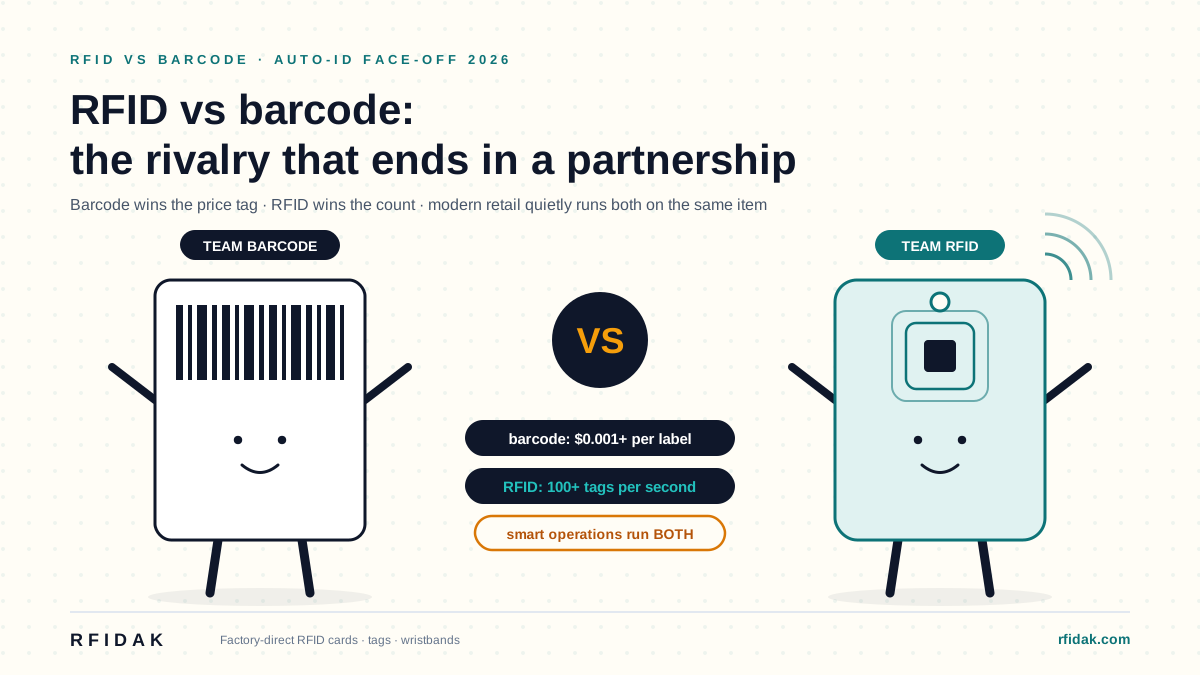
Barcode and RFID can work together. A printed barcode is visible and inexpensive to reproduce; UHF RFID can support bulk reads without optical line of sight. Compare item-level or case-level tagging against the actual read point, retailer specification and full system cost before calculating ROI.
RFID vs Barcode: The Core Differences
Barcodes and RFID are both automatic identification technologies, and that is roughly where the family resemblance ends. A barcode is an optical creature: a scanner reads printed patterns of lines or dots, provided it can actually see them. RFID is a radio creature: the reader talks to electronic tags through the air, eyesight not required.
Every practical advantage and limitation of each technology traces back to that one difference in how they sense the world.
The business case is operational: compare tag and equipment costs with measured labor, missed reads, exception handling and inventory changes at the same site. A market forecast cannot establish payback for an individual deployment.
How Each Technology Actually Works
Reader capacity and useful read rate differ. A UHF protocol can identify multiple tags, but the number captured at a door or in a cycle count depends on tag orientation, materials, antenna placement and movement.
| Layer | Barcode | RFID (UHF Class 1 Gen 2) |
|---|---|---|
| Encoding | Code 128 / EAN-13 / GS1-128 printed pattern | EPC SGTIN-96 in chip EEPROM (96-bit) |
| Transmission | Optical (laser / camera) reflection | Radio backscatter, 860–960 MHz |
| Standard | ISO/IEC 15420 (EAN/UPC), GS1 General Spec | ISO/IEC 18000-63, GS1 EPC Tag Data Standard |
| Anti-collision | None (one at a time) | Anti-collision supports multiple tags; validate site throughput |
| Power on tag | No power (passive ink) | Harvested from reader RF field (passive UHF) |
The optical life is a demanding one: every barcode label must be visible, oriented, and clean, or the scanner simply sulks. RFID skips the beauty contest — the reader broadcasts a field, every tag in range answers in turn, and a collision-avoidance protocol deduplicates the chorus. No line of sight, no fuss, all in milliseconds.
Speed and Efficiency
Barcode Scanning
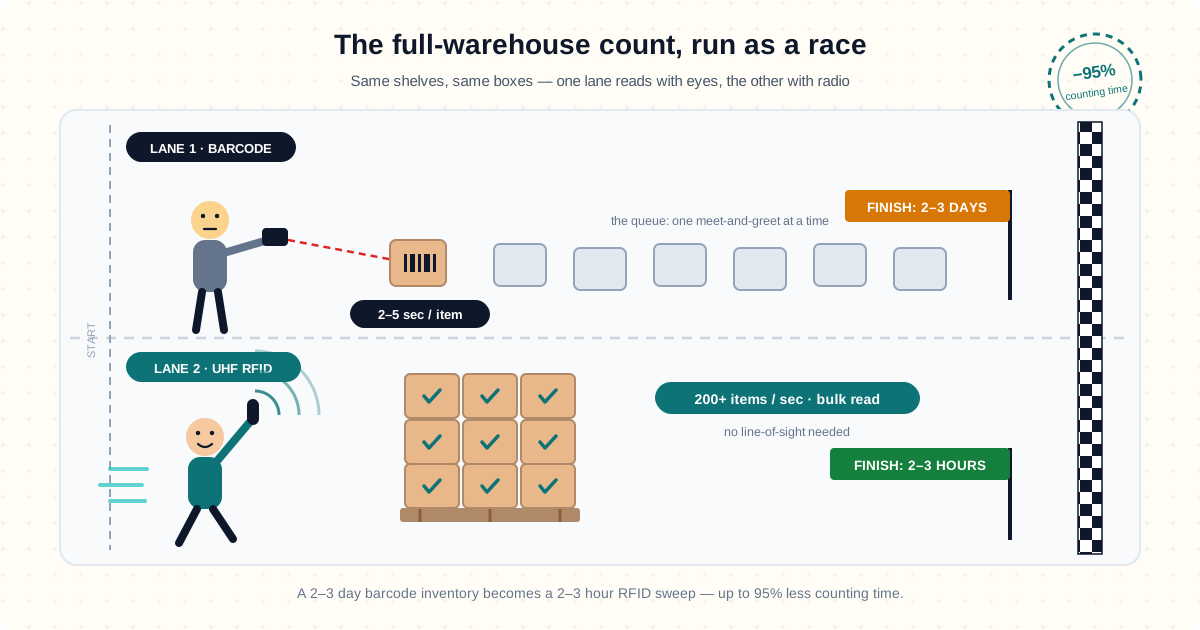
- Requires line-of-sight — the scanner must personally meet each individual barcode
- Scans one item at a time — no exceptions, no group discounts
- Per-item presentation — staff or automation must expose the printed code to an optical reader.
- Manual orientation of scanner required — a human aims it, every single time
RFID Scanning
- No line-of-sight required — reads through cartons as if they were not there
- Reads hundreds of tags simultaneously — the whole pallet answers at once
- Bulk read potential — measure capture and exceptions at the actual portal or handheld read point.
- Automatic scanning through portals possible — inventory counts itself as it rolls past
A controlled pilot should compare barcode and RFID counting time on the same items and staff process, then reconcile both results against a blind physical count.
Do not project labor savings from a protocol read-rate figure alone; handling, missed tags and data reconciliation may dominate the end-to-end process.
Accuracy and Reliability
| Metric | Barcode | RFID |
|---|---|---|
| Inventory accuracy | Measure against blind physical count | Measure missed reads and exceptions |
| Damaged label tolerance | Low (unreadable if torn / smeared) | High (chip survives label damage) |
| Environmental resistance | Poor (fades, smears, peels) | Excellent (industrial / on-metal tags) |
| Read in harsh conditions | Difficult (dirt, moisture, frost) | Depends on rated finished tag and reader setup |
| Data capacity | Up to 25 characters (Code 128) | 96 bits–8 KB+ (UCODE 9 / DESFire EV3) |
Cost Analysis
A barcode workflow has printed labels and optical equipment; an RFID workflow adds the selected tag, reader, antenna, encoding, software integration and exception handling. Price the same item and volume, including implementation and recurring costs. A fixed reader budget, tag price or five-year payback claim cannot be transferred across sites.
Evidence to collect before calculating ROI
Retailer requirements establish which tag and encoding to test. Your own operation establishes the savings: measure counting time, exceptions, inventory accuracy and full system cost before extrapolating a pilot.
Walmart supplier RFID requirements
Walmart's public packaging guide references GS1 serialized RFID encoding and Auburn ARC inlay standards. The assigned ARC specification varies by product and packaging category. It does not publish a universal stockout reduction or encoding format for every item; measure outcomes in your own pilot. See our Walmart RFID requirements guide.
Item-level retail pilot
Choose a representative category and record the barcode baseline. Test UHF inlays on actual products at the receiving, counting and checkout read points that matter. Record failed reads, exception handling, staff time and inventory corrections; use those observed values in the business case.
Store-count validation
Use the same sample area and item list for barcode and RFID cycle counts. Reconcile both against a blind physical count, then compare labor time and unresolved exceptions. A read-rate claim from a different store cannot establish accuracy or payback in your layout.
Best Applications for Each Technology
Barcode is Better For:
- Low-volume operations with tight budgets — cheap, cheerful, battle-tested
- Point-of-sale scanning (grocery, retail checkout) — the cashier is looking at the item anyway
- Static product identification — the label never needs to change its story
- Applications where per-unit cost is critical — nothing beats printed ink
- Simple tracking without real-time requirements — when “counted last Tuesday” is good enough
RFID is Better For:
- High-volume inventory management — where counting by hand goes to die
- Supply chain and logistics tracking — every carton announces itself at every door
- Asset tracking and management — tools and totes that report for duty
- Access control and security applications — a tap beats a key
- Reusable container tracking — one tag, hundreds of round trips
- Environments where barcodes fail (heat, moisture, chemicals) — the chip does not mind the weather
- Real-time location systems (RTLS) — for when “somewhere in aisle 12” is not an answer
Hybrid Approach: RFID + Barcode
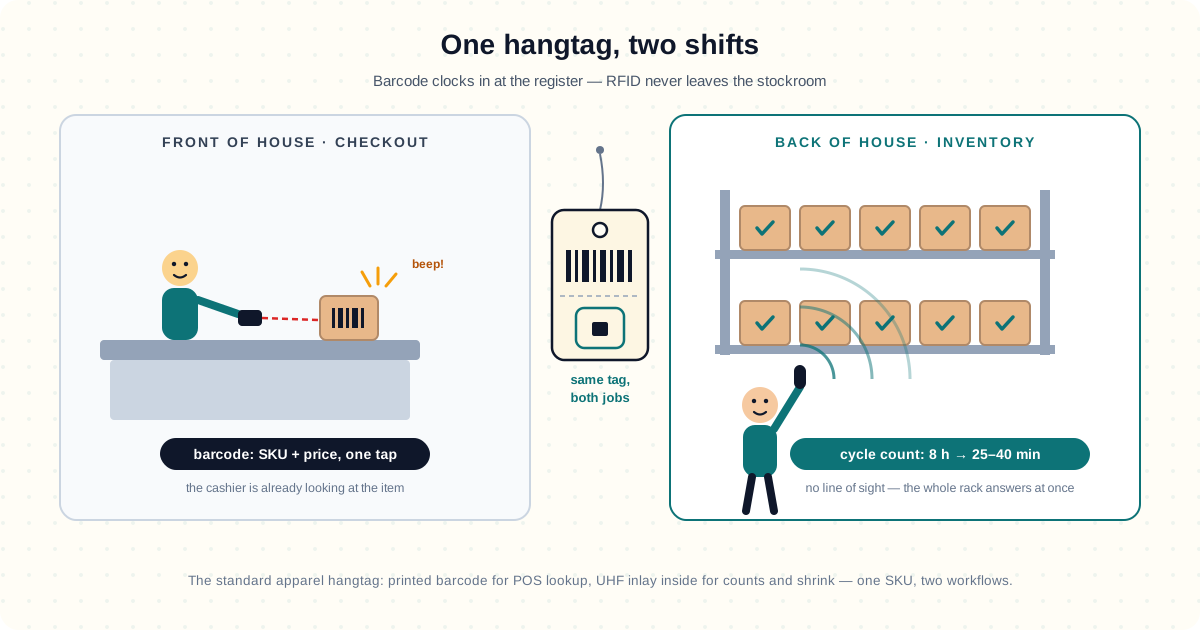
Here is the plot twist most comparison articles bury: the winning move is usually both. A retailer keeps barcodes at point-of-sale — where line-of-sight scanning is natural, because the cashier is already looking at the item — while RFID quietly runs backroom inventory management and supply chain tracking. Each technology works the shift it was born for, and the budget only pays for speed where speed pays back.
2D Barcode & the GS1 Sunrise 2027 Effect
GS1 Sunrise 2027 is an industry goal for retail POS systems to read and process GTINs from both existing 1D barcodes and approved 2D barcodes by the end of 2027. It does not retire EAN-13 or UPC or require every product to carry a 2D code. The relevant question is whether your retailer accepts the chosen symbol and whether the checkout software can process its data.
The buyer’s choice is now three-way: linear barcode for established POS lookup, approved 2D barcode for additional product data or a GS1 Digital Link URL when useful, and UHF RFID for bulk reads without line of sight. A dual-carrier design can serve both POS and inventory when each workflow justifies it. Read our Sunrise 2027 vs RFID guide.
Making the Switch to RFID
Quick decision framework
- Low volume, tight budget, line-of-sight OK → Stick with barcodes
- High volume, need speed and accuracy → Switch to UHF RFID labels
- Consumer interaction needed → Add NFC tags alongside barcodes
- Harsh environment (metal, moisture) → Use specialized anti-metal RFID tags
Migration Roadmap: Barcode-only to Hybrid in 5 Steps
Stage the rollout so tag selection, encoding and reader coverage are validated on a representative product group before expanding. Set the required capture rate from the receiving and counting workflow rather than assuming a universal threshold.
- Pilot selection — choose representative products and packaging, including difficult materials, and define baseline count and exception measures.
- Reader and antenna deployment — test the proposed fixed and handheld read points on site; request a configuration-specific equipment and integration quote.
- EPC encoding scheme — choose GS1 SGTIN-96 for retail / consumer goods, or GIAI-96 for returnable assets. Lock the encoding scheme with your supplier so all incoming tags follow it.
- ERP / WMS integration — confirm the actual connector, event mapping and exception workflow with the installed software vendor.
- Full rollout — expand after the pilot meets agreed capture, process and cost criteria; keep printed codes where the checkout or partner workflow still needs them.
For a structured 90-day pilot framework with defined KPIs, see our RFID 90-day pilot guide.
Key Takeaways
- Unit cost: request like-for-like quotes for printed labels and RFID tags, including encoding, equipment and software.
- Read speed: barcode presentation is optical; UHF can identify multiple tags when the site layout and tag placement support it.
- Line-of-sight: barcode requires direct visual scan; RFID reads through cardboard, fabric, foil (with proper construction).
- Rewriteability: barcode is print-once; RFID can rewrite data thousands of times across the tag’s life.
- Hybrid use: most modern apparel, retail, and logistics flows use BOTH — barcode at SKU level, RFID at carton/case/pallet level.
⚠️ Common pitfall
Item-level ROI depends on item margin, label cost, read capture, labor and exception handling. Validate the complete workflow before replacing a printed code or adding RFID.
RFID vs Barcode FAQ
Will RFID replace barcodes?
No — the consensus from GS1 and IDTechEx is hybrid coexistence, not replacement. Barcodes remain unbeaten on per-label cost, visual readability, and POS lookup. RFID adds bulk-read inventory accuracy at the case / pallet / asset level. The active migration story for 2024–2027 is linear barcode → 2D barcode (GS1 Sunrise 2027), with RFID added in parallel for inventory.
Which is cheaper for a small business?
A printed-code pilot often needs less specialist hardware, but the break-even point depends on your own labor, error rate and selected RFID system. Request current equipment and tag quotes, then compare measured site results using the RFID pricing guide framework.
Can RFID and barcode work on the same item?
Yes — this is the standard apparel hangtag today. The same hangtag carries a printed barcode (for POS lookup and human readability) and an embedded UHF RFID inlay (for inventory and shrink). The two encode the same SKU but serve different scan workflows.
How accurate is RFID compared to barcode in retail?
RFID may improve store-level inventory accuracy when tags stay attached, the reader covers the assortment and exceptions are reconciled into the inventory system. For BOPIS or ship-from-store, measure whether the pilot reduces cancelled orders and missing-item searches against the store's current process; no single accuracy percentage guarantees those outcomes.
Can iPhones read RFID tags?
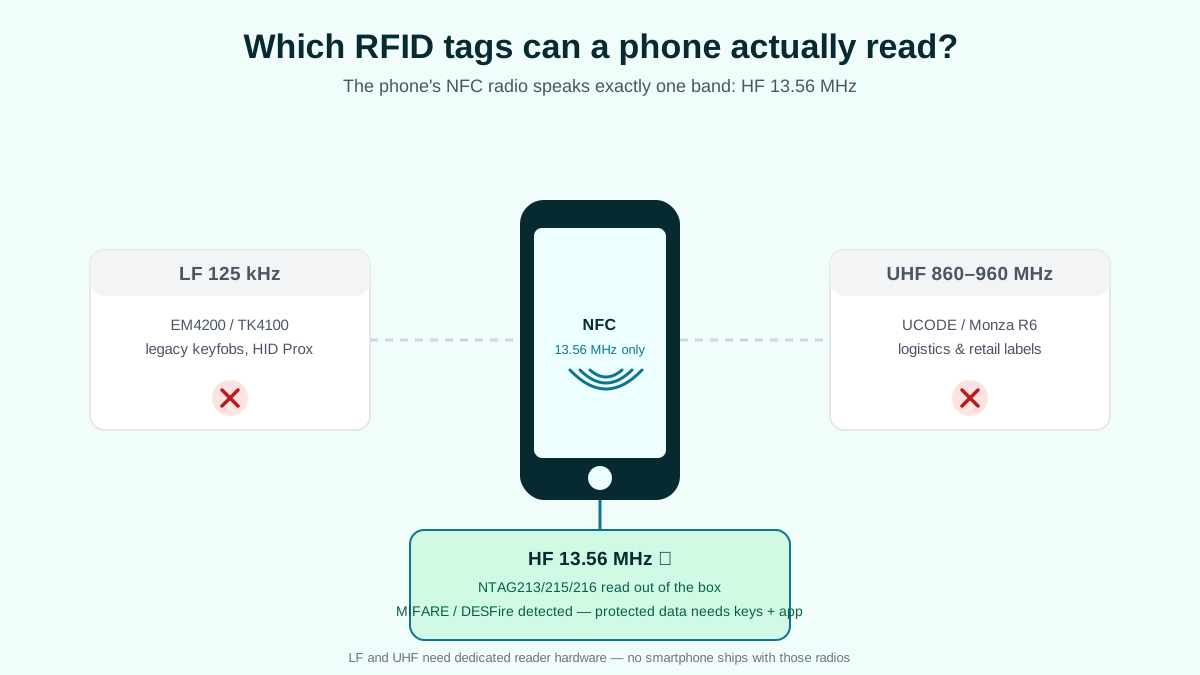
Only the HF/NFC subset — iPhones (iPhone 7+, iOS 13+) and Android phones natively read NFC tags at 13.56 MHz. They cannot read UHF RFID at 860–960 MHz; that requires a dedicated UHF reader. Read our NFC technology guide for the smartphone use cases.
Sources
- GS1 General Specifications — barcode + RFID standards. gs1.org/standards
- ISO/IEC 15420:2009 — Bar code symbology specification: EAN/UPC. iso.org/standard/46143
- ISO/IEC 18000-63:2015 — UHF RFID air interface (Class 1 Gen 2). iso.org/standard/63675
- Auburn University RFID Lab — Apparel inventory accuracy studies (2018, 2022). rfid.auburn.edu
- IDTechEx — "RFID Forecasts, Players and Opportunities 2024-2034". idtechex.com
- McKinsey & Company — "How retailers can use RFID to bring down costs" (2023). mckinsey.com/retail
- Walmart Newsroom — RFID expansion announcements (2022–2024). corporate.walmart.com
Begin with one representative product category and agreed read and cost measures. Contact RFIDAK to discuss sample availability and a configuration-specific pilot.
Contact our team for a customized RFID migration plan. You may also find our RFID supply chain guide and Sunrise 2027 barcode-to-RFID analysis useful for planning.
Need help turning this guidance into a product shortlist?
Use this next step when the article has narrowed the direction and you now need help choosing chips, formats, samples or the closest product family.
Comparison Pages
Compare the closest alternatives before you request samples
Open one of these if the article clarified the topic but the team still needs a cleaner format, chip or frequency decision.
Quick FAQ
Questions buyers often ask after reading this guide
Should I replace barcodes with RFID?
Barcodes and RFID can coexist when they support different read points. Keep the barcode or 2D code required for checkout and human-readable fallback, and test UHF RFID where bulk receiving, cycle counting or shipping scans could save work. If a customer-facing phone tap is needed, evaluate an NFC or camera-readable link separately. Map the data flow and compare pilot results before replacing an established process.
How much does RFID cost vs barcode?
Printed barcodes usually have a lower per-item media cost; RFID adds the tag, reader, antenna, integration, software and maintenance costs. The possible offset comes from the read points where bulk capture replaces manual scans. Price the complete approved design and measure current versus pilot labor, error correction and stock visibility before estimating a break-even date.
Is RFID more accurate than barcode?
RFID can improve inventory accuracy when the tag remains attached, readers cover the required items, and exception handling updates the inventory system correctly. It does not guarantee a particular accuracy rate. Establish a barcode-process baseline, then compare blind counts, missed reads, reconciliation work and stockouts during an item-level RFID pilot on the actual merchandise.
Can RFID read damaged or dirty labels?
An RFID label may remain readable when its print is damaged, but a broken antenna, cracked chip, failed bond or harsh cleaning can also make it unreadable. Compare print damage, read performance and attachment durability on the actual item; use a model with documented environmental ratings when washing, chemicals or sterilization are involved.
Where does barcode still beat RFID in 2026?
Barcodes often remain appropriate when staff can scan items individually, costs are low and the existing workflow is reliable. RFID is worth testing where line-of-sight scanning or bulk counts create measurable labor or accuracy problems. Compare the complete reader, label and integration cost against the current barcode process rather than relying on a universal daily-scan threshold.
What is the 5-year TCO difference between RFID and barcode?
Budget the complete workflow: tags, readers and antennas, installation, data integration, software, training, maintenance and exceptions. Get configuration-specific quotes and measure the current process against a limited pilot before estimating payback. No universal hardware price or payback period applies across sites.
Is RFID mandated by Walmart or other retailers?
Some retailer programs require item-level UHF tagging for specified products. Walmart's public packaging guide points to GS1 serialized RFID encoding and Auburn ARC approved inlays for its applicable U.S. store supply-chain programs; Auburn maps the relevant inlay specification by category and packaging type. Ask each retailer for the current item-level requirement before selecting or applying a tag.
What tags should I order for a barcode-to-RFID pilot?
Start with production-representative passive UHF inlays that meet the actual reader region, item material, packaging and any retailer specification. Size evaluation quantities from the number of items and repeat trials needed at each read point; include candidate inlays, placement and encoding checks. Request a written quote and sample plan for stock and custom constructions instead of assuming free bulk kits or a fixed delivery window.
Author
RFIDAK RFID Editorial Team
RFID supply editorial team
RFIDAK publishes practical RFID guides to help buyers compare chips, product formats, sampling plans and sourcing options before production.