Battery Passport 2026: EV/Industrial RFID, NFC & QR Carrier Guide
A practical guide to battery passport programs. Covers where QR codes fit, when RFID or NFC adds value, and how teams should think about traceability across full battery life cycles.
Topic Cluster
Continue this topic with the next closest guides
These are the articles buyers usually need next when they are moving from basic research into a real shortlist, pilot or compliance discussion.
Digital Product Passport (DPP) Guide 2026: NFC, RFID & QR Carrier Choice
A practical guide to comparing QR, NFC and RFID for digital product passport planning.
Read this nextRFID TECHNOLOGYQR vs NFC vs RFID 2026: Digital Product Passport Carrier Decision
Compare QR, NFC and UHF RFID by reader workflow, security and durability when planning a digital product passport;
Read this nextRFID TECHNOLOGYTextile DPP 2026: QR vs NFC vs RFID for Apparel Brands
Textile DPP planning guide: current ESPR timetable, QR, NFC and UHF carrier trade-offs, garment placement and...
Read this nextRFID TECHNOLOGYSunrise 2027 vs RFID 2026: Why 2D Barcodes Won't Replace Item-Level Tagging
A practical guide to the GS1 Sunrise 2027 industry goal. Compare POS-ready 2D barcodes with RFID, retailer...
Read this next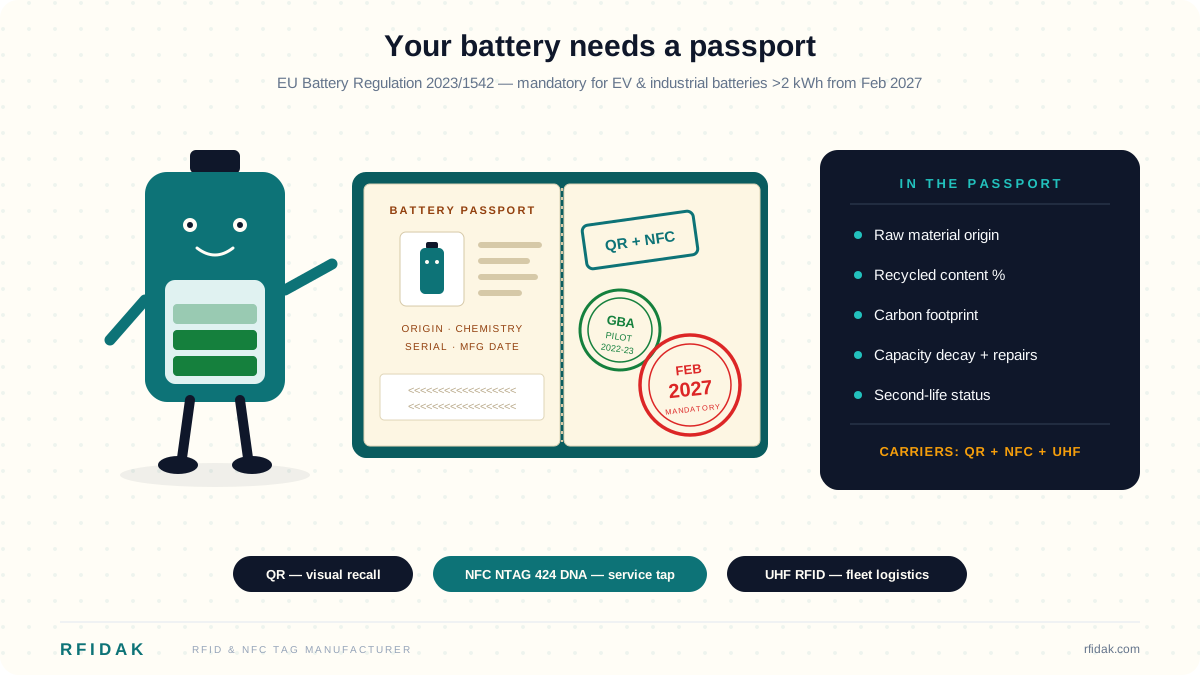
Quick Answer
EU Battery Passport applies from 18 February 2027 to EV batteries, light-means-of-transport batteries and industrial batteries above 2 kWh placed on the EU market or put into service (Regulation (EU) 2023/1542, Article 77). Article 13 provides for QR-code access. NFC and UHF RFID can serve additional service or logistics workflows, but neither is a required battery-passport carrier.
Why battery passport is now a high-priority identity topic
Batteries are getting passports before most of us get around to renewing our own. What began as a sustainability slideshow is now structured implementation: the EU battery regulation introduced electronic battery-passport requirements alongside broader labeling and QR obligations, while the Global Battery Alliance has continued scaling its pilot work, including a second wave of battery passport pilots in 2024 and operational trial planning into 2026. That momentum has pushed battery identity into sourcing, regulatory, manufacturing and after-sales conversations at the same time — usually uninvited, always agenda item one.
For many teams, the key question is no longer whether a battery passport is coming — the itinerary is already printed. It is how the physical battery should connect to its digital record through production, use, repair, second life and recycling without losing its papers somewhere along the trip.
EU Battery Regulation 2023/1542: Timeline & Scope
Meet the passport office: Regulation (EU) 2023/1542, which entered into force August 17, 2023 and replaces the older 2006 Battery Directive. Like any border authority, it does nothing all at once — the regulation phases requirements in by battery category over multiple years, so the first planning job is simply knowing which deadline has your product’s name on it.
| Date | Battery Category | Requirement |
|---|---|---|
| Aug 2023 | All categories | Regulation enters into force; replaces 2006/66/EC |
| 18 Feb 2027 | EV, LMT and industrial batteries >2 kWh | Battery passport under Article 77; QR-code access under Article 13 |
For an affected battery, identify who places it on the EU market, how the QR code resolves to the passport and who maintains the required data over its lifetime. Other labeling and sustainability requirements have their own scope and dates; check them separately in the regulation.
Why QR is not the whole answer
QR codes earned their seat at the table: visible, standardized and easy to deploy on labels — the dependable intern of machine-readable identity. But QR is not automatically enough for every battery workflow. If the project also needs stronger durability, service access, pack-level authentication or operational reads, then RFID or NFC may need to sit alongside the QR layer, handling the jobs a printed square politely declines.
This becomes obvious the moment batteries stop being merchandise and start being patients — moving beyond initial sale into maintenance, diagnostics, reuse and circularity workflows.
When NFC makes sense for battery programs
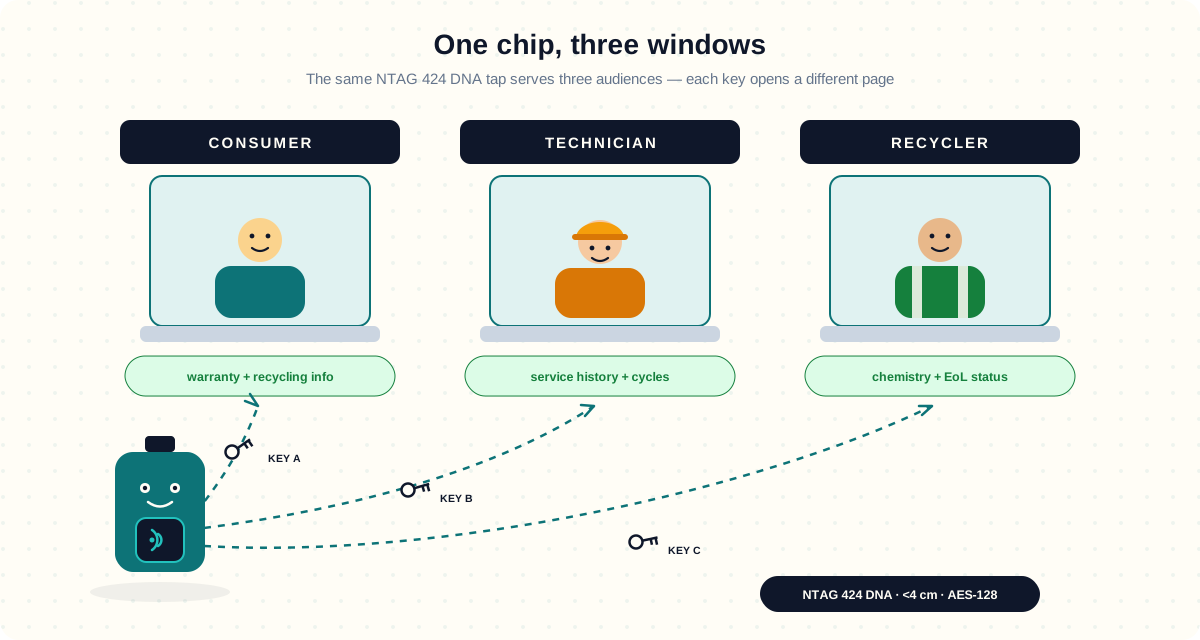
NFC is the deliberate handshake of the carrier family — a strong fit when service technicians, inspectors or controlled end users need an intentional tap interaction. It can support product record access, service history lookup, authenticity checks or maintenance workflow triggers without requiring camera alignment, which matters more than it sounds in a dim service bay with a scuffed label. That makes it interesting for serviceable industrial packs, premium battery products and controlled field operations.
When RFID belongs in the architecture
RFID is what you hire once batteries start traveling in groups. It becomes more attractive when the workflow needs faster non-line-of-sight reads across handling, warehouse movements, return flows or pack aggregation. If the team wants visibility across logistics or end-of-life collection rather than only a service lookup, RFID can add value that QR and NFC alone do not provide — nobody taps four hundred packs one by one and calls it a process.
Carrier Comparison: QR vs NFC vs UHF RFID at a Glance
Many battery passport programs end up running multiple carriers in parallel, for the same reason airports employ more than one kind of officer: no single technology covers the full lifecycle. The trade-offs:
| Dimension | QR Code | NFC (NTAG 424 DNA) | UHF RFID |
|---|---|---|---|
| Per-tag cost | $0.001 (printed) | $0.35–$0.60 | $0.50–$8 (anti-metal) |
| Read range | Camera focal distance | <4 cm | 1–10 m |
| Smartphone read | Yes (camera) | Yes (NFC) | No |
| Anti-counterfeit | Limited (visible copy) | Strong (AES-128 SUN) | Moderate (Gen2v2) |
| Re-writable | No (re-print needed) | Yes (NDEF + counters) | Yes (EPC + user memory) |
| Best lifecycle stage | Sale, recall, consumer | Service, warranty, recycle | Logistics, fleet, collection |
The QR access required by the Batteries Regulation is the starting point. NFC may add a technician tap, and UHF may add bulk operational reads, if the project needs them. Neither optional layer replaces the required QR code.
Required Data Fields in a Battery Passport
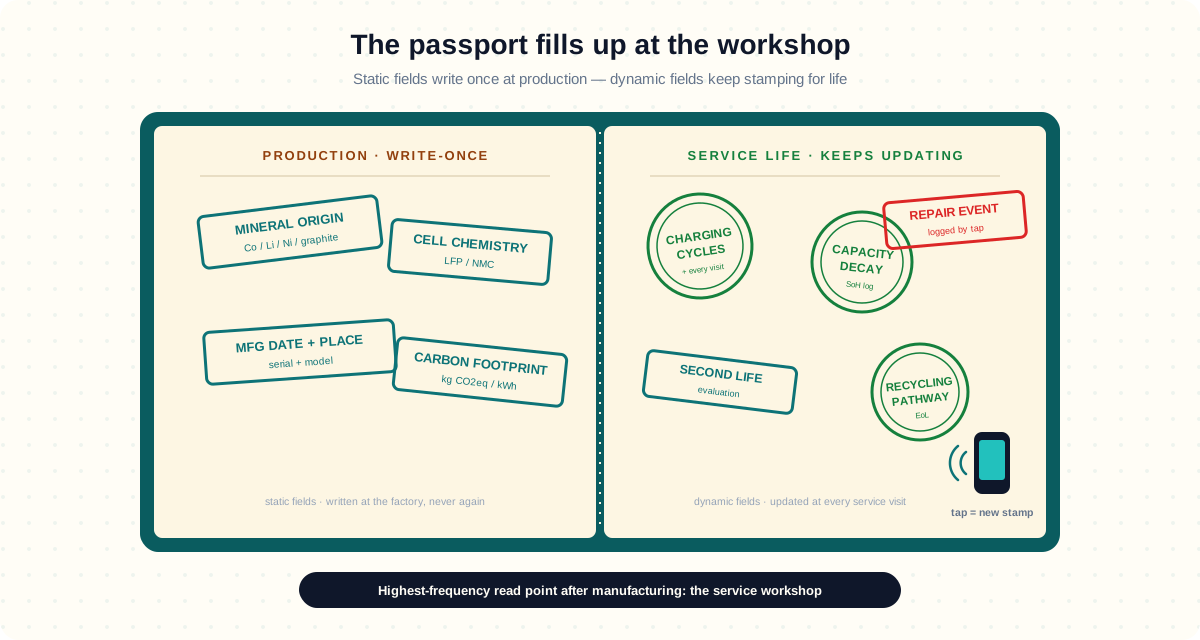
The EU Battery Regulation specifies what data the passport must carry, and it reads less like a label and more like a biography. The fields fall into three categories — static at production, dynamic over service life, and end-of-life status:
- Identification: manufacturer, model, serial, manufacturing date, place of production
- Material composition: chemistry (LFP / NMC / etc.), cell count, mass, mineral origin (cobalt / lithium / nickel / graphite)
- Sustainability: recycled content percentages, carbon footprint (kg CO₂eq / kWh), responsible sourcing audit
- Performance: nominal capacity, voltage, expected service life, state of health (SoH)
- Service history (dynamic): charging cycles, capacity decay, repair / replacement events
- End-of-life: second-life status, dismantling instructions, recycling pathway
This is why the writeable requirement matters: at least the dynamic and EoL fields must update over the battery’s service life. A read-only printed QR cannot meet that on its own — the digital record sits in a manufacturer or third-party database, with the carrier acting as the lookup key plus tamper-evident proof.
Where battery-passport teams should think beyond compliance
- Manufacturing traceability — the birth certificate: where the pack was made and who signed for it
- Service and maintenance history — the medical file, appended at every workshop visit
- Warranty and replacement workflows — the insurance paperwork nobody enjoys until they need it
- Second-life evaluation — the retirement interview: storage duty, or the recycler
- Recycling and circularity records — the estate, settled responsibly
The longer the lifecycle, the more important the physical-to-digital identity strategy becomes — a passport only helps if it survives the whole trip.
Questions to answer before choosing the carrier
- Will the battery be read mainly by consumers, technicians, warehouses or recyclers?
- Is a visible QR enough, or does the workflow need tap or non-line-of-sight reads?
- Does the program require authenticity or anti-tamper capability?
- Will the identity medium face heat, abrasion, chemicals or long service life?
- Is the passport only for compliance, or also for service and circularity optimization?
How to evaluate a battery-passport reference
Before using a company as a procurement precedent, find its dated primary publication and verify the battery category, actual physical carrier, public and restricted data, trial scale and results. A general battery-traceability project is not proof of a completed EU battery passport or an NFC requirement.
A practical pilot path
Start humble: one battery type and one realistic lifecycle slice, such as production-to-service or service-to-return. Compare QR-only against a layered QR + NFC or QR + RFID design, and let the hardware do the arguing instead of the meeting room. The right answer often becomes obvious only when the physical battery, label location, service environment and reader behavior are tested together.
Final takeaway
Tags for battery environments
Ceramic tags — heat-resistant, on-metal, compact
Anti-metal tags — designed for metal enclosures
NFC stickers — consumer-facing tap-to-verify
See also: QR vs NFC vs RFID for DPP
Key Takeaways
- Regulation: Article 77 applies from 18 February 2027 to EV, LMT and industrial batteries above 2 kWh.
- Carrier: Article 13 specifies QR-code access; NFC or UHF is optional for separately defined work.
- Data: raw material origin, recycled %, carbon footprint, capacity decay, second-life status.
- Verticals: EV batteries (Tesla, BYD, CATL, LG Energy), industrial energy storage, e-bike packs.
- DPP integration: Battery Passport feeds into broader EU DPP framework.
⚠️ Common pitfall
Changing lifecycle data can be maintained in the authorised backend record; the physical QR code or optional NFC tag need not be rewritten after each service event. Define access and update responsibilities before selecting the carrier.
Battery Passport FAQ
Who is responsible for paying for the battery passport tag?
The battery manufacturer or pack assembler bears the per-tag cost as part of the bill of materials. For EVs, this typically rolls into the OEM’s vehicle cost. The hosted database backend (where dynamic data lives) is usually operated by the manufacturer, with shared access protocols for service shops, recyclers, and regulators per the EU Reg 2023/1542 access tiers.
Do consumer batteries (AA, AAA, smartphone) need a passport?
No — the digital passport requirement applies only to EV batteries, industrial batteries >2 kWh, and LMT (light means of transport) packs. Portable consumer batteries (AA, AAA, button cells, phone batteries) face labeling and recycled-content rules but not the full passport.
Can battery passport data be updated over the battery’s life?
The authorised digital record can be updated under the applicable access rules as required information changes. A printed QR code can continue to resolve to that record without being reprinted, and an optional NFC tag need not store every update. Confirm the exact data and update responsibilities against Annex XIII and the implementing rules.
What does it cost per battery to add a passport?
Carrier hardware adds $0.50–$3 per pack (QR + NFC dual marking) for industrial / EV scale. Backend database, integration with manufacturing MES, and supplier data collection adds higher one-time costs ($500K–$5M for major OEMs). The dominant cost is data infrastructure, not the physical tag.
What happens if the carrier (tag or QR) is damaged or unreadable?
Plan durable QR placement and a documented way to restore access if the mark is damaged. A printed serial or optional NFC tag may help a particular service workflow, but Regulation (EU) 2023/1542 does not generally mandate NFC or redundant QR-plus-NFC carriers.
Sources
- Regulation (EU) 2023/1542 — Batteries and waste batteries. eur-lex.europa.eu/eli/reg/2023/1542/oj
- Global Battery Alliance — Battery Passport (Pilot & Operational Trial). globalbattery.org/battery-passport
- ISO/IEC 18000-63:2015 — UHF RFID air interface. iso.org/standard/63675.html
- ISO/IEC 14443-1..4:2018 — HF NFC proximity cards. iso.org/standard/73598.html
- IDTechEx — "Battery Passport: Materials, Markets, Players 2024-2034". idtechex.com/battery-passport
- NXP Semiconductors — NTAG 424 DNA datasheet. nxp.com/NTAG424DNA
- International Energy Agency (IEA) — Global EV Outlook 2024. iea.org/global-ev-outlook-2024
Battery passport is a long-life product identity project — the physical carrier decision matters more than many teams expect. Contact RFIDAK to evaluate which carrier mix best fits your battery program — or start from the RFID label range and the broader DPP carrier guide.
Turn this identity strategy into a tag shortlist
Best for teams deciding between QR, NFC and RFID and now needing help with tag placement, material fit, sample options or pilot scope.
Comparison Pages
Compare the closest alternatives before you request samples
Open one of these if the article clarified the topic but the team still needs a cleaner format, chip or frequency decision.
Quick FAQ
Questions buyers often ask after reading this guide
When does EU Battery Passport take effect?
Article 77 of Regulation (EU) 2023/1542 requires a battery passport from 18 February 2027 for EV batteries, light-means-of-transport batteries and industrial batteries above 2 kWh placed on the EU market or put into service. Other battery categories are not covered by that passport date. Article 13 specifies QR-code access; verify the current regulation and its implementing measures for the detailed data and access requirements.
Will battery passports rely only on QR codes?
Regulation (EU) 2023/1542 specifies QR-code access for covered batteries. NFC or UHF RFID may support a separate service or logistics workflow, but the regulation does not generally require those extra carriers. Choose any optional tag only after testing placement, durability, reader access and identifier mapping on the actual battery assembly.
How much does a battery passport RFID tag cost?
Unit price depends on the exact chip and inlay, finished construction, approved quantity per design, printing, encoding, packaging and QC requirements. Request a dated itemized quote showing sample and setup charges, unit tiers, freight and lead time; a generic chip or tag price does not establish the cost of the approved product.
What chip works on metal battery casings?
No chip alone is a default metal-casing solution. Select the finished antenna, spacer or ferrite construction for the exact surface and read point, then verify the reader band and the battery maker’s temperature, chemical, electrical and safety constraints. Keep the QR access required by the battery regulation separate from any optional NFC or UHF operational tag.
Which companies are piloting battery passport RFID?
Do not infer a battery-passport RFID deployment from a company joining an industry group or researching traceability. Request a dated primary case study that names the battery category, physical carrier and operational scope before treating any brand as a reference. Article 77 sets the passport date for covered batteries; it does not prescribe NFC or UHF RFID.
Can NFC or RFID tags survive battery manufacturing temperature?
Survival depends on when the finished tag is attached and the measured temperature, pressure, chemicals and duration it actually experiences. Obtain process data from the battery manufacturer and a test report for the proposed finished construction, then run production-representative trials. Do not infer endurance from the bare chip or a generic ceramic or PPS material rating.
What data goes in an EU Battery Passport?
Regulation (EU) 2023/1542 Article 77 and Annex XIII divide required battery information by access level, including publicly available information and restricted model- or battery-specific information. Article 13 provides for a QR code linked to the passport. GS1 Digital Link and NFC are not prescribed as the universal access format; confirm the applicable technical rules and the exact battery category before designing the identifier.
What is the minimum order for battery passport RFID tags?
RFIDAK's published standard tags-and-labels MOQ baseline is 1,000 pieces. Confirm the exact chip, antenna, construction, print, encoding and quantity per design in a written quote. Free stock samples (up to 5 pieces) — buyer covers DHL/FedEx freight ($25–60), refunded 1:1 against the first production order over $500. Larger evaluation lots, custom samples, production timing and delivery are agreed separately for the selected configuration. For medical, food, pharmaceutical or battery applications, define the applicable product and process requirements before testing. A tag sample or chip specification does not establish regulatory compliance, sterilization performance or safety of the finished assembly.
Author
RFIDAK RFID Editorial Team
RFID supply editorial team
RFIDAK publishes practical RFID guides to help buyers compare chips, product formats, sampling plans and sourcing options before production.