Sunrise 2027 vs RFID 2026: Why 2D Barcodes Won't Replace Item-Level Tagging
A practical guide to the GS1 Sunrise 2027 industry goal. Compare POS-ready 2D barcodes with RFID, retailer specifications and a measurable pilot.
Topic Cluster
Continue this topic with the next closest guides
These are the articles buyers usually need next when they are moving from basic research into a real shortlist, pilot or compliance discussion.
Digital Product Passport (DPP) Guide 2026: NFC, RFID & QR Carrier Choice
A practical guide to comparing QR, NFC and RFID for digital product passport planning.
Read this nextRFID TECHNOLOGYQR vs NFC vs RFID 2026: Digital Product Passport Carrier Decision
Compare QR, NFC and UHF RFID by reader workflow, security and durability when planning a digital product passport;
Read this nextRFID TECHNOLOGYBattery Passport 2026: EV/Industrial RFID, NFC & QR Carrier Guide
A practical guide to battery passport programs. Covers where QR codes fit, when RFID or NFC adds value, and how teams...
Read this nextRFID TECHNOLOGYTextile DPP 2026: QR vs NFC vs RFID for Apparel Brands
Textile DPP planning guide: current ESPR timetable, QR, NFC and UHF carrier trade-offs, garment placement and...
Read this next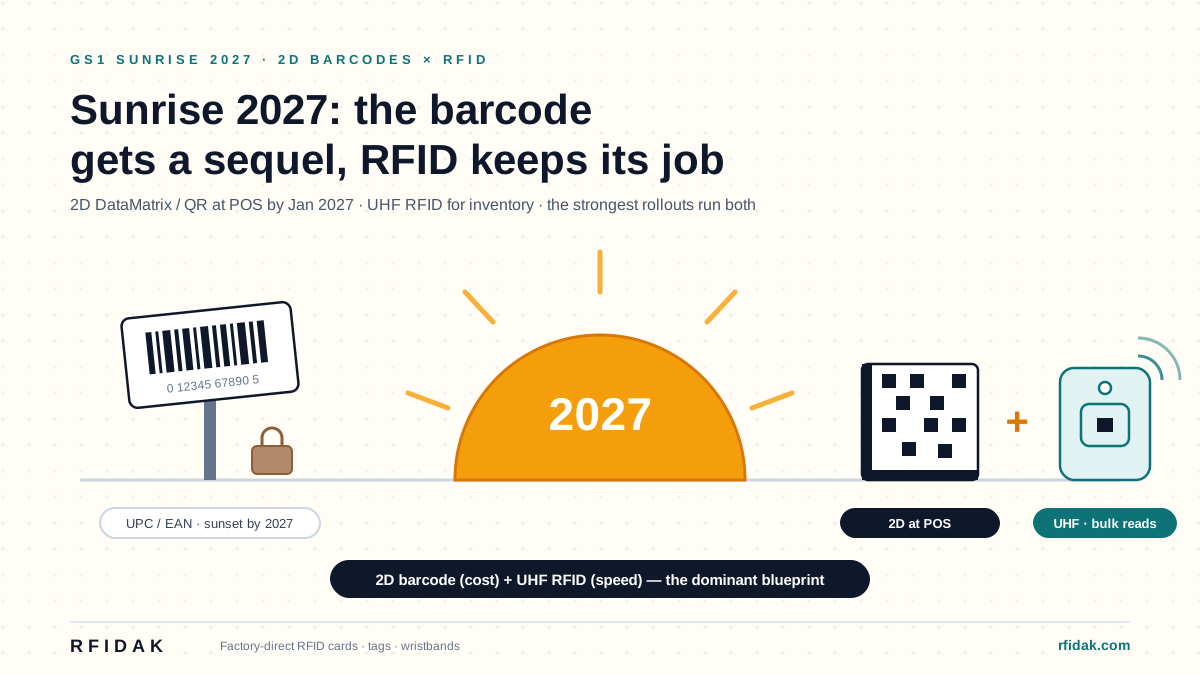
Quick Answer
GS1 Sunrise 2027 is an industry goal for retail point-of-sale systems worldwide to read and process GTINs from both existing 1D and approved 2D barcodes by the end of 2027. It is not a law requiring every product to switch to 2D or to RFID. Brands should check each retailer's actual marking requirements; UHF RFID remains a separate operational option for bulk inventory reads.
Why Sunrise 2027 is suddenly a major retail search topic
GS1 US has been steering the market toward a Sunrise 2027 milestone, which means retailers are preparing point-of-sale systems to accept 2D barcodes at checkout by the end of 2027. Suddenly brand, packaging, POS and traceability teams — groups that historically met once a year at the holiday party — find themselves in the same conversation. And many of them open with the wrong question: will 2D barcodes replace RFID?
For most retailers, the real answer is no — and it is not even close. The two technologies solve different layers of the same product-identity problem, which makes “versus” the wrong preposition entirely.
What Sunrise 2027 actually changes
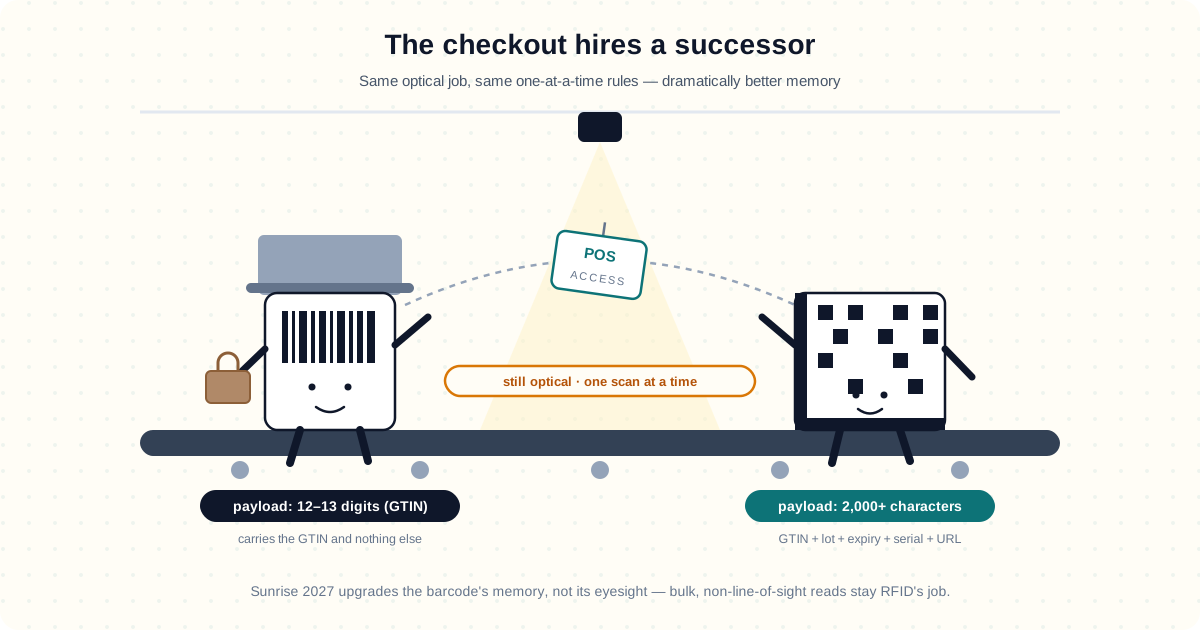
Sunrise 2027 is about making richer 2D barcode data usable at POS. Where a classic UPC recites one number and considers its work done, a 2D barcode can carry far more information and support digital-link experiences, traceability, recall support and consumer-facing content. For packaging and checkout workflows — especially in apparel, general merchandise and food — that is a genuinely meaningful upgrade.
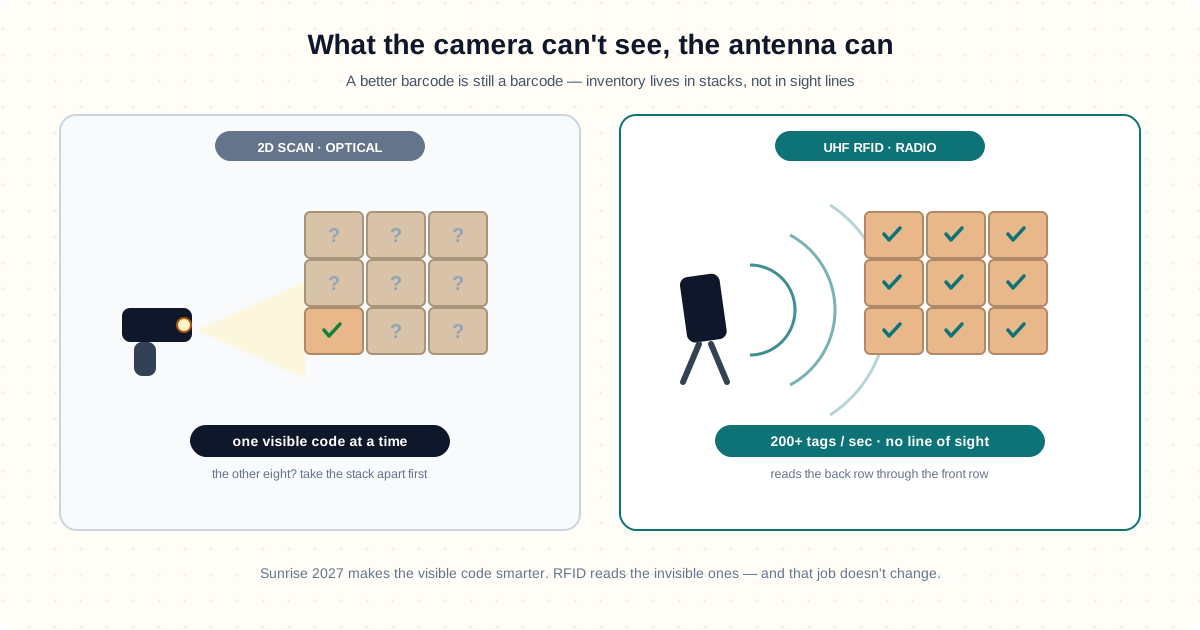
But notice what is missing from that list: none of it touches the operational value of non-line-of-sight RFID reads in stores, stockrooms and returns centers. A better barcode is still a barcode.
Sunrise 2027 Timeline: What Happens by Year
Despite the name, Sunrise 2027 does not rise all at once — it is a multi-year alignment effort that has been quietly climbing since 2018. The timeline below shows where the global retail and supplier ecosystem stands today and what milestones remain.
| Year | Milestone | Stakeholders |
|---|---|---|
| 2018 | GS1 launches "Sunrise 2027" initiative globally | GS1 international standards body |
| 2022–2023 | Retail POS capability work | Verify published retailer programs |
| 2024–2025 | Supplier label printers + ERP system upgrades | CPG brands, FMCG manufacturers |
| 2026 | Retailers continue testing and upgrading POS systems | Mid-tier retailers, e-commerce |
| End of 2027 | GS1 industry goal: POS can process GTIN from both 1D and 2D | Participating retail ecosystem |
This is an industry capability goal, not a statutory deadline. GS1's guidance says POS should be able to process GTINs from both existing linear and 2D codes by the end of 2027. Existing EAN/UPC codes continue during the transition; a supplier should follow each retailer's actual marking requirements.
1D vs 2D vs RFID: Capability Comparison Table
Sunrise 2027 expands the carrier choice for retail product identity from one to three — and each candidate interviews very differently. The question is not which one wins; it is which combination fits the workflow.
| Capability | 1D Barcode (UPC/EAN) | 2D (DataMatrix/QR) | UHF RFID |
|---|---|---|---|
| Per-unit cost | $0.001 (printed) | $0.001 (printed) | $0.05–$0.30 |
| Payload | 12–13 digits (GTIN) | 2,000+ characters | 96 bits–8 KB |
| Read mode | Optical line-of-sight | Optical line-of-sight | RF, no line-of-sight |
| Bulk read | No (one at a time) | No (one at a time) | 200+ tags/sec |
| Smartphone read | Yes (camera) | Yes (camera, native iOS/Android) | No (HF/NFC only) |
| Re-writable | No | No (re-print needed) | Yes |
| Best for | Existing POS identification continues during transition | POS, recall, consumer engage | Inventory, supply chain, shrink |
Where 2D barcodes are strongest
- Visible consumer and cashier scanning
- Low-cost printed packaging updates
- Digital-link experiences for product information
- Data-rich support for recalls, expiration and traceability
If the main requirement is POS readiness, visible product information and packaging-level compliance, 2D barcodes may cover a lot of ground at a lower cost than RFID — roughly the price of ink, with zero chips involved.
Where RFID still wins
- Fast item-level inventory counting
- Receiving and stockroom visibility without line of sight
- Bulk reading in stores, DCs and reverse logistics
- Higher labor savings in cycle counting and exception handling
This is why Sunrise 2027 should be filed as a barcode upgrade, not as a reason to abandon item-level RFID. A printed 2D code can improve checkout and consumer access; RFID still powers the operational reads a camera physically cannot make — through the stack, through the stockroom, hundreds at a time.
Why apparel and general merchandise will often need both
In apparel and general merchandise, the hangtag ends up with two jobs. 2D barcodes work the public-facing shift — richer POS and customer experiences on hangtags and packaging — while UHF RFID works the operational one: inventory accuracy, replenishment, omnichannel fulfillment and returns. The strongest architecture is often dual-purpose rather than single-purpose; asking one carrier to cover both shifts is how gaps happen.
The stakes rise further if the brand is also preparing for textile digital product passport workflows or broader DPP planning — the identity architecture chosen now is the foundation those programs will stand on.
GS1 Digital Link: The Standard Behind 2D Barcodes
GS1 Digital Link is one way to encode a product identifier in a web-friendly 2D barcode and connect it to online information. Sunrise 2027 is the broader POS capability goal: read and process GTINs from approved 2D symbols while retaining 1D support. Digital Link is useful when a project needs a consumer-facing URL, but it is not mandatory for every 2D barcode or retailer.
A Digital Link URL looks like an ordinary web address wearing a very strict uniform — the pattern lets backend systems extract the GTIN, batch, expiration, or serial number on sight:
Whether one code can serve checkout, consumer information and traceability depends on the accepted symbol, data syntax and each system's rules. Validate those workflows separately before simplifying a package design.
For deeper GS1 Digital Link discussion in DPP and traceability contexts, see our Digital Product Passport guide.
When barcode-only is enough
Honest answer: a barcode-first path can be enough — if the project is mainly about POS readiness, data-rich packaging and consumer transparency, and if the retailer does not yet need item-level inventory automation. For some brands, that is the right first step, taken with eyes open rather than by default.
When RFID should stay in scope
- If inventory accuracy is a core KPI
- If stores or DCs need rapid bulk identification
- If returns and reverse logistics are part of the ROI case
- If the brand already uses or plans item-level tagging
How to evaluate a 2D and RFID pilot
Check the current retailer marking specification before choosing a code. On a representative SKU, test the approved 1D and 2D symbols at the actual POS, verify GTIN parsing and print quality, and measure any separate UHF inventory workflow with known-count reads. Publish named retailer examples only when a dated primary source confirms the carrier and rollout scope.
Questions buyers should answer now
- Is the main driver checkout modernization, inventory accuracy or both?
- Will the same identity layer support recalls, returns and consumer engagement?
- Is the item sold one by one, in bulk, or across multiple channels?
- Can the team support dual-marking during the transition?
- Should the physical carrier sit on packaging, hangtag or product itself?
Final takeaway
Related guides
Key Takeaways
- Industry goal: by the end of 2027, retail POS systems can read and process GTIN from both existing 1D and approved 2D barcodes.
- 2D format: use a GS1-approved 2D symbol accepted by the retailer; the permitted data and syntax depend on the use case.
- Sunrise 2027 vs RFID: not a substitute — many retailers do 2D + UHF RFID simultaneously.
- RFID: evaluate UHF separately if bulk inventory reads justify the reader infrastructure.
- Follow the actual marking requirement of each retailer and retain 1D support during the transition where needed.
⚠️ Common pitfall
A 2D-capable scanner alone may not complete the POS data flow. Check software parsing, GTIN handling, print quality and the retailer's accepted barcode format; the GS1 goal does not require every supplier to use DataMatrix.
Sunrise 2027 FAQ
Will old POS scanners still work during the 2D transition?
A 1D-only scanner can still read an existing UPC/EAN code. It cannot read a 2D-only symbol, so test the actual package and retailer POS before changing marking. GS1's end-2027 goal is for POS systems to process GTINs from both 1D and approved 2D barcodes; it does not set a date when UPC/EAN stops working.
Does my supplier need to change anything?
Yes — suppliers need: (1) label printer firmware update to support GS1 DataMatrix or QR; (2) ERP / artwork system update to generate 2D codes alongside 1D; (3) GS1 Digital Link adoption if the retailer requires it. Plan supplier alignment 12–18 months ahead of any retailer deadline.
Is QR or DataMatrix preferred for Sunrise 2027?
GS1 DataMatrix is GS1’s recommended choice for healthcare, pharma, and retail because it’s more compact at high data densities and the spec is more strictly defined. QR Code is acceptable and consumer-friendly because every smartphone camera reads it natively without an app. Many implementations use DataMatrix for trade items and QR for consumer-facing engagement.
How does GS1 Digital Link relate to GTIN, batch, and serial numbers?
Digital Link encodes GS1 keys (GTIN, batch / lot, serial, expiration) inside a standard URL using GS1 Application Identifiers. The URL works in two modes: a browser opens the URL for the consumer; a POS system parses the URL to extract the GTIN-12 / GTIN-13 plus any variable data. One barcode, two audiences, one standard.
What if I miss the Sunrise 2027 deadline?
Sunrise 2027 is an industry capability target, not a legal deadline requiring every product to change its marking. Continue to follow each retailer's barcode specification. If a retailer later requires a particular 2D format, plan artwork, printer and POS data checks against that requirement; an EU DPP obligation must be assessed separately by product category.
Sources
- GS1 — Sunrise 2027 official information page. gs1.org/standards/2d
- GS1 — Digital Link standard. ref.gs1.org/standards/digital-link
- ISO/IEC 16022:2006 — DataMatrix bar code symbology specification. iso.org/standard/44230.html
- ISO/IEC 18004:2015 — QR Code bar code symbology. iso.org/standard/62021.html
- GS1 General Specifications — barcode + EPC standards. gs1.org/standards
- IDTechEx — "RFID Forecasts, Players and Opportunities 2024-2034". idtechex.com
- Walmart Newsroom — RFID + 2D barcode supplier announcements. corporate.walmart.com
Sunrise 2027 raises the importance of 2D barcodes, but it does not erase the business case for RFID — this particular sunrise has room for both. RFIDAK supplies UHF labels and packaging-friendly tag options for item-level retail tagging. Contact us for retail RFID planning.
Turn this identity strategy into a tag shortlist
Best for teams deciding between QR, NFC and RFID and now needing help with tag placement, material fit, sample options or pilot scope.
Comparison Pages
Compare the closest alternatives before you request samples
Open one of these if the article clarified the topic but the team still needs a cleaner format, chip or frequency decision.
Quick FAQ
Questions buyers often ask after reading this guide
What is GS1 Sunrise 2027?
GS1 Sunrise 2027 is an industry goal for retail POS systems to read and process GTINs from existing 1D and approved 2D barcodes by the end of 2027. It is not a law requiring every item to switch to 2D, and UPC/EAN remains usable. The actual marking requirement depends on the retailer and accepted symbol.
Will Sunrise 2027 replace RFID in retail?
No. Sunrise 2027 addresses POS barcode capability. UHF RFID can support bulk inventory and logistics reads when those workflows justify it. Test checkout and inventory separately against the actual equipment and measurable performance targets; neither a 2D code nor an RFID tag automatically satisfies the other workflow.
Where are 2D barcodes stronger than RFID?
Five areas. Consumer access (QR and Digital Link readable from any smartphone camera, zero additional hardware). POS checkout (visible, human-verifiable, works with existing operator workflow). Variable data printing (cheap to update artwork per SKU or batch). Regulatory signage (food ingredients, DPP compliance under ESPR). Physical durability depending on substrate (printed directly on paper, card or foil). 2D barcodes cover the consumer and display layer; RFID covers the bulk operational layer.
Where are RFID and 2D barcodes weakest?
2D barcodes cannot read through obstructions, cannot bulk-scan many items at once, and cannot be authenticated cryptographically (a printed QR is trivially duplicated). RFID cannot be read by consumer smartphones natively (UHF requires dedicated reader; HF NFC is readable by smartphones but expensive and needs a tap gesture). Neither alone covers both consumer engagement and operational automation; that is why the layered model wins.
Should retailers plan for both 2D barcodes and RFID?
Evaluate each workflow first. An approved 2D code can support POS and product-information access; UHF RFID is useful when bulk reads or inventory processes justify the added tags and readers. ESPR does not generally require UHF RFID, and the GS1 Sunrise goal does not require it either. Test a dual-carrier sample if both needs are present.
What is GS1 Digital Link?
GS1 Digital Link is a GS1 URI syntax that can connect a product identifier to online information, including when carried in a suitable 2D code. It is not a general ESPR DPP requirement. A UHF tag stores an EPC identifier rather than the same web URL; a backend can map both identifiers to one product record. Check the retailer's barcode specification and the relevant product rule separately.
What hardware does Sunrise 2027 require at POS?
GS1 Sunrise 2027 is an industry goal for POS systems to process 2D barcodes, not a universal legal mandate. Retailers should audit each scanner, POS software and data workflow against their own rollout plan. Request a current model-specific quote for any imaging scanner and test the intended GS1 data carrier.
Do Sunrise 2027 and ESPR DPP use the same 2D barcode?
They address different requirements. GS1 Sunrise 2027 is an industry goal for POS systems to process GTINs from both 1D and approved 2D barcodes; ESPR DPP requirements depend on product-specific delegated acts. A GS1 Digital Link QR may be useful in both workflows when accepted by the retailer and the applicable final DPP rule, but no single printed code is automatically compliant with both.
Author
RFIDAK RFID Editorial Team
RFID supply editorial team
RFIDAK publishes practical RFID guides to help buyers compare chips, product formats, sampling plans and sourcing options before production.