MIFARE Classic vs DESFire 2026: Security, Cost & Migration Guide
A detailed comparison of Mifare Classic and Mifare DESFire RFID chips. Covers security, memory, performance, cost and ideal use cases — plus the migration path when a legacy Classic fleet needs to move to AES-based credentials.
Quick Answer
MIFARE Classic 1K (NXP MF1ICS50, 1994, Crypto-1 cipher) and MIFARE DESFire (EV1/EV2/EV3, AES-128) are NOT interchangeable — they are 30 years apart in security. Classic Crypto-1 has been publicly broken since 2008 (Garcia et al, USENIX Security); DESFire EV2/EV3 is the current default for new cashless, transit, and access programs. Classic remains acceptable only on isolated low-risk legacy systems.
Mifare Classic vs DESFire: Overview
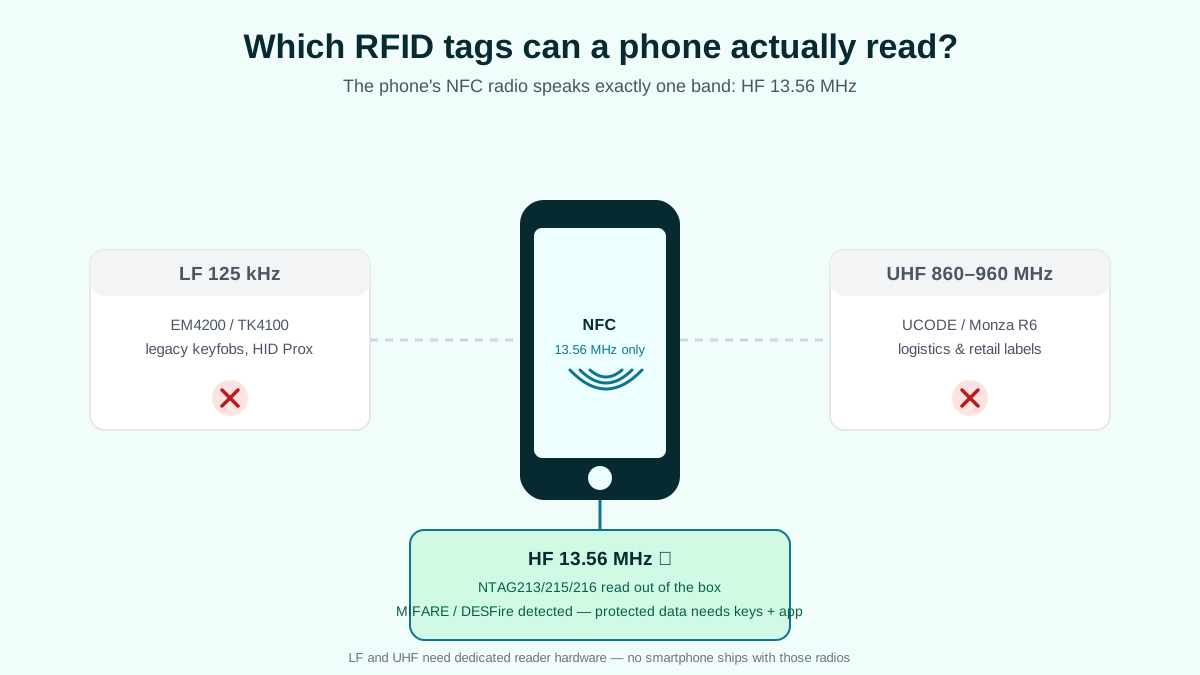
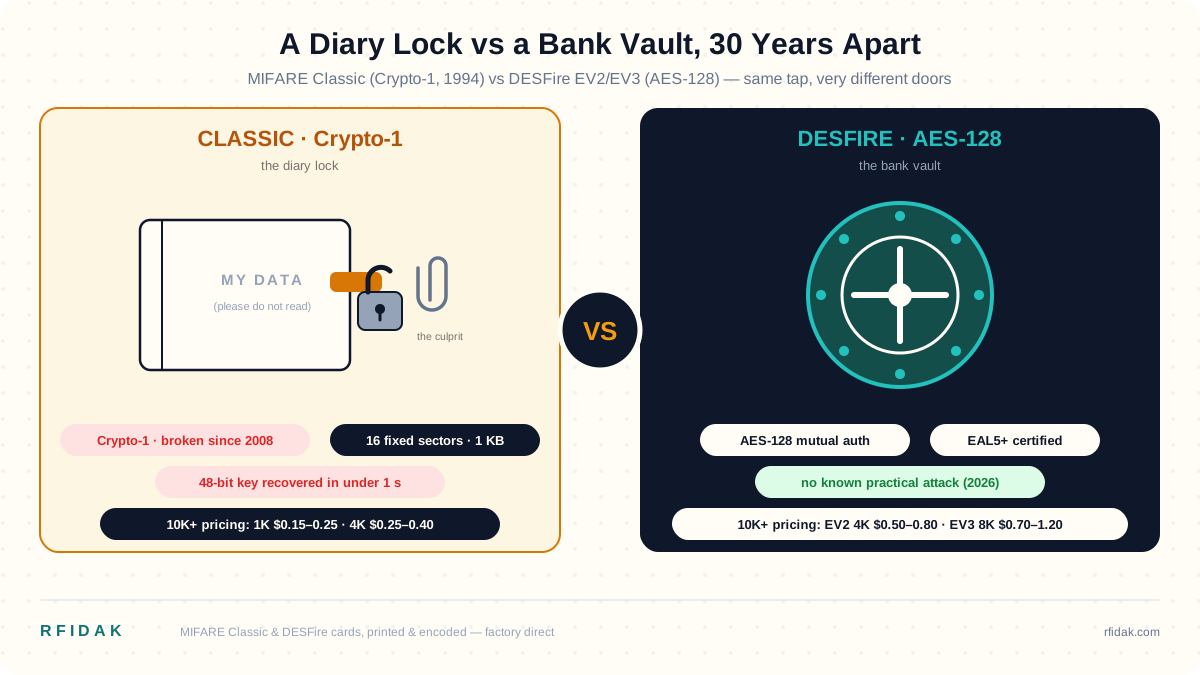
When selecting an RFID chip for contactless smart cards, the choice often comes down to two of NXP's most popular product lines: Mifare Classic and Mifare DESFire. Both operate at 13.56 MHz (HF) and comply with ISO 14443 Type A — and that is roughly where the family resemblance ends. One protects your data like a diary with a heart-shaped padlock; the other, like the room where the bank keeps the diaries. They differ significantly in security architecture, memory structure, and application flexibility.
As of 2025, over 10 billion Mifare cards have been deployed globally, making it the world's most widely used contactless smart card technology. Which means the difference between these two chip families is not academic trivia — it is the line between a credential and a souvenir, and it decides how well your procurement order ages.
Crypto-1
Classic encryption (broken 2008)
AES-128
DESFire encryption standard
3–5x
DESFire price premium vs Classic
Security Comparison
Mifare Classic Security
Mifare Classic uses NXP's proprietary Crypto-1 algorithm for authentication and data encryption. Crypto-1 provided adequate security when introduced in 1994 — a sentence with the same reassuring warmth as “the bridge was considered safe when it opened”. Vulnerabilities were publicly demonstrated in 2008. Key weaknesses include:
- 48-bit Crypto-1 encryption (now considered weak)
- Known vulnerability to relay and cloning attacks
- Static UID that can be duplicated
- No mutual authentication between card and reader
Despite these limitations, Mifare Classic remains widely used in applications where the cost of upgrading outweighs the security risk, or where additional system-level security measures are in place. It endures on diary-lock logic: not because it stops a determined reader, but because the rooms it sits in are mostly locked anyway.
Mifare DESFire Security
Mifare DESFire was designed from the ground up with modern cryptographic standards — less diary lock, more vault door with a spinning wheel:
- AES-128 encryption — overall system security still depends on key management and implementation
- DES, 2K3DES, 3K3DES also supported
- Mutual authentication between card and reader
- Random UID option to prevent tracking
- Transaction MAC for secure payment verification
- Common Criteria EAL5+ certification (DESFire EV3)
DESFire EV3, the latest generation, adds Secure Messaging (SDM), enabling secure NFC interactions with smartphones without requiring a dedicated app.
Cloning Reality Check: How Easy Is It Really?
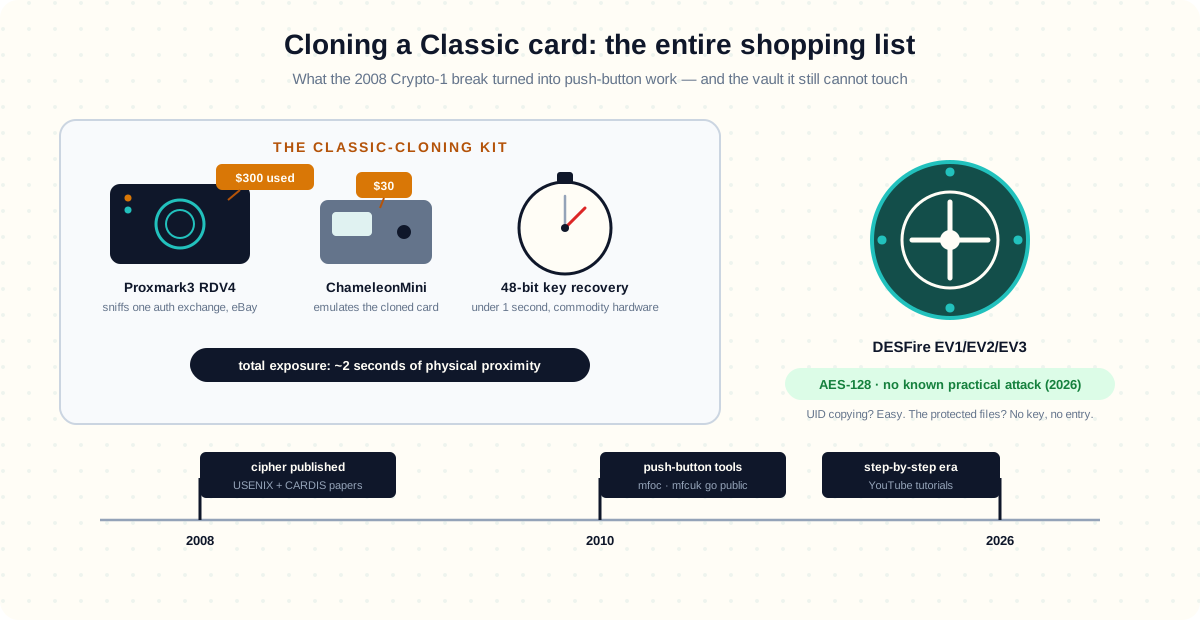
Marketing comparisons gloss over the practical attack surface. The real question buyers ask is — if I keep Classic, what does an attacker actually need to clone my card? The answer for Classic has been public knowledge for years, and it fits on a sticky note:
- 2008 — Crypto-1 publicly reverse-engineered. Karsten Nohl, Henryk Plötz, Starbug published the cipher (USENIX 2008). Garcia et al. published a practical key-recovery attack the same year (CARDIS 2008).
- Public attack tooling. Research and open-source tools demonstrate attacks on MIFARE Classic Crypto-1 under particular card, key and reader conditions. The effort depends on the installed system; audit the actual credential and reader configuration.
- Operational implication. Do not use MIFARE Classic as the sole protection for payments or high-value access. Review key management and reader capability, then pilot a supported AES credential where the threat model requires it.
What the Classic break does not compromise: DESFire EV1/EV2/EV3 with AES-128 mutual authentication. Even with full cipher knowledge, an attacker without the AES key cannot derive working session keys. As of 2026 there is no known practical attack against DESFire EV2 or EV3 in production silicon. UID copying is still possible (and easy) but the protected file structure and counters are not replicable without the AES key. The burglar can photocopy the name plate on the vault door; the vault is unmoved.
Memory Architecture
| Feature | MIFARE Classic 1K | MIFARE Classic 4K | DESFire EV2/EV3 |
|---|---|---|---|
| Total Memory | 1,024 bytes | 4,096 bytes | 2K / 4K / 8K bytes |
| Structure | Fixed 16 sectors | Fixed 40 sectors | Flexible file system |
| Multi-App Support | Limited | Limited | Up to 28 applications |
| File Types | Data blocks only | Data blocks only | Standard, Value, Record, Cyclic |
The flexible file system of DESFire allows multiple independent applications on a single card, each with its own security keys — an apartment building with separate leases, where Classic offers one long corridor of lockers. This makes DESFire ideal for multi-purpose cards combining access control, payment, and identification.
Performance Comparison
| Metric | MIFARE Classic | DESFire EV3 |
|---|---|---|
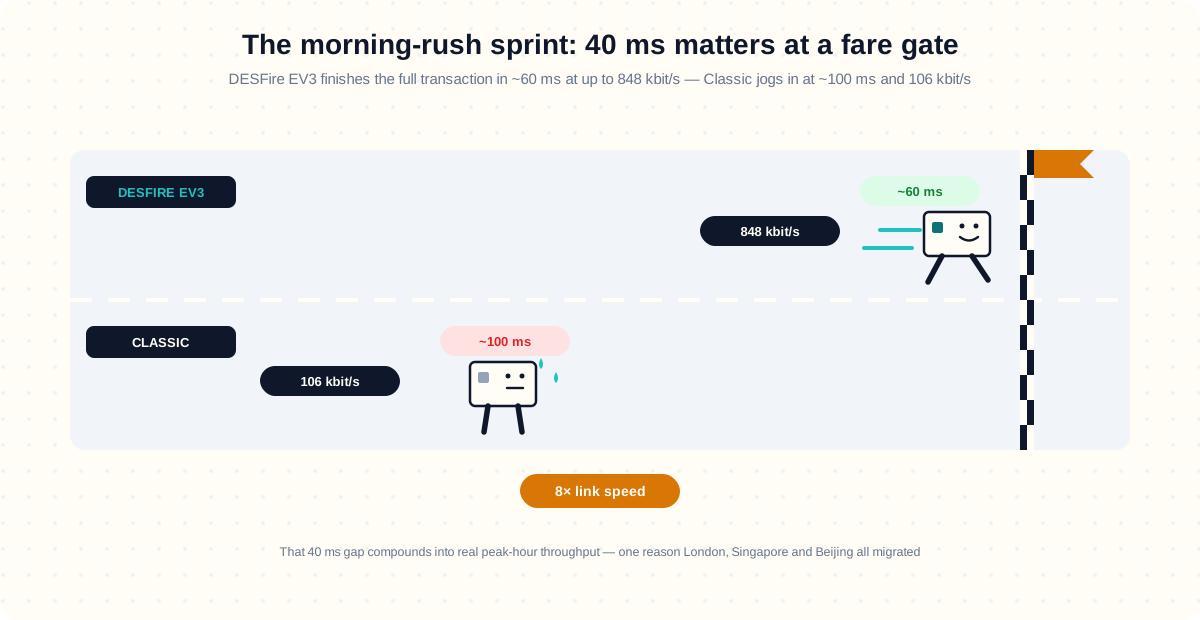
| Communication Speed | 106 kbit/s | Up to 848 kbit/s |
| Transaction Time | ~100 ms | ~60 ms (8 ms target on EV3 SDM) |
| Read Range | Up to 10 cm | Up to 10 cm |
| NFC Compatible | Yes (read/write) | Yes (full feature + SDM) |
Cost Comparison
Card cost depends on the exact chip article, approved status, card body, printing, encoding, quantity and delivery terms. Compare current quotes for the same specification after confirming that the installed reader and application support the proposed credential.
Best Use Cases
Choose Mifare Classic When:
- Budget is the primary concern
- Application requires basic access control
- Existing infrastructure uses Mifare Classic readers
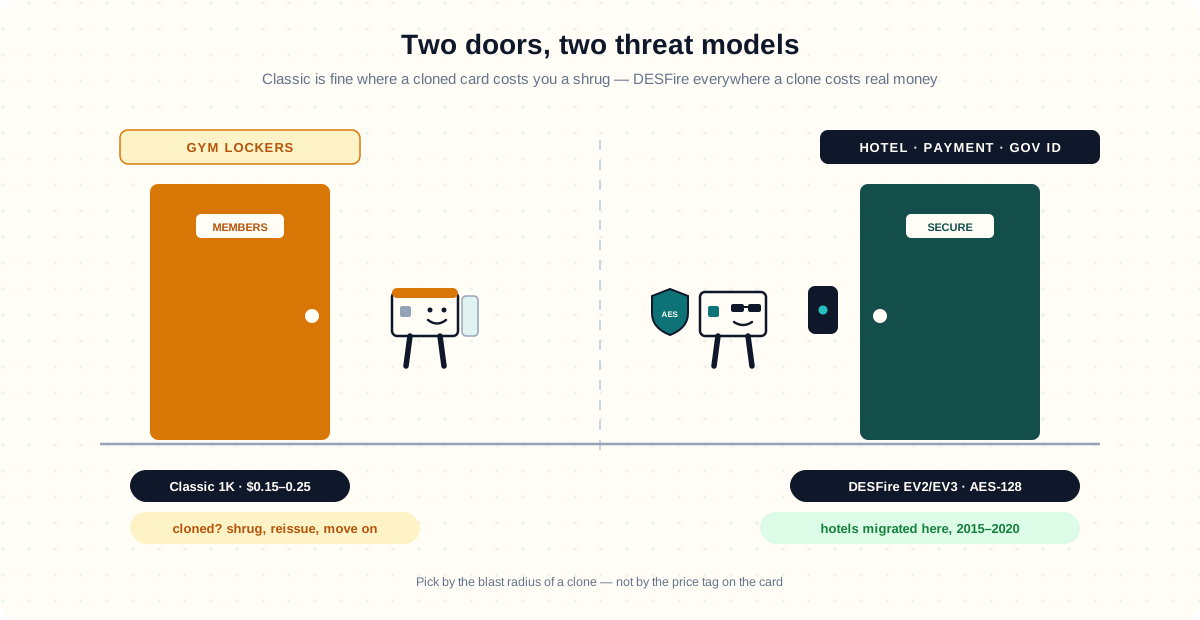
- Data sensitivity is low (gym access, parking)
- Single-application cards are sufficient
Choose Mifare DESFire When:
- High security is required (financial, government)
- Multi-application cards are needed
- Regulatory compliance demands strong encryption
- Future-proofing is important
- Smartphone NFC interaction is desired
Migration Path
Organizations using MIFARE Classic need to audit the installed readers and access application before choosing a migration chip. DESFire EV3 is functionally backward-compatible with earlier DESFire generations, but it does not emulate Classic or provide a Classic-compatible Security Level 1. A reader that only supports Classic application commands will need a supported upgrade or replacement for DESFire. A suitable MIFARE Plus part may allow staged Classic-compatible card issuance; moving to AES still requires compatible reader software, keys and application changes.
5-Step Migration Path: Classic → DESFire
For operators with a 5,000–50,000 card install base, a clean migration runs through five sequential phases over 6–18 months. Skipping the reader audit (step 1) is the most common cause of stalled migrations — it is the load-bearing step, and it looks exactly like the boring one.
- Audit the installed system. Record each reader and controller model, firmware version, working card, application data format and key owner. Confirm whether the vendor supports DESFire commands and AES authentication.
- Choose the migration route. For DESFire, plan any required reader or controller upgrade. For staged Classic-compatible issuance, evaluate an appropriate MIFARE Plus part with the system integrator and document when readers and applications can move to AES.
- Pilot on actual doors. Test approved samples with the installed readers, encoder, keys and access software, including offline and failure-recovery conditions. Set acceptance criteria from the site's security and operating requirements.
- Upgrade and issue in stages. Apply vendor-supported firmware or hardware changes, then issue the new credential only where the complete system has passed the pilot.
- Retire the legacy path. After users and readers have migrated, disable any remaining Classic authentication in the access application and document the final key-management process.
Deployment patterns to test
A legacy Classic reader may need an approved firmware or hardware change before it can authenticate DESFire. For a gym, hotel, campus or transit system, verify the exact reader, controller, firmware, keys and issuance software before choosing the card chip. Published chip specifications cannot establish compatibility with a particular installation.
Bottom line
- Choose Classic for cost-sensitive, low-security projects (basic access, loyalty cards)
- Choose DESFire EV3 for transit, payments, government ID, or any project requiring strong encryption
- Choose Mifare Plus if you need AES security but want to reuse existing Classic reader infrastructure
Key Takeaways
- MIFARE Classic 1K uses legacy Crypto-1; evaluate any continued use against the access value and an explicit migration plan.
- MIFARE DESFire supports authenticated applications; verify the exact chip generation and configured security features with the system owner.
- Reader capability depends on model, firmware, application and key management; test the installed fleet before card reissue.
- Migration path: keep Classic for non-sensitive ID, upgrade to DESFire for any payment or security workflow.
- Cloning reality: Classic is clonable in seconds with a Proxmark3 (publicly known); DESFire AES is not practically clonable as of 2026.
⚠️ Common pitfall
Migrating a Classic-only access system to DESFire requires verifying every reader supports DESFire AES — some legacy installations only handle Classic. Always test one reader-and-card pair before bulk reissue.
MIFARE Classic vs DESFire FAQ
Is MIFARE Classic still safe for office access in 2026?
MIFARE Classic Crypto-1 has published weaknesses. Whether a legacy system can remain in service depends on the asset protected, keys, monitoring and risk owner. For new high-value access or payment designs, review an appropriate AES credential and verify reader support.
Can DESFire cards be read by MIFARE Classic readers?
A reader may detect a DESFire card at the ISO/IEC 14443A air interface, but a Classic-only application cannot read or authenticate its DESFire files. DESFire has no Classic-emulation Security Level 1; that staged migration concept belongs to the MIFARE Plus family. Check the exact reader, controller, firmware and keys before ordering replacement cards.
Why is DESFire 3–5× the price of Classic?
The exact DESFire article and its enabled features affect silicon cost, while card body, print, encoding and volume affect delivered price. Request a current like-for-like quote and verify the supplier part number and applicable certification.
Which is faster in real transit operations?
DESFire EV3 supports higher air-interface bit rates than Classic, but complete transaction time depends on commands, authentication, reader and backend. Benchmark both approved configurations at the intended gate before making throughput claims.
Do I need DESFire if my system is offline / closed-loop?
If the system is air-gapped, has no payment integration, and an attacker cloning a card costs you only the cost to reissue, Classic is acceptable. If any of those conditions fail (online verification, payment, regulated data, expensive reissue), use DESFire. The decision is about blast radius of a clone, not just network topology.
Sources
- ISO/IEC 14443-1..4:2018 — Identification cards / contactless integrated circuit cards / proximity cards (HF 13.56 MHz). iso.org/standard/73598.html
- Karsten Nohl, Henryk Plötz & Starbug — "Reverse-Engineering a Cryptographic RFID Tag." USENIX Security 2008. usenix.org
- Garcia, de Koning Gans, Muijrers et al. — "A Practical Attack on the MIFARE Classic." CARDIS 2008. cs.ru.nl
- NXP Semiconductors — MIFARE DESFire EV3 product datasheet (compatibility with earlier DESFire generations). nxp.com/MF3D_H_X3_SDS.pdf
- NXP Semiconductors — MIFARE Plus X migration fact sheet (Classic-compatible Security Level 1 and AES Security Level 3). nxp.com/MIFAREPLUSXFS.pdf
- NXP Semiconductors — MIFARE Classic family product page. nxp.com/mifare-ics
- Common Criteria — MIFARE DESFire EV3 EAL5+ certificate. commoncriteriaportal.org
- NIST Special Publication 800-38B — CMAC mode of operation (used by DESFire AES-128 transactions). csrc.nist.gov/sp/800-38b
RFIDAK supplies RFID smart cards with both MIFARE Classic and DESFire chips, including custom printing, encoding, and packaging. We also offer keyfobs and wristbands with these chips. Contact us for samples of both chip types for testing.
Need help turning this guidance into a product shortlist?
Use this next step when the article has narrowed the direction and you now need help choosing chips, formats, samples or the closest product family.
Comparison Pages
Compare the closest alternatives before you request samples
Open one of these if the article clarified the topic but the team still needs a cleaner format, chip or frequency decision.
Quick FAQ
Questions buyers often ask after reading this guide
Is MIFARE Classic still safe to use in 2026?
Only for low-risk workflows. Practical Crypto-1 attacks have been public since 2008 (Radboud University and others), and card cloning with inexpensive hardware takes minutes. Gym access, parking, employee loyalty and similar low-value deployments still use Classic because a cloned card does not cause financial or regulatory damage. Any workflow touching payment, transit fares, regulated access, hotel locks or government identity should move to MIFARE Plus SE or DESFire EV3 with AES-128.
What is the main difference between MIFARE Classic and DESFire EV3?
MIFARE Classic uses the broken 48-bit Crypto-1 cipher, fixed-sector memory (1K or 4K), no mutual authentication, and single-application cards. DESFire EV3 uses AES-128 with mutual authentication, a flexible file system supporting up to 28 independent applications per card, Common Criteria EAL5+ certification, and Secure Messaging for smartphone tap. Classic runs at 106 kbit/s; DESFire EV3 runs up to 848 kbit/s with ~60 ms transaction time. Both operate at 13.56 MHz under ISO/IEC 14443A.
How much do MIFARE Classic and DESFire EV3 cards cost?
Unit price depends on the exact chip and inlay, finished construction, approved quantity per design, printing, encoding, packaging and QC requirements. Request a dated itemized quote showing sample and setup charges, unit tiers, freight and lead time; a generic chip or tag price does not establish the cost of the approved product.
Can I migrate from MIFARE Classic to DESFire EV3 without replacing readers?
Only if the installed readers and access application support DESFire. DESFire EV3 is backward-compatible with earlier DESFire generations, not with MIFARE Classic commands; it has no Classic-emulation Security Level 1. Audit each reader model, firmware, credential data format and key plan, then test a card on the actual system. Classic-only readers need a supported upgrade or replacement before DESFire credentials can be issued. MIFARE Plus supports a staged Classic-compatible mode, but moving to AES security requires compatible readers and an application/key migration.
Which MIFARE chip should I choose for a hotel key card system?
Ask the lock-system provider for the exact approved credential part, memory, security configuration, encoder and key requirements for each installed lock model. DESFire EV3 may suit a new system designed for its security features, but a chip-family match does not make it compatible with a current lock. Test a finished card across guest-room, shared-area and recovery workflows before ordering.
What is Secure Messaging on DESFire EV3?
DESFire EV3 supports secure application communication and configurable features, but a smartphone-readable dynamic URL is not a default capability of every DESFire EV3 card. If phone-tap verification is required, confirm the exact chip feature, NDEF configuration, application keys and server-side verifier with the system integrator; NTAG 424 DNA Secure Dynamic Messaging is a separate product family. No chip alone establishes an EU Digital Product Passport.
Does every smartphone read MIFARE DESFire EV3?
NFC-capable phones can detect compatible ISO/IEC 14443 cards, but access to protected DESFire application data requires the correct application, keys and device support. A public NDEF URL needs a separately specified configuration and real-device tests. Do not infer that a phone can use a hotel or access credential merely because it detects the card.
What is the minimum order quantity for MIFARE cards from RFIDAK?
RFIDAK's published standard card MOQ baseline is 500 pieces. Confirm the exact chip, card construction, printing, encoding and quantity per design in a written quote. Free stock samples (up to 5 pieces) — buyer covers DHL/FedEx freight ($25–60), refunded 1:1 against the first production order over $500. Larger evaluation lots, custom samples, production timing and delivery are agreed separately for the selected configuration.
Author
RFIDAK RFID Editorial Team
RFID supply editorial team
RFIDAK publishes practical RFID guides to help buyers compare chips, product formats, sampling plans and sourcing options before production.