MIFARE Card Guide 2026: Classic vs Plus vs DESFire vs Ultralight
NXP MIFARE chips ship by the billions every year — Classic 1K alone still sees 800M+ units annually despite Crypto-1 being broken in 2008. This guide covers Classic, Plus, DESFire and Ultralight, and which one fits which project.
Quick Answer
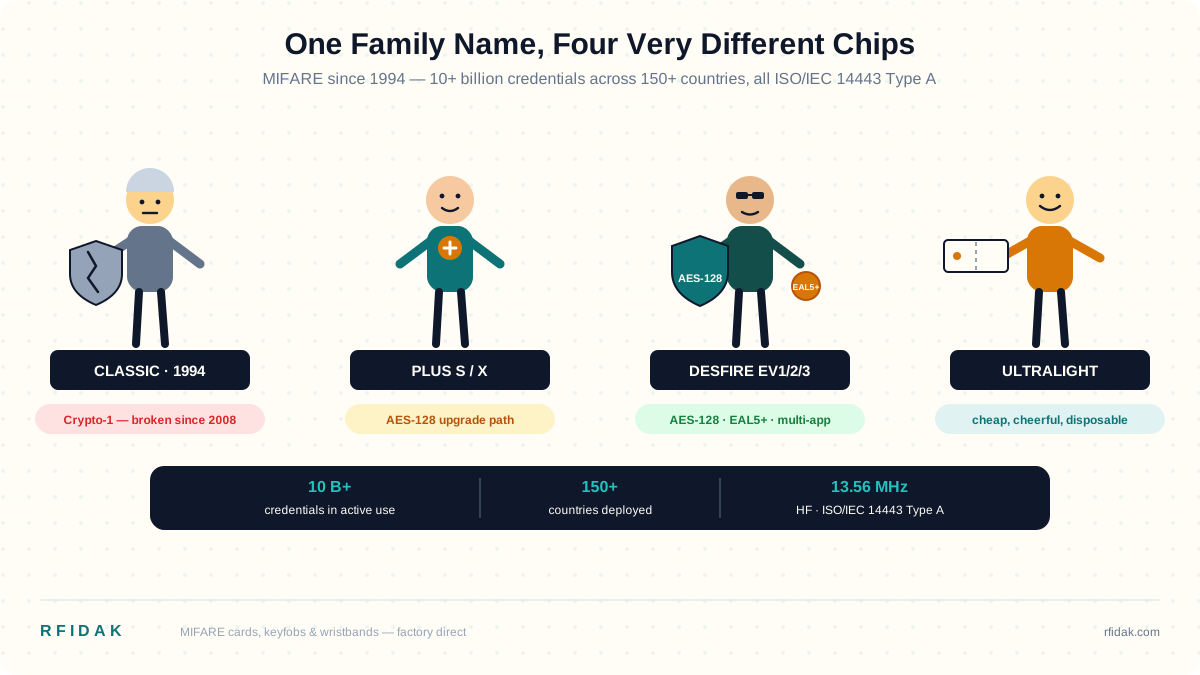
MIFARE is NXP’s family of HF 13.56 MHz contactless smart card chips, launched in 1994 with 10+ billion credentials in active use across 150+ countries. Four product lines under ISO/IEC 14443 Type A: MIFARE Classic (Crypto-1, publicly broken since 2008 — legacy only); MIFARE Plus (AES-128 upgrade path from Classic); MIFARE DESFire EV1/EV2/EV3 (AES-128 mutual auth, Common Criteria EAL5+, current default for new payment, transit, and access deployments); and MIFARE Ultralight (low-cost disposable for tickets and events).
What is Mifare?
Mifare is NXP Semiconductors' family of contactless smart card chips, launched in 1994 (originally under Philips Semiconductors) — which makes it older than Google and considerably harder to avoid. Over the next three decades it became the default chip behind public-transit ticketing, hotel locks, gym lockers, campus cards, cashless venue payment and event wristbands. If you tapped anything on your way to work today, odds are you greeted a member of this family: NXP estimates 10+ billion Mifare credentials are in active use across 150+ countries.
Mifare runs at 13.56 MHz HF and complies with ISO/IEC 14443. The product line covers four security tiers — four relatives who share a surname and not much else: Classic (legacy / Crypto-1, broken in 2008 — the proud grandparent), Plus (drop-in upgrade with AES-128 ready — the diplomatic middle child), DESFire (full enterprise security — the one with the vault job), and Ultralight (low-cost disposable — the cheerful intern). Project teams pick a tier based on threat model, memory needs and reader compatibility — covered in the comparison sections below.
10 B+
Mifare cards sold worldwide
150+
Countries with Mifare deployments
1994
Year Mifare was introduced
Mifare Classic
Mifare Classic is the most widely deployed contactless smart card technology — and, since 2008, also the most widely picked lock in the business. It comes in two main variants:
Mifare Classic 1K (S50)
Features 1024 bytes of EEPROM memory organized in 16 sectors of 4 blocks each — a filing cabinet with 16 drawers, each drawer with its own tiny lock. The first block of each sector is a key block containing access keys and conditions. It supports Crypto-1 authentication and has a unique 4-byte serial number. Reading distance is typically 10 cm.
Mifare Classic 4K (S70)
Offers 4096 bytes of memory organized in 40 sectors (32 sectors of 4 blocks and 8 sectors of 16 blocks). It provides the same security features as the 1K version but with significantly more storage capacity for applications requiring more data. Same tiny locks, bigger cabinet.
Security note
Mifare Classic's Crypto-1 encryption was publicly broken in 2008. For new access control or payment projects requiring strong security, consider upgrading to Mifare Plus (AES-128) or DESFire EV3. Read our Mifare Classic vs DESFire comparison for a detailed breakdown.
Mifare Plus
Mifare Plus is the successor to Mifare Classic and the designated peacemaker of the family: modern security in one hand, backward compatibility with the old readers in the other. It comes in two variants: Mifare Plus S (simplified) and Mifare Plus X (extended).
Key features include AES-128 encryption (compared to Crypto-1 in Classic), multiple security levels (SL0-SL3), backward compatibility with Mifare Classic infrastructure, and available in 2K and 4K memory options. In practice, Plus exists so you can upgrade a Classic estate without one dramatic forklift weekend.
Mifare DESFire
Mifare DESFire represents the highest security level in the Mifare product line — the family member with the vault job and the tailored suit. It features an open architecture with a flexible file structure supporting multiple applications on a single card.
DESFire EV2
Available in 2K, 4K, and 8K memory options, DESFire EV2 supports DES, 2K3DES, 3K3DES, and AES-128 encryption. It features multi-application support, transaction MAC for securing payment transactions, and MISmartApp for hosting web applications.
DESFire EV3
The latest generation offers improved security features, faster communication speeds, support for Secure Messaging (SDM) for NFC interaction, and enhanced privacy features with optional random UID.
| Feature | Classic 1K | Plus S/X | DESFire EV3 | Ultralight EV1 |
|---|---|---|---|---|
| Memory | 1 KB | 2 / 4 KB | 2 / 4 / 8 KB | 48 / 128 bytes |
| Encryption | Crypto-1 | AES-128 | AES-128 / 3DES | None / AES |
| Security Level | Low | Medium–High | High | Low |
| Multi-App | No | No | Yes | No |
| Best For | Basic access | Upgrades | Transit, payments | Tickets, events |
Mifare Ultralight
Mifare Ultralight is the family’s cheerful intern: cost-effective, built for limited-use applications, and gone by Monday without hard feelings. It features 64 bytes of memory with no encryption (Ultralight) or with AES authentication (Ultralight C/EV1). Common applications include event tickets, single-use transit tickets, and loyalty cards. RFIDAK offers RFID paper cards with Ultralight chips for disposable ticketing projects.
NTAG vs MIFARE: Where the Lines Cross
Buyers often confuse NTAG (NXP’s NFC tag family for smartphone tap interaction) with the MIFARE smart-card family. Both are NXP, both run on 13.56 MHz HF, and both are dispatched under ISO/IEC 14443 Type A — but they answer different commands and target different deployments. Same maker, different day jobs: specify the wrong one and your tap-to-info campaign becomes a box of very quiet stickers.
| Family | Standard | Designed For | Smartphone Read? |
|---|---|---|---|
| MIFARE Classic / Plus / DESFire | ISO 14443-3/4 + NXP custom | Reader-side auth: payment, transit, access | Read UID only (most phones) |
| MIFARE Ultralight | ISO 14443-3 | Disposable tickets, event passes | Yes (NDEF readable) |
| NTAG 213/215/216 / 424 DNA | ISO 14443-3 + NFC Forum Type 2 | Tap-to-info, anti-counterfeit, marketing | Yes (full NDEF) |
If you need an iPhone or Android phone to read your tag without an app, you almost always want NTAG — not MIFARE Classic. If you’re building a closed-loop system with proprietary readers (transit gate, hotel lock, office door), MIFARE DESFire is the right family. (A phone can wave at a DESFire card all day; without the keys, the card waves back politely and says nothing.) Read the NTAG 424 DNA guide for the smartphone-secure use case.
The Crypto-1 Break (2008): What Actually Happened
MIFARE Classic uses a proprietary stream cipher called Crypto-1 with a 48-bit key — designed in the 1990s when 48 bits was considered hard to brute-force in real time. The 1990s, it turns out, do not offer extended warranties. Two academic teams independently broke it in 2008:
- USENIX Security 2008 — Karsten Nohl, Henryk Plötz and Starbug reverse-engineered the Crypto-1 algorithm by reading the chip’s photographic die layer-by-layer, then published the cipher.
- CARDIS 2008 — Garcia, de Koning Gans, Muijrers et al. demonstrated a practical key-recovery attack: capture a single legitimate authentication exchange, then derive the 48-bit key in under 1 second on commodity hardware.
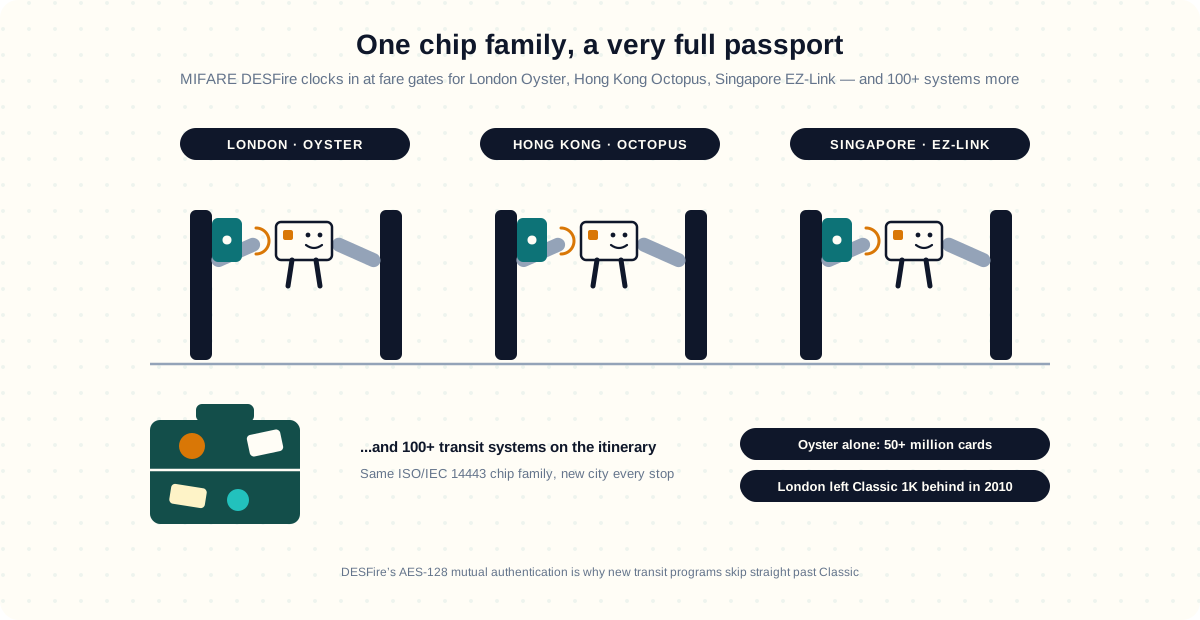
- 2010 onwards — "MIFARE Classic offline cracker" tools (mfoc, mfcuk) made the attack push-button. By 2012 Dutch transit operator OV-chipkaart had migrated away from Classic; London Oyster moved to DESFire by 2010.
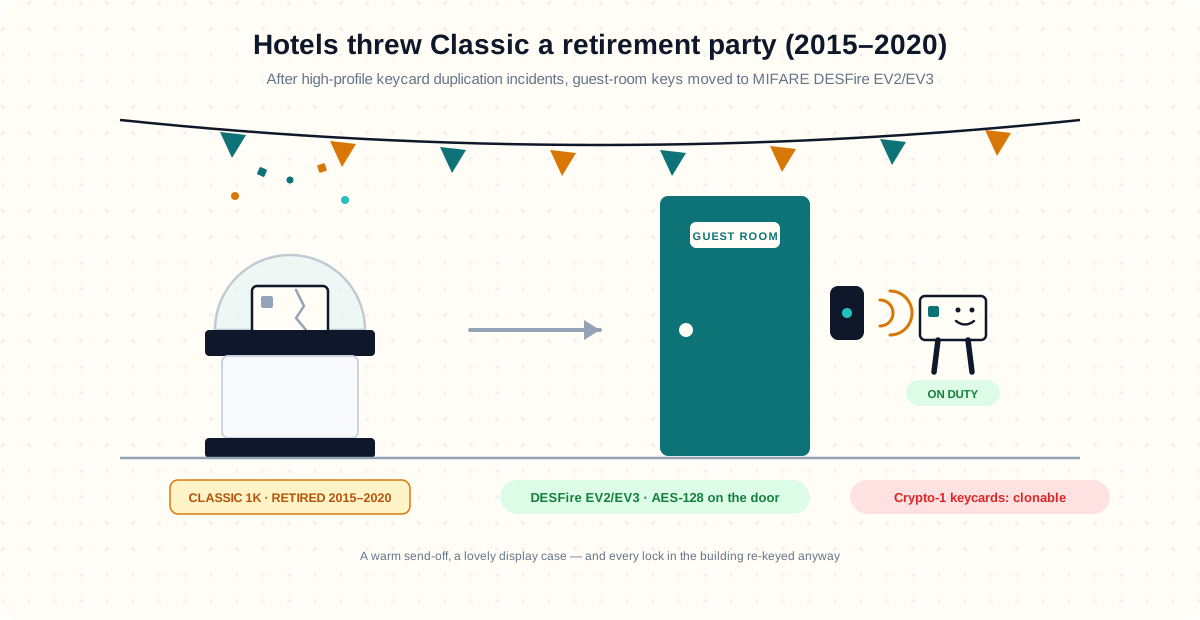
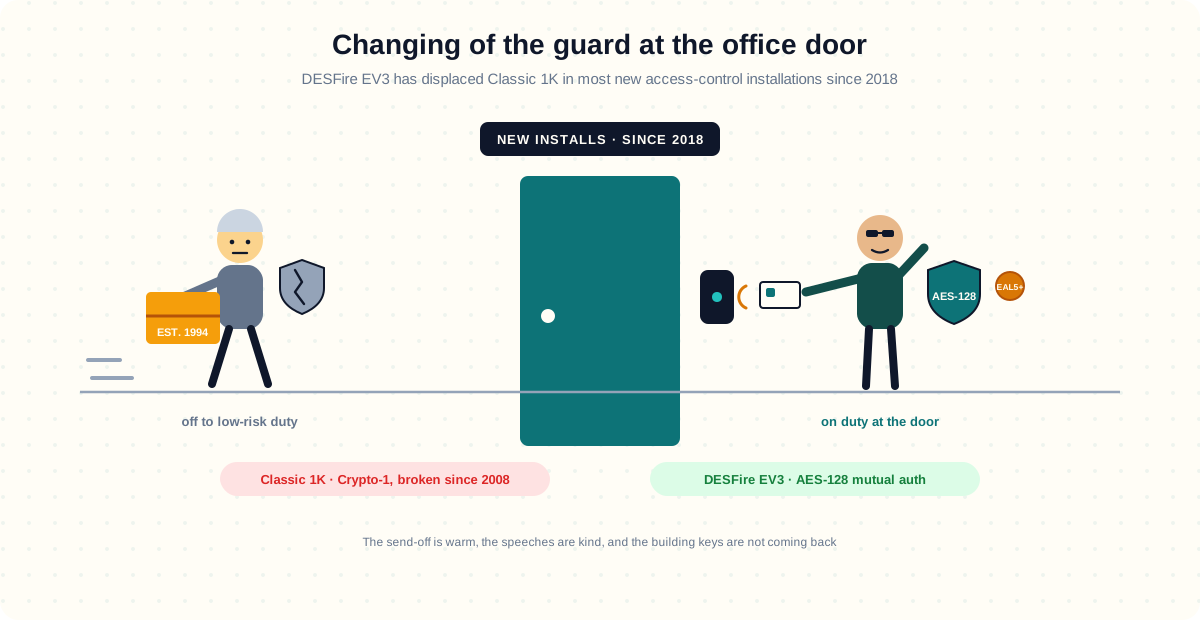
The practical takeaway: any new project that needs cryptographic security must avoid Classic. Classic 1K is still produced because billions of legacy readers exist — the retirement keeps getting postponed, like a rock band’s farewell tour — and many low-risk applications (gym lockers, library cards, school IDs) tolerate the weakness. For payment, transit, hotel keys, or corporate access, DESFire EV2/EV3 is the only defensible default.
MIFARE Migration Path: Classic → Plus → DESFire
If you operate a Classic 1K install base and want to upgrade without forklifting every reader and card in one heroic, career-defining weekend, MIFARE Plus is the explicit migration product. The migration runs through five practical steps:
- Inventory readers — confirm every reader supports ISO/IEC 14443-4 (T=CL) protocol; readers older than ~2010 may need firmware updates.
- Order MIFARE Plus X cards in Security Level 1 (SL1) — behaves like Classic 1K with Crypto-1 backwards compatibility. New cards work on existing readers without code changes.
- Upgrade reader firmware in batches to support AES-128 and Plus protocol. Most modern readers (HID, Identiv, Zebra, Feig) support the upgrade in software.
- Switch to Security Level 3 (SL3) on cards — cards now require AES-128 mutual authentication. Crypto-1 fallback disabled.
- (Optional) Move to DESFire EV3 for the next replacement cycle — multi-application support, 8 KB memory, EAL5+ certified, NXP’s flagship for new deployments.
An SL1-to-SL3 transition requires compatible readers and application software, an approved key plan, credential issuance and revocation procedures, and tested fallback. Set the schedule from the installed fleet and cutover plan rather than a generic cardholder-turnover estimate.
How to evaluate a MIFARE migration
Obtain the installed reader and controller models, firmware, credential format, key-management plan and approved chip articles from the system owner. Test enrollment, authorized and denied access, replacement and revocation with a small non-production card set. Public transport or hotel programs using a related chip family do not prove compatibility with your installed readers.
Choosing the Right Mifare Chip
The choice between Mifare variants comes down to three honest questions: what happens if a card is cloned, how much data needs to ride on it, and who signs the invoice. In other words — security requirements, memory needs, and budget, in that order.
Quick decision guide
- Budget access control → Mifare Classic 1K — widely compatible, lowest cost
- Upgrading from Classic → Mifare Plus — AES security, same reader infrastructure
- Transit or multi-purpose → DESFire EV3 — highest security, multi-app support
- Disposable tickets → Ultralight EV1 — minimal memory, lowest per-unit cost
Key Takeaways
- MIFARE Classic 1K/4K: Crypto-1 has known weaknesses; assess legacy use against the site threat model and migration plan, not a presumed low price.
- MIFARE DESFire EV2/EV3: AES-128 mutual auth, transaction MAC, multi-application — current default for cashless payment, transit, secure access.
- MIFARE Plus: can support a staged migration in a compatible configuration; AES operation requires supported readers, software and key management.
- NTAG213/215/216: NDEF-focused, smartphone NFC tap, no Crypto-1, no Classic-style sectors — the tap-to-info workhorse.
- Sharing an ISO/IEC 14443 air interface does not prove application-level credential compatibility. Test the exact chip and configuration with the installed reader fleet.
⚠️ Common pitfall
Specifying “MIFARE” alone is ambiguous — Classic and DESFire are 30 years apart in security. Always specify the exact chip variant (e.g., DESFire EV2 4K) in the RFQ to avoid accidental Classic supply.
MIFARE Cards FAQ
Is MIFARE Classic still safe to use in 2026?
Only for low-risk closed-loop systems — gym lockers, school IDs, library cards, internal cafeteria payments. Crypto-1 has been publicly broken since 2008; commodity tools clone Classic UIDs in under 1 second. For payment, transit, hotel keys, or office access — use DESFire EV2 or EV3.
Can I read a MIFARE card with my smartphone?
Most phones can read the UID of any MIFARE card via NFC, but cannot decrypt or perform reader-side authentication on Classic / Plus / DESFire because those need the secret keys held by the legitimate reader. MIFARE Ultralight and NTAG21x are NDEF-compatible and can be read fully by any NFC phone.
What is the difference between MIFARE DESFire EV2 and EV3?
EV3 (released 2019) adds Secure Unique NFC (SUN) for tap-to-verify URLs (similar to NTAG 424 DNA), faster transactions (up to 8 ms vs 12 ms), and improved transaction MAC for offline payment. EV2 remains in production for cost-sensitive deployments. Both are AES-128 + Common Criteria EAL5+ certified.
How much does a MIFARE card cost in bulk?
Price depends on the exact NXP article, card body, artwork, encoding, approved quantity per design and current stock. Ask for a dated itemized quote and test the finished card on the installed system; the RFID pricing guide explains which quote components to compare.
Can a MIFARE card be cloned?
Classic 1K/4K can be cloned trivially (UID + sectors) using off-the-shelf tools after Crypto-1 break. Plus in SL3 mode, DESFire EV1/EV2/EV3, and Ultralight C/EV1 have AES-128 mutual authentication and are not cloneable in the cryptographic sense. Physical UID copying is still possible but the secure file structure / counters cannot be replicated without the AES key.
Sources
- ISO/IEC 14443-1..4:2018 — Identification cards / contactless integrated circuit cards / proximity cards (HF 13.56 MHz). iso.org/standard/73598.html
- Karsten Nohl, Henryk Plötz & Starbug — "Reverse-Engineering a Cryptographic RFID Tag." USENIX Security 2008. usenix.org
- Garcia, de Koning Gans, Muijrers et al. — "A Practical Attack on the MIFARE Classic." CARDIS 2008. cs.ru.nl
- NXP Semiconductors — MIFARE product family overview. nxp.com
- NXP Semiconductors — MIFARE DESFire EV3 product datasheet. nxp.com/MIFARE-DESFire-EV3
- Common Criteria — MIFARE DESFire EV3 EAL5+ certificate. commoncriteriaportal.org
- NIST Special Publication 800-38B — CMAC mode of operation (used by DESFire AES-128 transactions). csrc.nist.gov/sp/800-38b
RFIDAK supplies RFID smart cards with all MIFARE chip variants and can help you select the solution for your application. We also offer MIFARE keyfobs and wristbands for alternative form factors. Contact us for samples and pricing.
Need help turning this guidance into a product shortlist?
Use this next step when the article has narrowed the direction and you now need help choosing chips, formats, samples or the closest product family.
Comparison Pages
Compare the closest alternatives before you request samples
Open one of these if the article clarified the topic but the team still needs a cleaner format, chip or frequency decision.
Quick FAQ
Questions buyers often ask after reading this guide
What are the main types of MIFARE cards?
MIFARE is a 13.56 MHz family with different application protocols: Ultralight for limited-use tickets, Classic for existing low-security systems, Plus for a planned Classic-to-AES migration, and DESFire for secure multi-application credentials. MIFARE Plus can start in a Classic-compatible security level, but AES operation needs reader, application and key support. DESFire does not emulate Classic. NXP advises using DESFire EV3 for new designs rather than assuming every EV1 or EV2 ordering code remains available.
Is MIFARE the same as NFC?
Not exactly. MIFARE is a family of contactless smart card chips from NXP at 13.56 MHz under ISO/IEC 14443A. NFC (Near Field Communication, ISO/IEC 18092) is a separate protocol layer at the same frequency, optimized for peer-to-peer and card-emulation use cases at about 4 cm. NFC smartphones can read MIFARE cards (they share the air interface), but the application data still needs the right keys or reader app. For pure NFC tap workflows use NTAG213-216 or NTAG424 DNA; for access control and payment use MIFARE Classic, Plus or DESFire.
Why are MIFARE cards so popular?
MIFARE became widely used as contactless reader infrastructure expanded and NXP added chip families for different security and application needs. The shared 13.56 MHz air interface does not make Classic, Plus, Ultralight and DESFire application data interchangeable. Confirm the exact reader, firmware, credential format and keys before choosing a replacement chip.
Which MIFARE chip is most secure?
DESFire EV3 provides modern cryptographic and multi-application features, including optional Secure Unique NFC messaging when configured. Security depends on the issuer’s keys, reader support, personalization and revocation process. Compare NXP’s actual chip features and the installed system requirements; no chip name alone guarantees a secure deployment.
How much do MIFARE cards cost in 2026?
Unit price depends on the exact chip and inlay, finished construction, approved quantity per design, printing, encoding, packaging and QC requirements. Request a dated itemized quote showing sample and setup charges, unit tiers, freight and lead time; a generic chip or tag price does not establish the cost of the approved product.
Can MIFARE Classic and DESFire work with the same reader?
Some readers can support both families at the ISO/IEC 14443A air interface, but the installed firmware, application and keys determine whether they can process each credential. A Classic-only reader cannot read DESFire application data: DESFire has no Classic-emulation Security Level 1. Check the exact reader model and configuration and test both cards before ordering a mixed fleet. For a staged Classic migration, evaluate a suitable MIFARE Plus part with the system integrator; AES operation requires a compatible reader and key plan.
Which MIFARE chip is best for a hotel key card project?
Ask the lock-system provider for the approved credential article, reader and encoder model, firmware and key plan. DESFire EV3 may be suitable for a new compatible installation, but it is not a universal hotel default or a drop-in replacement for existing cards. Test a finished sample on every required lock workflow.
What is the minimum order quantity for MIFARE cards?
RFIDAK's published standard card MOQ baseline is 500 pieces. Confirm the exact chip, card construction, printing, encoding and quantity per design in a written quote. Free stock samples (up to 5 pieces) — buyer covers DHL/FedEx freight ($25–60), refunded 1:1 against the first production order over $500. Larger evaluation lots, custom samples, production timing and delivery are agreed separately for the selected configuration.
Author
RFIDAK RFID Editorial Team
RFID supply editorial team
RFIDAK publishes practical RFID guides to help buyers compare chips, product formats, sampling plans and sourcing options before production.