Skip to content
RFID Cards

RFID Paper Card

Need a disposable credential where the per-unit cost matters more than lifetime?

MOQ
500 pcs

Stock SKU. Custom tooling from 2,000 pcs.

Lead time
7–15 days

Standard; rush possible on request.

Free sample
Ships in 1–3 days

Stock samples via DHL / FedEx.

Use this paper card when each credential has a short useful life (hours to weeks) and cost per unit drives the project. Confirm printed artwork path, HF/UHF chip option, and recycling disposal fit before rollout.

What buyers usually confirm first

swipe →

System Match

Will it work with the installed reader or lock?

Start from protocol and chip family, then confirm whether you need blank, printed, or pre-encoded supply.

Card Build

PVC, paper, wood, clamshell, or inlay-only?

Choose the card body around durability, branding, and whether you are embedding the inlay into your own format.

Approval Step

Do you need sample matching before a bulk order?

Most buyers validate reader behavior, print finish, and numbering logic before they lock a production run.

Spec Check

What to confirm in the card spec sheet

Protocol, chip family, card body, print finish, and encoding plan usually need to be locked before card samples are approved.

Product Name RFID Paper Card (Disposable RFID Ticket)
Card Material Coated paper 250 / 300 / 350 / 400 / 450 gsm (5 stock weights)
Dimensions 85.6 x 54 mm (ISO 7810 CR-80 standard); custom die-cut shapes available
Thickness 0.38 mm (250 gsm), 0.50 mm (350 gsm), 0.60 mm (450 gsm)
Weight 1.5-2.8 g per card (paper weight dependent)
Operating Frequency 13.56MHz (HF, ISO/IEC 14443A / 15693); 860-960MHz (UHF, ISO/IEC 18000-6C)
Compliance ISO/IEC 14443A, ISO/IEC 15693, ISO/IEC 18000-6C, ISO 7810 ID-1
HF Chip Options NXP MIFARE Ultralight EV1 / C / Nano (single-use transit), MIFARE Classic 1K / 4K, NTAG213 / 215 / 216, Fudan FM11RF08
UHF Chip Options Alien Higgs-3 / 9, Impinj Monza 4QT / R6, NXP UCODE 8 / 9
Memory 48 bytes (Ultralight EV1) to 888 bytes (NTAG216) chip dependent
Read Range HF: 4-6 cm; UHF: up to 8 m (reader dependent)
Printing 4/4 CMYK offset + up to 5 spot colors + metallic ink; variable data overprint (inkjet, thermal-transfer, laser)
Variable Data Sequential serial numbers, QR codes, barcodes, route / date / fare codes
Operating Temperature -25 deg C to +70 deg C
Storage Temperature -40 deg C to +80 deg C
Humidity 20-80% RH (non-condensing)
Lifecycle Single-use or 5-50 trip; chip data retention 10-20 years
Packaging 500 / 1,000 / 2,000 pcs per roll (kiosk dispensing); or individually boxed 50 / 100 / 500 pcs (manual distribution)
Recyclability Fully recyclable paper substrate (meets EU Single-Use Plastics Directive substitution criteria)
MOQ 5,000 pieces (stock SKU); 50,000 pieces (custom paper weight + chip); 100,000 pieces (custom die-cut shape)
Lead Time 10-15 business days stock; 15-25 business days custom artwork or encoding

Shortlist Logic

Why buyers keep this card format on the shortlist

These points usually matter when a project is balancing reader compatibility, print quality, and repeat-order consistency.

30-50% lower per-unit cost than PVC cards - coated paper substrate reduces material cost for high-volume disposable ticketing applications
Eco-friendly and recyclable - biodegradable paper meets sustainability procurement requirements for transit and public venue operators
Paper weights from 250 to 450 gsm 250g for single-use transit, 350g for multi-day passes, 450g for premium event tickets
Full CMYK 4/4 offset printing with DOD variable data - serial numbers, QR codes, and barcodes for anti-counterfeiting and tracking
Dual-frequency: HF 13.56MHz (ISO/IEC 14443A/15693) and UHF 860-960MHz (ISO/IEC 18000-6C) - covers both gate-tap and long-range applications
Roll packaging for kiosk and vending machine dispensing - supports automated ticket issuance at transit stations and venue entrances

Use Cases

Where teams usually deploy this card format

These are the workflows where buyers most often compare this card against other credential options before they request samples.

Public transit ticketing

disposable RFID cards for subway, light rail, and bus systems processing 50,000+ passengers per station daily

Theme park and zoo admission

single-day or multi-day passes with RFID gate access and optional cashless spending functionality

Ski resort lift passes

disposable UHF cards readable through jacket pockets at chairlift gates in -25 deg C conditions

Event and concert ticketing

anti-counterfeit RFID tickets with unique serial verification at entry scanners

Museum and exhibition passes

visitor flow tracking and capacity management via RFID gate counting

Short-term parking tokens

disposable RFID cards for hourly parking systems with automated entry and payment

Paper Card vs Standard PVC — How To Choose

Disposable or durable? Pick by credential lifespan, not by price

Paper cards are not a cheaper alternative to PVC — they are a fundamentally different product designed for short-lifespan use cases where the credential is expected to be discarded after hours or weeks. PVC cards are built to last 1-3 years. Match the card type to the credential's intended lifespan, not to the unit price.

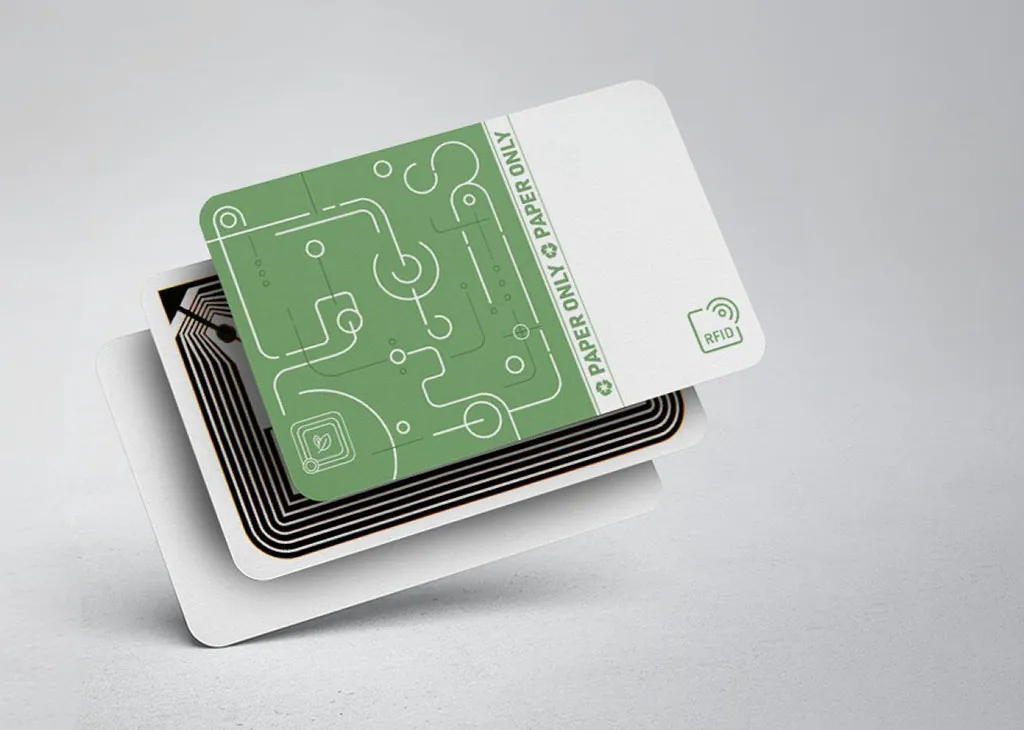
RFIDAK RFID paper card — disposable contactless ticket made from FSC-certified paper with embedded HF inlay, biodegradable, designed for single-use transit, events, and visitor badges Option A

Paper Card (this product — disposable, recyclable)

Single-use / short-life, lowest unit cost, compostable

Material
FSC paper with embedded HF inlay
Thickness
0.35 – 0.45 mm
Typical lifespan
Hours to weeks (single-trip or event)
Recyclability
Paper-stream compostable
Chip support
MIFARE Classic / Ultralight C / NTAG213
Unit price (MOQ 10K)
$0.10 – 0.28

Best for

  • Public transit single-ride and 24-hour tickets
  • Music festival and concert day passes — attendee discards after event
  • Hospital visitor badges, time-limited access with daily reissue
  • Trade show attendee credentials for 3-5 day events with check-in / check-out
RFIDAK standard PVC RFID smart card — ISO 7810 CR80 durable plastic credential for reloadable transit, hotel keys, office access, designed for 1-3 year daily-carry lifespans Option B

Standard RFID Card (0.76 mm PVC)

Reusable, durable, full-color branded

Material
PVC / PET / ABS composite
Thickness
0.76 mm (ISO 7810)
Typical lifespan
1 – 3 years daily carry
Recyclability
Specialty PVC recycling stream
Chip support
Full range LF / HF / UHF
Unit price (MOQ 5K)
$0.28 – 0.48

Best for

  • Reloadable transit season passes and multi-trip fare cards
  • Hotel key cards where card is returned at checkout and reused
  • Office / campus access credentials issued on a 1-4 year refresh cycle
  • Any deployment where total cost of ownership matters more than unit price

Quick decision tip — If the card's expected life is < 1 month and the venue wants to avoid return logistics — paper (Option A) is the right choice even though it looks more expensive per gram. If the card will be carried daily for 6+ months, PVC (Option B) works out cheaper per use despite higher unit cost. Hybrid programs exist: paper for day-pass visitors, PVC for season members.

RFID Paper Card Types

1 Should I choose the RFID paper card for my ticketing program?

Yes if you run transit, theme park, ski resort, museum, event, or short-term parking ticketing at 50,000+ tickets per month and need per-ticket cost 30-50% below PVC cards with a fully recyclable substrate. The The paper card delivers coated-paper body (250-450 gsm), HF or UHF chip options, full CMYK 4/4 offset printing with DOD variable serials / QR / barcodes, and roll packaging for automated kiosk and turnstile dispensing.

Pick a different card if the credential must survive 6+ months of daily pocket wear (use PVC), if it needs cryptographic security (use MIFARE DESFire EV3 on PVC), or if the workflow requires phone NFC with long URL payload (use NTAG216 on a PVC card). Pick paper when: disposable / single-use economics matter; recycling compliance is in procurement spec; kiosk dispensing is required; per-ticket unit cost is the primary KPI.

2 Spec decision matrix disposable ticketing options

Comparison across the 5 disposable-ticketing credential classes transit and event operators typically evaluate. Prices indicative at MOQ 50,000 pieces.

ClassMaterialReuseChip rangeBest fitUnit price
The paper card (HF or UHF)Coated paper 250-450 gsmSingle-use or 5-10 tripHF / UHFTransit, theme park, museum, short-term parking$0.14-0.28
Tyvek paper cardSynthetic paper + laminate3-7 day multi-tripHF (NTAG, Classic)Multi-day festival, hospital visitor, water-resistant day pass$0.18-0.34
Thin PVC card 0.30 mmPVCMulti-week / monthHF (Classic, Plus, DESFire)Student bus pass, weekly transit, event season pass$0.24-0.48
Standard PVC card 0.76 mmPVCMulti-year reuseAll HF / UHFPermanent credential, access control, payment$0.38-1.35
Paper wristband (closed)Coated paper + barbed lockSingle-eventHF (NTAG, Classic)Concert, event, gate-admission one-wear$0.22-0.40

Verdict: paper card wins on transit / venue disposable ticketing at scale. Tyvek wins when water / sweat resistance matters for 3-7 day wear. Thin PVC wins for re-usable weekly / monthly passes. Standard PVC wins only when reuse > 1 month.

3 Typical deployment pattern - transit paper ticketing

Metro systems replacing magnetic-stripe stock with RFID paper tickets typically standardize on MIFARE Ultralight EV1 or Ultralight C inlays in 250-450 gsm coated paper, dispensed from kiosks in roll format and validated contactlessly at gates. No swipe path means no swipe wear, so the main failure mode of magstripe gates disappears.

Authorities usually run a single-line pilot with gate-fail monitoring before a network-wide cutover, and lock kiosk dispensing mechanics (roll vs single-piece) early because they constrain ticket construction.

4 Compatibility reference chips, printers, dispensing equipment

Verified compatibility across chip options, printing technologies, and ticket dispensing / reading equipment.

CategorySupportedNotes
HF chip optionsNXP MIFARE Ultralight EV1 / C / Nano, MIFARE Classic 1K / 4K, NTAG213 / 215 / 216, Fudan FM11RF08Ultralight EV1 is the transit-standard chip; NTAG213 for NFC event tickets
UHF chip optionsAlien Higgs-3 / Higgs-9, Impinj Monza 4QT / R6, NXP UCODE 8 / 9UHF used for ski lift cards readable at 6-8 m through winter clothing
Printing offset CMYKHeidelberg, Komori, Manroland offset presses (standard 4/4 CMYK)Up to 5 spot colors + metallic ink supported on premium runs
Printing variable dataThermal-transfer (Zebra, Sato, Postek), inkjet (Domino, Videojet), laserVariable data: serial number, QR code, barcode, date, route
Ticket dispensing equipmentScheidt & Bachmann, INIT, Cubic Transportation, Thales / Gemalto TVM500-count roll standard; 1,000 and 2,000-count variants available
Transit AFC gate readersCubic Nextfare, INIT, Thales / Gemalto Cardalis, Scheidt & Bachmann TVMHF gate tap time 180-350 ms per card
Theme park / ski resortaccesso / ShoWare, Axess, Skidata, VivaticketUHF readable through jackets at 6-8 m for chairlift gates
Paper weights by use case250 gsm: single-use transit; 300 gsm: multi-ride city pass; 350 gsm: multi-day event; 400-450 gsm: premium concert / VIPThicker paper improves handling life but adds $0.04-0.08 per unit
Die-cut shapesStandard 85.6 x 54 mm (ISO 7810 CR-80), rounded-corner, rectangular custom, tag-shapeCustom die NRE: $350-800 one-time tooling

5 Cost at volume FAQ

How much does the The paper card cost at 10K pcs? Stock 300 gsm + Ultralight EV1 + standard CMYK print: $0.28-0.42 per card at MOQ 10,000. Volume brackets: MOQ 5,000 = $0.42-0.65; MOQ 50,000 = $0.18-0.28; MOQ 250,000 = $0.14-0.22; MOQ 1,000,000+ = $0.10-0.16.

Chip upgrade cost? NTAG213: +$0.02-0.04; MIFARE Classic 1K: +$0.04-0.07; NTAG216 (888 bytes): +$0.08-0.12; UHF Higgs-3: +$0.02-0.04; UHF Monza R6: +$0.04-0.07.

Paper weight up-charge? 250 gsm (transit baseline): included. 300 gsm: +$0.01-0.02. 350 gsm (multi-day): +$0.03-0.05. 400-450 gsm (premium / concert): +$0.06-0.12.

Variable data printing? Sequential serial (small): +$0.003 per card. QR code variable: +$0.005 per card. Per-card unique artwork: +$0.02-0.05 per card (digital inkjet overprint cost).

Kiosk roll packaging vs single-piece? 500-count roll standard: no up-charge. 1,000-count roll: -$0.01 per card (less packaging labor). Single-piece boxed: +$0.02-0.04 per card (individual inspection + boxing).

ROI vs magstripe disposable ticket? Magstripe disposable at 0.20-0.24/unit + 4-5% gate-reject rate equals ~ 0.24-0.28 effective cost. Paper RFID at 0.16 + 0.3% reject rate equals 0.16 effective cost = 33-43% per-ticket savings. On 100M tickets/year this is 8-12M annual material savings alone, before gate-throughput improvements.

6 Market context - disposable RFID ticketing

Transit systems worldwide continue to retire magnetic-stripe ticketing in favor of contactless RFID paper tickets, driven by lower gate-failure rates and faster throughput. MIFARE Ultralight-family chips dominate transit disposables, with NTAG-family chips growing in event, festival, and museum segments where smartphone interaction matters.

Supplier Fit

Why buyers source RFID Paper Card from RFIDAK

Once the format is right, most teams still need confidence in manufacturing control, sample support, and repeat-order reliability.

ISO 9001

Quality-focused manufacturing and sample support for custom RFID projects.

Since 2008

RFID manufacturing experience across cards, tags, labels, wristbands and readers.

Free Samples

Test product compatibility before bulk purchasing and customization decisions.

Commercial Fit

How buyers usually move this product from shortlist to sample

Most inquiry-ready visitors want to know whether this product matches their workflow, region and approval stage. These cues help them move faster without leaving the product page.

Access-control integrators

Usually comparing reader compatibility, security level and print consistency for recurring issuance.

Hotel and hospitality suppliers

Often focused on lock-system matching, guest branding and quick repeat orders for card replenishment.

Campus and membership programs

Typically need numbering logic, artwork approval and cards that support more than one workflow.

Quote Checklist

What to send us for a faster recommendation

  • Current reader, lock or software system you need the card to match.
  • Preferred chip family, security level and whether NFC phone interaction matters.
  • Artwork, numbering, magnetic stripe, QR code or encoding requirements.
  • Order quantity, target country and delivery timing for sampling or bulk production.

Market Notes

Regional conversations often tied to this category

North America

Replacement access cards, office credentials and membership programs often start with a sample-first approval cycle.

Europe

Common requests include hotel key cards, premium finishes, eco-look materials and stronger chip security planning.

Middle East and Africa

Hospitality, residential compounds and visitor programs often prioritize durability, branding speed and dependable repeat supply.

More Ways To Source This

Order this by chip, format or region

These sourcing pages cover the chip-specific and market-specific buying details that often decide the final spec for this product.

Before You Order

Procurement guides every RFID Cards buyer reads first

Five short reads on the procurement-side topics every B2B RFID buyer wants answered before signing a quote — MOQ thresholds, lead time reality, pricing transparency, sample policy, and how to audit a Chinese factory before your first order.

Buyer Questions

Questions buyers usually ask before sample approval

These FAQs cover the points that usually come up between a first shortlist and a real sample or quote request.

What is the minimum order quantity (MOQ) for RFID Paper Card? +

For RFID Paper Card, the standard MOQ starts at 500 pieces on stock SKUs. Custom die-cut shapes, oversized inlays or specialty substrates (wood, metal) move MOQ to 2,000–5,000 pieces due to tooling. Exact MOQ and unit pricing are quoted per project once chip, customization and packaging are confirmed.

Does RFIDAK provide free samples of RFID Paper Card? +

Yes. Stock rfid cards samples of RFID Paper Card are typically free; we only ask buyers to cover DHL/FedEx express shipping. Samples ship in 1–3 business days after your order is confirmed and arrive in 2–5 days to most countries. Custom samples (new chip, new size, printed artwork) usually take 3–7 additional days.

What is the production lead time for RFID Paper Card? +

Standard RFID Paper Card orders ship in 7–15 business days after PO confirmation and artwork approval. Large runs (>100k units) or orders with complex encoding / custom molds may take 15–25 business days. Rush production is available on request for time-sensitive launches; confirm MOQ and artwork early to protect the timeline.

Can RFID Paper Card be customized for my brand or project? +

Yes. RFID Paper Card supports end-to-end customization: full-color CMYK / silk-screen / UV printing, laser engraving, serial numbering, custom chip encoding (UID write, NDEF, sector locking), custom shape / size (subject to tooling MOQ), and packaging. Share your artwork, chip requirement and quantity and we will return a spec sheet + price within 24 hours.

Is RFID Paper Card compatible with my existing reader or system? +

Compatibility depends on the frequency band (LF 125 kHz / HF 13.56 MHz / UHF 860–960 MHz) and chip family used by your reader or installed system. Send a photo of your current card / reader model and we will recommend the matching chip + test a sample before bulk order.

What certifications and quality control does RFIDAK apply to RFID Paper Card? +

RFIDAK operates under ISO 9001:2015 (Quality Management) and ISO 14001 (Environmental Management), audited by SGS. RFID Paper Card is subject to incoming material inspection, in-process QC at every lamination / bonding / encoding step, and 100% electrical performance testing before shipment. Products meet CE, FCC, RoHS and REACH as applicable by market. Full test reports are available on request for buyer audits.

Can RFID Paper Card be pre-encoded or printed with my artwork before shipment? +

Yes. RFID Paper Card can ship with UID range assignment, NDEF URL encoding (for NFC), sector-locked user data, serial numbering, and CMYK / silk-screen / UV printing of your artwork. Provide an AI/PDF artwork file at 300 dpi with 3 mm bleed and a chip-encoding spec; we return a digital proof for approval before production.

How does RFIDAK ship RFID Paper Card internationally? +

RFIDAK ships RFID Paper Card via DHL / FedEx / UPS (door-to-door, 3–5 days to most countries), air cargo (5–7 days for heavier orders), or sea freight (20–35 days for bulk over 500 kg). Standard Incoterms are EXW, FOB Shenzhen and DDP; choose based on customs clearance preferences. Commercial invoice, packing list and CoC / MSDS are included automatically.

How does RFIDAK handle repeat orders of RFID Paper Card? +

For repeat buyers, RFIDAK locks tooling, artwork and chip encoding on file so subsequent POs ship faster — typically 5–10 business days for stock chip types at previously-run quantities. Price is adjusted transparently per chip market rate and FX movement; we flag any chip shortage (e.g., DESFire EV3) before quotation so the project plan stays realistic.

What are the technical specifications of RFID Paper Card? +

Key RFID Paper Card specs: frequency 13.56 MHz (HF, ISO/IEC 14443A / 15693); 860-960 MHz (UHF, ISO/IEC 18000-6C); dimensions 85.6 x 54 mm (ISO 7810 CR-80 standard); custom die-cut shapes available. A full technical datasheet including read range, chip memory map, IP / temperature rating and compliance certificates is available on request; attach your reader model and target environment so we can confirm suitability before quoting.

Get Free RFID Samples

Try before you buy. Request free samples of any RFID product from our 50+ SKU catalog. Samples shipped via DHL/FedEx within 1-3 business days worldwide.

Not ready to chat? Just drop your email and we'll send the RFIDAK product catalog (PDF).

We'll only use your email to send the catalog and reply to your inquiry.

WhatsApp Get a Quote