Skip to content
RFID Readers

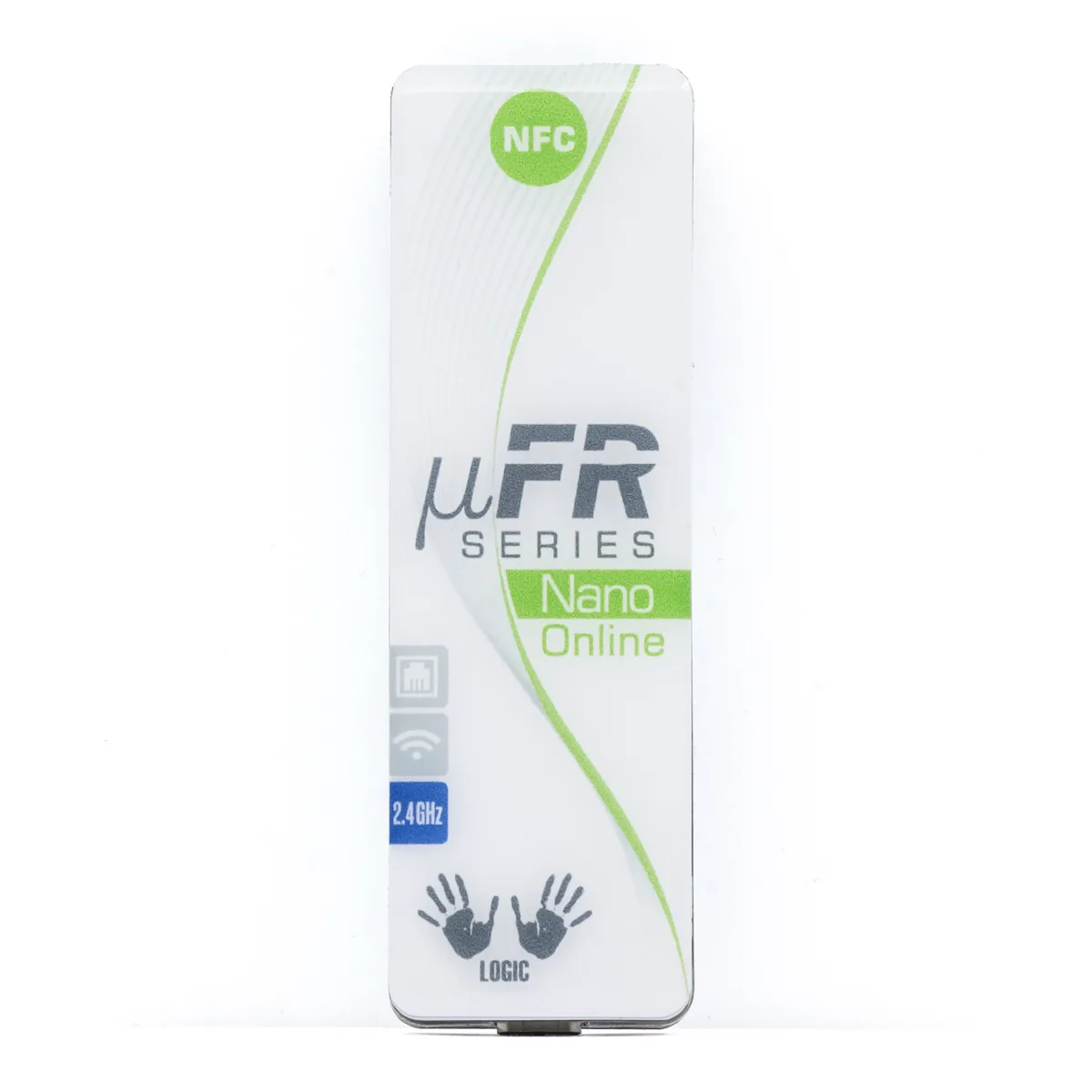
µFR Nano Online NFC Reader

Need hardware that can read or encode the exact chip family you plan to deploy?

MOQ
1 pc (eval)

Stock SKU. Custom tooling from 2,000 pcs.

Lead time
7–15 days

Standard; rush possible on request.

Free sample
Ships in 1–3 days

Stock samples via DHL / FedEx.

Use this hardware when the project needs enrollment, encoding, or compatibility testing around a specific chip family and interface. Confirm protocol support, SDK expectations, and deployment style before the shortlist is locked.

What buyers usually confirm first

swipe →

Protocol

Which chip, frequency, and standard must the reader support?

Compatibility with the credential comes first, especially for access, enrollment, and encoding workflows.

Form Factor

Desktop device, reader-writer, fixed reader, or OEM module?

Choose the hardware style around the operator workflow, not only the protocol.

Integration

What operating system, SDK, or interface does your team expect?

Reader projects move faster when interface expectations are confirmed before sampling.

Spec Check

What to confirm before hardware testing

Chip protocol, operating system, interface, and SDK expectations should all be clear before a reader sample is approved.

Product Name FR Nano Online NFC Reader/Writer
Operating Frequency 13.56MHz (HF)
Compliance ISO/IEC 14443 Type A/B, ISO 18092 (NFC)
Communication Speed Up to 424 Kbit/s
Read Range 0-60 mm (0-2.36 in)
Supported Cards NXP MIFARE Classic/Plus/Ultralight/DESFire EV1-EV3, NTAG 21x, NTAG 4xx DNA, JCOP Java Card, SmartMX
Connectivity USB, Wi-Fi (802.11 b/g/n), BLE 4.2, Ethernet (variant), UART, RS232, external NFC reader port
Network Protocols UDP, TCP, HTTP, HTTPS, WebSocket (WS/WSS), MQTT
Operating Modes Slave Mode, Master Mode (HTTP POST), BLE HID Mode, Log and Access Control Mode (optional)
Hardware Variations Wi-Fi (USB+Wi-Fi+BLE), GPIO (USB+Wi-Fi+BLE+GPIO), Ethernet (USB+Wi-Fi+BLE+Ethernet+GPIO)
GPIO 4-pin (GPIO variant and Ethernet variant)
Supply Voltage 5V DC
Supply Current 200-500 mA (operating)
Dimensions 86 x 27 x 9 mm
Weight 28 g (device), 119 g (commercial set)
Built-in Features RTC (Real Time Clock), external EEPROM, RGB LEDs, piezo beeper, external NFC reader port
SDK Free Java, JavaScript, Node.js, PHP, Python, Arduino IDE, Lazarus, Borland Delphi, C++ WxWidgets, MS.NET (C#, VB.NET, C++.NET)
Firmware Updates Free regular updates available for download
Certification CE
Warranty 2-year standard (3 or 5-year options)

Shortlist Logic

Why this reader setup makes the shortlist

Hardware usually stays in consideration when it reduces integration risk and supports the exact credential workflow being planned.

Wi-Fi + BLE + Ethernet connectivity - three wireless/wired options for network-connected NFC reading without a dedicated host PC at each location
HTTP/HTTPS, MQTT, WebSocket protocol support - push card event data directly to cloud services (AWS IoT, Azure IoT Hub, private brokers)
Master Mode autonomous operation - reader POSTs card UID and data to configured HTTP endpoint on each tap, no SDK polling required
BLE HID keyboard emulation - sends card UID as keystrokes to paired mobile devices for rapid integration with existing mobile apps
Built-in RTC, EEPROM, RGB LEDs, beeper, 4-pin GPIO - standalone operation capability for access control and IoT trigger applications
60 mm read range at 13.56MHz - ISO/IEC 14443 Type A/B and ISO 18092 with full MIFARE, NTAG, DESFire, and Java Card support

Use Cases

Where teams usually use this reader setup

Deployment context helps determine whether this hardware belongs at a desk, in a kiosk, in a gate, or inside a device.

IoT access control

Wi-Fi-connected readers at door points push card events to cloud-based access management platforms in real time

Cashless vending integration

Ethernet-connected readers enable NFC tap-to-pay at vending machines without PC middleware

Smart office check-in

BLE HID mode sends card UID to tablet-based reception kiosks for visitor badge verification

Industrial IoT data collection

GPIO triggers external relays, sensors, or PLCs on authenticated card tap events at workstations

Remote site access logging

Wi-Fi readers at unmanned facilities push timestamped access records to central monitoring dashboards

Cloud-based attendance systems

MQTT-connected readers feed real-time tap events to SaaS workforce management platforms

µFR Nano Online vs µFR Classic CS — How To Choose

Cloud-connected or offline desktop? Pick by IT architecture

Both are µFR-family NFC readers but differ fundamentally in connectivity. µFR Nano Online connects directly to cloud via WiFi / Ethernet with MQTT. Remote readers feeding SaaS platforms. µFR Classic CS is a traditional desktop reader connecting to a local PC via USB — offline-capable, IT-department-friendly. Different IT strategy, different reader.

RFIDAK µFR Nano Online NFC reader — WiFi / Ethernet connected, MQTT to cloud SaaS platforms, deploy standalone at remote sites Option A

µFR Nano Online (this product — cloud MQTT)

WiFi / Ethernet, MQTT cloud-native

Connectivity
WiFi + Ethernet + MQTT
Host PC
None needed (cloud direct)
Deployment
Remote / distributed sites
Unit price
$135 – 225

Best for

  • Multi-site attendance / check-in across branches
  • SaaS workforce management integration
  • IoT analytics platforms feeding dashboards
RFIDAK µFR Classic CS NFC reader — traditional USB-connected desktop reader for local PC applications, offline-capable Option B

µFR Classic CS (sibling — USB desktop)

USB desktop, offline-capable

Connectivity
USB (to local PC)
Host PC
Required (Windows / Linux)
Deployment
Local-network workflows
Unit price
$65 – 125

Best for

  • Hotel PMS card issuance stations
  • Access control enrollment on local server
  • Offline / air-gapped IT environments

Quick decision tip — If the reader feeds a cloud / SaaS platform directly without a local PC (workforce SaaS, IoT dashboards, multi-site distribution), Nano Online (Option A) at 2x cost eliminates local PC dependency. If the reader integrates with existing on-premise software (hotel PMS, access control server, in-office enrollment), Classic CS (Option B) via USB is the lower-cost traditional choice that IT teams are comfortable deploying.

µFR Nano Online NFC Reader Types

Wi-Fi + BLE Version - µFR Nano Online NFC Reader detail

1 Wi-Fi + BLE Version

The base FR Nano Online variant combines USB, Wi-Fi (802.11 b/g/n), and Bluetooth Low Energy 4.2 in a single 86 x 27 x 9 mm enclosure weighing 28 g. Wi-Fi enables direct HTTP/HTTPS and MQTT communication with cloud services. In Master Mode, the reader autonomously POSTs card UID and data to a configured server endpoint on each tap no host PC required at the read point. BLE HID mode sends card UID as keystrokes to paired mobile devices.

GPIO Version - µFR Nano Online NFC Reader detail

2 GPIO Version

The GPIO variant adds a 4-pin general-purpose I/O port to the Wi-Fi + BLE base, enabling the reader to trigger external relays, solenoids, LEDs, or sensor inputs on authenticated card tap events. This version is ideal for standalone access control points, industrial automation triggers, and IoT sensor nodes where a card tap must directly control physical hardware without middleware.

Ethernet Version - µFR Nano Online NFC Reader detail

3 Ethernet Version

The Ethernet variant adds a wired 10/100 Ethernet port and GPIO to the Wi-Fi + BLE base, providing the most reliable network connectivity for mission-critical installations where Wi-Fi is not permitted or not reliable enough. Enterprise IT departments prefer the Ethernet version for corporate access control deployments where network security policies require wired connections and PoE (Power over Ethernet) reduces cabling to a single run.

Pin Configuration - µFR Nano Online NFC Reader detail

4 Pin Configuration

All FR Nano Online variants share a standardized pin header layout for USB, UART, RS232, and GPIO connections. The pin diagram shows the physical connector positions and signal assignments for OEM integration. Built-in features across all versions include a Real Time Clock (RTC) for timestamped card events, external EEPROM for local data storage, RGB LED indicators for status feedback, and a piezo beeper for audible confirmation.

Supplier Fit

Why buyers source µFR Nano Online NFC Reader from RFIDAK

Once the format is right, most teams still need confidence in manufacturing control, sample support, and repeat-order reliability.

ISO 9001

Quality-focused manufacturing and sample support for custom RFID projects.

Since 2008

RFID manufacturing experience across cards, tags, labels, wristbands and readers.

Free Samples

Test product compatibility before bulk purchasing and customization decisions.

Commercial Fit

How buyers usually move this product from shortlist to sample

Most inquiry-ready visitors want to know whether this product matches their workflow, region and approval stage. These cues help them move faster without leaving the product page.

System integrators

Usually need reader compatibility, interface clarity and sample hardware that matches the planned deployment.

Device and kiosk makers

Often looking for OEM-ready modules or development-friendly reader hardware with practical integration support.

Enrollment and IT teams

Typically focused on workstation issuance, desktop testing and reader plus credential matching.

Quote Checklist

What to send us for a faster recommendation

  • Chip family, frequency and protocol you need the reader to support.
  • Operating system, interface and whether you need SDK or integration notes.
  • Desktop, handheld, fixed or embedded form factor based on the real workflow.
  • Sample quantity, application scenario and whether matching tags or cards are needed too.

Market Notes

Regional conversations often tied to this category

North America

Desktop enrollment, access-control replacement and asset-reading workflows often require clear driver and interface expectations.

Europe

Reader projects commonly involve NFC development, kiosk integration and bundled supply with matching tags or cards.

Middle East and Southeast Asia

Attendance, access-control and hospitality rollouts often prioritize simple deployment and dependable hardware pairing.

Before You Order

Procurement guides every RFID Readers buyer reads first

Five short reads on the procurement-side topics every B2B RFID buyer wants answered before signing a quote — MOQ thresholds, lead time reality, pricing transparency, sample policy, and how to audit a Chinese factory before your first order.

Buyer Questions

Questions buyers usually ask before sample approval

These FAQs cover the points that usually come up between a first shortlist and a real sample or quote request.

What is the minimum order quantity (MOQ) for µFR Nano Online NFC Reader? +

For µFR Nano Online NFC Reader, the standard MOQ starts at 1 piece (for evaluation); 10+ for bulk order on stock SKUs. Custom shapes, molds or non-standard materials typically move MOQ to 2,000–5,000 pieces to cover tooling setup. Exact MOQ and unit pricing are quoted per project once chip, customization and packaging are confirmed.

Does RFIDAK provide free samples of µFR Nano Online NFC Reader? +

Yes. Stock rfid readers samples of µFR Nano Online NFC Reader are typically free; we only ask buyers to cover DHL/FedEx express shipping. Samples ship in 1–3 business days after your order is confirmed and arrive in 2–5 days to most countries. Custom samples (new chip, new size, printed artwork) usually take 3–7 additional days.

What is the production lead time for µFR Nano Online NFC Reader? +

Standard µFR Nano Online NFC Reader orders ship in 7–15 business days after PO confirmation and artwork approval. Large runs (>100k units) or orders with complex encoding / custom molds may take 15–25 business days. Rush production is available on request for time-sensitive launches; confirm MOQ and artwork early to protect the timeline.

Can µFR Nano Online NFC Reader be customized for my brand or project? +

Yes. µFR Nano Online NFC Reader supports end-to-end customization: full-color CMYK / silk-screen / UV printing, laser engraving, serial numbering, custom chip encoding (UID write, NDEF, sector locking), custom shape / size (subject to tooling MOQ), and packaging. Share your artwork, chip requirement and quantity and we will return a spec sheet + price within 24 hours.

Is µFR Nano Online NFC Reader compatible with my existing reader or system? +

Compatibility depends on the frequency band (LF 125 kHz / HF 13.56 MHz / UHF 860–960 MHz) and chip family used by your reader or installed system. Send a photo of your current card / reader model and we will recommend the matching chip + test a sample before bulk order.

What certifications and quality control does RFIDAK apply to µFR Nano Online NFC Reader? +

RFIDAK operates under ISO 9001:2015 (Quality Management) and ISO 14001 (Environmental Management), audited by SGS. µFR Nano Online NFC Reader is subject to incoming material inspection, in-process QC at every lamination / bonding / encoding step, and 100% electrical performance testing before shipment. Products meet CE, FCC, RoHS and REACH as applicable by market. Full test reports are available on request for buyer audits.

Does µFR Nano Online NFC Reader ship with an SDK or sample code? +

Yes. µFR Nano Online NFC Reader ships with SDK and sample code (Windows / Linux / Android where applicable), plus USB-HID keyboard-emulation mode for zero-integration deployments. Request the developer bundle at inquiry stage and we will include it with the evaluation unit.

How does RFIDAK ship µFR Nano Online NFC Reader internationally? +

RFIDAK ships µFR Nano Online NFC Reader via DHL / FedEx / UPS (door-to-door, 3–5 days to most countries), air cargo (5–7 days for heavier orders), or sea freight (20–35 days for bulk over 500 kg). Standard Incoterms are EXW, FOB Shenzhen and DDP; choose based on customs clearance preferences. Commercial invoice, packing list and CoC / MSDS are included automatically.

How does RFIDAK handle repeat orders of µFR Nano Online NFC Reader? +

For repeat buyers, RFIDAK locks tooling, artwork and chip encoding on file so subsequent POs ship faster — typically 5–10 business days for stock chip types at previously-run quantities. Price is adjusted transparently per chip market rate and FX movement; we flag any chip shortage (e.g., DESFire EV3) before quotation so the project plan stays realistic.

What are the technical specifications of µFR Nano Online NFC Reader? +

Key µFR Nano Online NFC Reader specs: frequency 13.56 MHz (HF); dimensions 86 x 27 x 9 mm. A full technical datasheet including read range, chip memory map, IP / temperature rating and compliance certificates is available on request; attach your reader model and target environment so we can confirm suitability before quoting.

Get Free RFID Samples

Try before you buy. Request free samples of any RFID product from our 50+ SKU catalog. Samples shipped via DHL/FedEx within 1-3 business days worldwide.

Not ready to chat? Just drop your email and we'll send the RFIDAK product catalog (PDF).

We'll only use your email to send the catalog and reply to your inquiry.

WhatsApp Get a Quote